Aquarium Water Parameters: Ideal Levels for Freshwater Fish
Aquarium Water Parameters: Ideal Levels for Freshwater Fish
A clear reference chart for ammonia, nitrite, nitrate, pH, GH, KH and temperature, plus how to test your fish tank water and fix readings that drift out of range.
By Fish Explain Editorial TeamUpdated November 9, 202610 min read
Illustration: Fish Explain
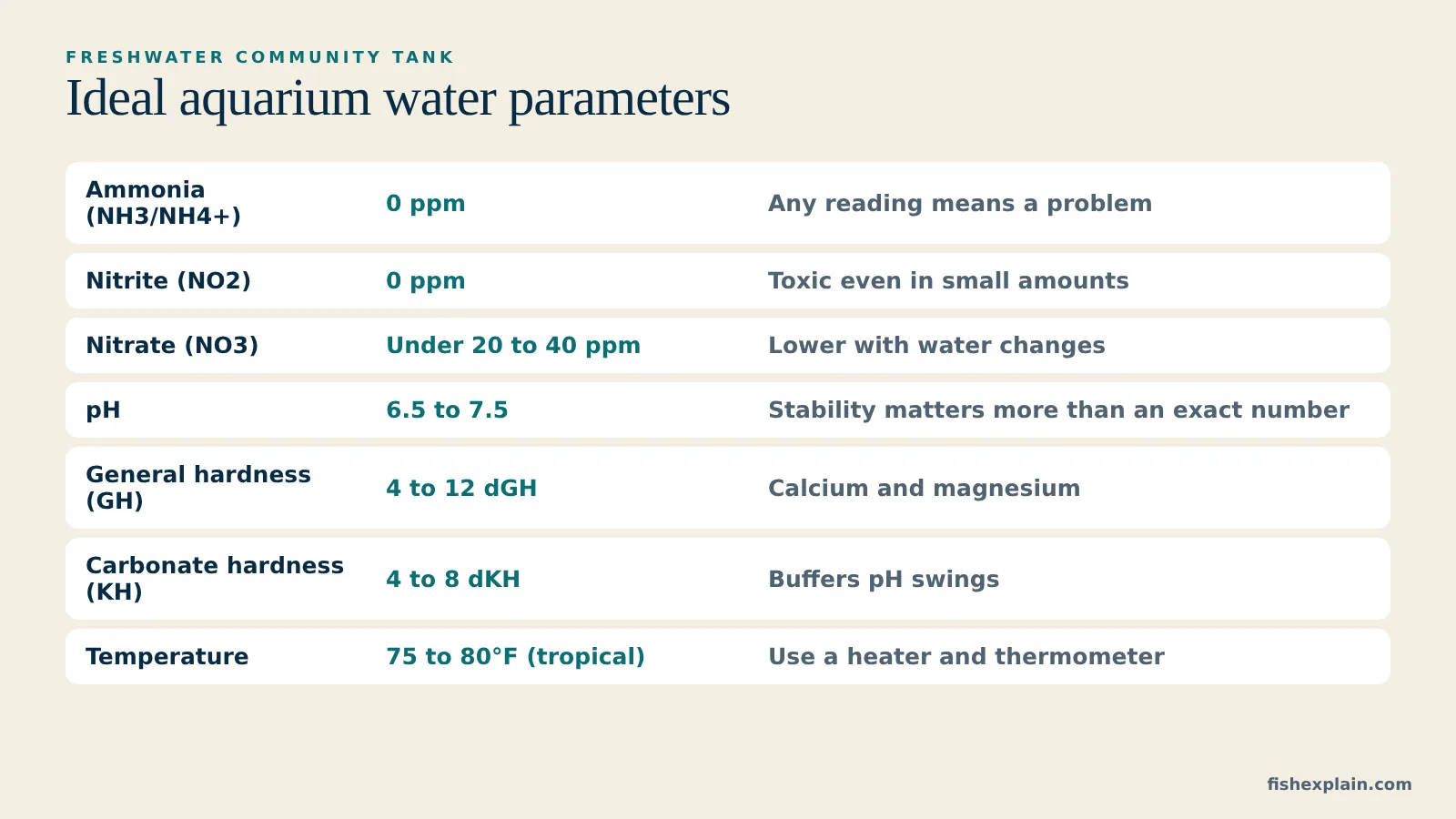
Ideal aquarium water parameters for most freshwater community fish are 0 ppm ammonia, 0 ppm nitrite, nitrate under 20 to 40 ppm, pH 6.5 to 7.5, GH 4 to 12 dGH, KH 4 to 8 dKH and a temperature of 75 to 80°F for tropical fish. Test weekly in an established tank, daily while cycling, and right away if your fish act sick. Stable readings matter more than chasing exact numbers.
On this page
What Are Aquarium Water Parameters?
Aquarium water parameters are the measurable chemical and physical properties of your tank water. The main ones are ammonia, nitrite, nitrate, pH, general hardness (GH), carbonate hardness (KH) and temperature. Together they decide whether fish can breathe, grow and fight off disease. Most fish illness in home tanks starts with poor water rather than a germ that arrived from outside.
If you are setting up for the first time, our step by step guide on how to set up a fish tank shows where water testing fits into the process.
Clear water is not always safe water
Ammonia and nitrite are invisible. A tank can look spotless while fish gasp at the surface. The opposite is also true: some cloudiness is harmless, as our guide to a cloudy fish tank explains. Only a test kit tells you what is really in the water.
Why stability matters most
Fish adapt to a wide range of conditions, but they cope poorly with sudden change. A steady pH of 7.8 is safer than a pH that swings between 6.8 and 7.6. Aim for readings inside the safe range and change them slowly.
Ideal Freshwater Aquarium Water Parameters Chart
These target ranges suit most tropical community fish such as tetras, rasboras, livebearers, gouramis and corydoras. Use them as your baseline, then adjust for the species you keep.
Water parameters by tank type
Different fish come from very different waters. African rift lake cichlids live in hard, alkaline lakes, while discus come from soft, acidic Amazon rivers. This table gives general ranges by setup.
| Tank type | Temperature | pH | GH (dGH) | KH (dKH) |
|---|---|---|---|---|
| Tropical community | 75 to 80°F | 6.5 to 7.5 | 4 to 12 | 4 to 8 |
| African cichlids | 76 to 82°F | 7.8 to 8.5 | 12 to 20 | 10 to 18 |
| Discus and soft water planted | 80 to 86°F | 6.0 to 7.0 | 3 to 8 | 3 to 6 |
| Livebearers (guppies, mollies, platies) | 74 to 80°F | 7.0 to 8.0 | 10 to 20 | 6 to 12 |
| Coldwater (goldfish) | 65 to 74°F | 7.0 to 8.0 | 6 to 16 | 4 to 10 |
In every tank type, ammonia and nitrite should read 0 ppm and nitrate should stay low. See our guides to African cichlids and discus tank setup for species details.
Ammonia, Nitrite and Nitrate
These three compounds come from fish waste, leftover food and decaying plants. In a healthy tank, beneficial bacteria turn ammonia into nitrite and then into nitrate. Our article on the aquarium nitrogen cycle explains this process in detail.
Ammonia: target 0 ppm
Ammonia is the most dangerous of the three. Test kits measure total ammonia, which is a mix of toxic free ammonia (NH3) and much less harmful ammonium (NH4+). According to the University of Florida’s guide to ammonia in aquatic systems, free ammonia is about 100 times more toxic than ammonium, and gill damage can begin above 0.05 mg/L of free ammonia. Any ammonia reading in an established tank is a warning sign. Our full guide to ammonia in a fish tank covers the causes, poisoning signs and how to lower it step by step.
How pH and temperature change ammonia toxicity
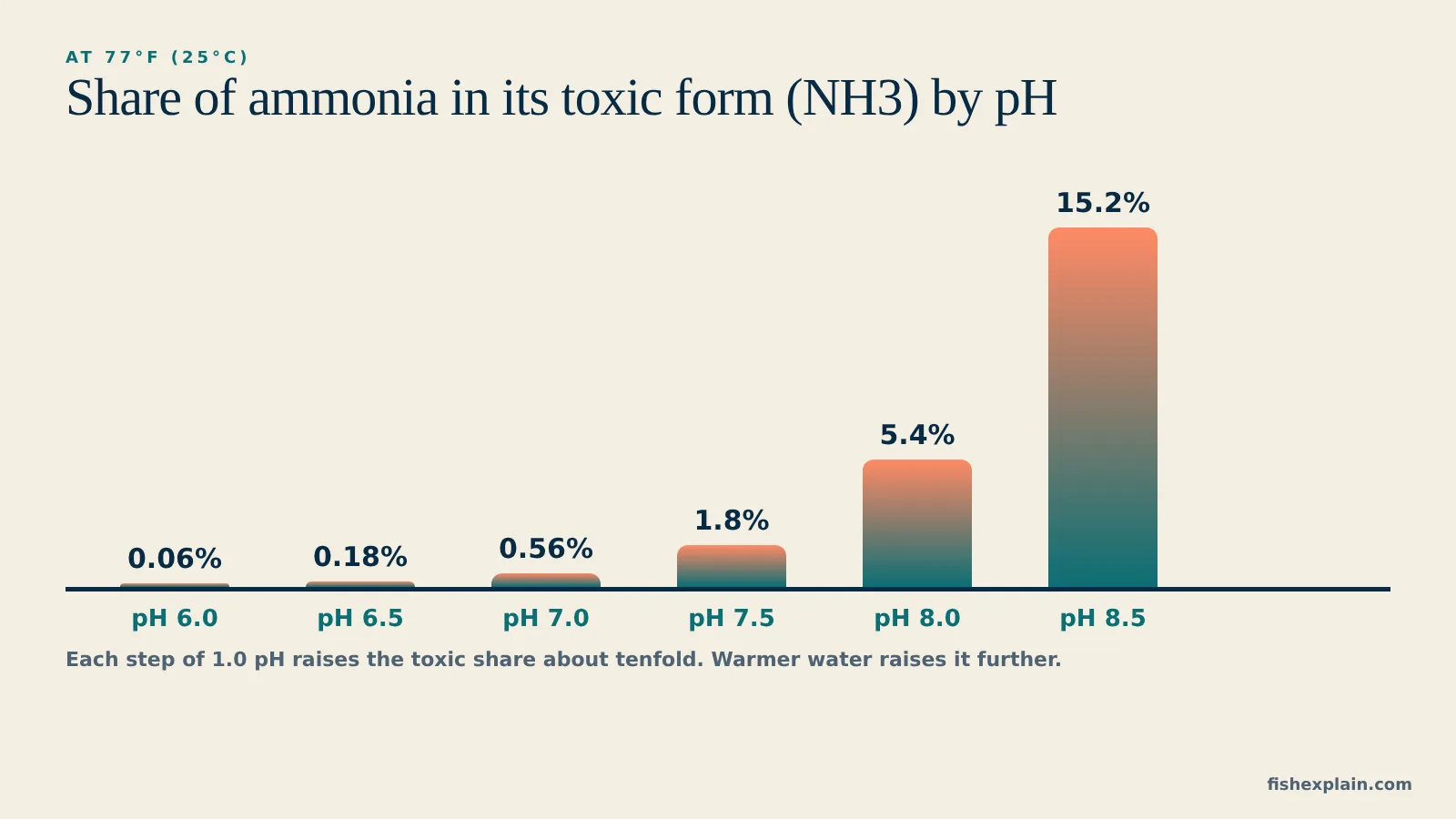
The share of ammonia in its toxic NH3 form rises sharply with pH and temperature. At 77°F, a tank at pH 8.0 has nearly ten times as much free ammonia as a tank at pH 7.0 with the same test reading. This is why ammonia spikes hit hard water tanks such as African cichlid setups so quickly.
Nitrite: target 0 ppm
Nitrite stops fish blood from carrying oxygen properly, so affected fish gasp at the surface and may show brown gills. The University of Florida notes that nitrite can be toxic at levels as low as 0.10 mg/L. Like ammonia, it should read zero once your tank is cycled.
Nitrate: keep it low
Nitrate is far less toxic, but it builds up between water changes and can stress fish over time and feed algae. Most keepers aim for under 20 ppm, and many sources advise keeping it below 40 to 50 ppm. Regular partial water changes are the main way to keep nitrate down. Our step by step guide on how to clean a fish tank shows how to do those changes without disturbing beneficial bacteria.
Aquarium pH
pH measures how acidic or alkaline the water is on a scale from 0 to 14, with 7 as neutral. Below 7 is acidic and above 7 is alkaline. Our full guide to aquarium pH shows how to raise or lower it safely.
What pH range do freshwater fish need?
Most community fish do well between pH 6.5 and 7.5. Many captive-bred fish adapt outside their wild range, so a steady pH close to your tap water is often the safest choice. Soft water fish such as discus and many tetras prefer the lower end, while livebearers and African cichlids prefer higher values.
Why pH changes must be slow
The pH scale is logarithmic. A drop from 7.0 to 6.0 means the water is ten times more acidic. Fast swings stress fish and can harm the bacteria that break down waste. If you need to change pH, move it no more than a few tenths per day.
Common causes of pH drift
pH tends to fall over time as waste builds up and KH gets used up. Driftwood and peat lower pH, while crushed coral, limestone and some rocks raise it. If pH keeps dropping, check KH first.
GH and KH: Water Hardness
Hardness describes the dissolved minerals in water. Test kits usually report it in degrees (dGH and dKH) or in parts per million. One degree equals about 17.8 ppm.
General hardness (GH)
GH measures calcium and magnesium. Fish and invertebrates use these minerals for bones, scales and shells. Soft water species prefer low GH, while livebearers, African cichlids and snails do better in harder water.
Carbonate hardness (KH)
KH measures carbonates and bicarbonates, which act as a buffer that holds pH steady. With low KH, pH can crash suddenly, which is dangerous for fish. The University of Florida also notes that nitrifying bacteria stop working effectively when alkalinity falls below about 20 mg/L, so very low KH can slow your biological filter.
Worked example: reading your hardness test
Say your liquid kit shows a KH of 3 dKH and a GH of 8 dGH. That is about 53 ppm KH and 142 ppm GH. The GH suits most community fish, but the KH is on the low side, so expect pH to drift down between water changes. Weekly water changes or a small bag of crushed coral in the filter will help steady it.
Temperature, Chlorine and Oxygen
Three more factors affect water quality even though they are not part of the nitrogen cycle.
Temperature
Most tropical fish do best at 75 to 80°F, and the water should stay within a degree or two each day. Use a reliable fish tank heater and a separate thermometer. Warmer water holds less oxygen and makes ammonia more toxic.
Chlorine and chloramine
US tap water is treated with chlorine or chloramine to make it safe for people. The EPA drinking water regulations allow up to 4 mg/L of either, which is far more than fish can tolerate. Always treat new water with a water conditioner that neutralizes both chlorine and chloramine. Our guide to spring or distilled water for a fish tank explains when other water sources make sense.
Dissolved oxygen
Fish need dissolved oxygen of about 5 mg/L or more. Few hobbyists test it directly. Instead, keep the surface moving with your filter outflow or an air stone, avoid overstocking and watch for fish gasping at the top.
How to Test Aquarium Water
Water testing is quick once you have the right kit and a routine.
Test strips vs liquid test kits
Test strips are fast and easy, which makes them good for quick checks. Liquid kits take a few minutes more but are usually more accurate, especially for ammonia and nitrite. Many keepers use a liquid master kit for regular testing and keep strips for spot checks.
How often to test
| Situation | What to test | How often |
|---|---|---|
| Cycling a new tank | Ammonia, nitrite, nitrate, pH | Daily or every other day |
| Established tank | Ammonia, nitrite, nitrate, pH | Weekly |
| Established tank | GH and KH | Every 2 to 4 weeks |
| After adding fish or medicine | Ammonia, nitrite, pH | Daily for a week |
| Fish act sick or gasp | Everything | Right away |
Tips for accurate results
Take the sample from mid-water, not near the filter outlet. Follow the kit’s timing exactly and read colors in daylight against a white card. Check expiry dates, because old reagents give false readings. Write each result down so you can spot trends.
How to Fix Bad Water Parameters
When a reading is out of range, act calmly and change one thing at a time.
Quick fixes by problem
| Problem | Likely cause | What to do |
|---|---|---|
| Ammonia above 0 | Uncycled tank, overfeeding, dead fish, overstocking | Do a 25 to 50% water change, feed lightly, remove waste, add a conditioner that binds ammonia |
| Nitrite above 0 | Tank still cycling or filter cleaned too hard | Do water changes, reduce feeding, keep the filter media in place |
| High nitrate | Too few water changes | Increase water change size or frequency, add live plants |
| pH falling | Low KH, waste build up | Raise KH slowly with water changes or crushed coral |
| Wrong temperature | Heater failure or wrong size | Check the heater, adjust slowly by 1 to 2°F per day |
When to suspect a cycling problem
Repeated ammonia or nitrite readings usually mean the filter bacteria cannot keep up. Follow our guide on how to cycle a fish tank and avoid adding new fish until both read zero. If fish already show signs of illness, our common fish diseases chart can help you match symptoms.
Aquarium Water Parameter FAQs
What are the most important aquarium water parameters?
Ammonia, nitrite, nitrate, pH and temperature matter most. Ammonia and nitrite should always read 0 ppm in a cycled tank, nitrate should stay low, and pH and temperature should stay stable within your fish’s preferred range.
What is a safe nitrate level for freshwater fish?
Under 20 ppm is ideal, and most freshwater fish handle up to about 40 ppm. Higher levels stress fish over time and feed algae, so use partial water changes to keep nitrate down.
How often should I test my aquarium water?
Test ammonia, nitrite, nitrate and pH weekly in an established tank and daily while a new tank is cycling. Test right away if fish gasp at the surface, stop eating or look sick.
Is tap water safe for a fish tank?
Yes, once treated. US tap water contains chlorine or chloramine, which harm fish, so add a water conditioner that removes both before the water goes into the tank.
What pH is best for a freshwater aquarium?
Most community fish do well between pH 6.5 and 7.5. Soft water species prefer lower values and African cichlids prefer 7.8 to 8.5. A stable pH matters more than hitting an exact number.
Final Thoughts
Test regularly and change things slowly
Good aquarium water parameters come down to a few simple habits: keep ammonia and nitrite at zero, hold nitrate low with regular water changes, keep pH and temperature steady and treat all new water. Test on a schedule, write down your results and make any change gradually. Your fish will show the difference in their color, appetite and lifespan.
Keep exploring
More fish guides

Keep exploring
 Aquarium Care
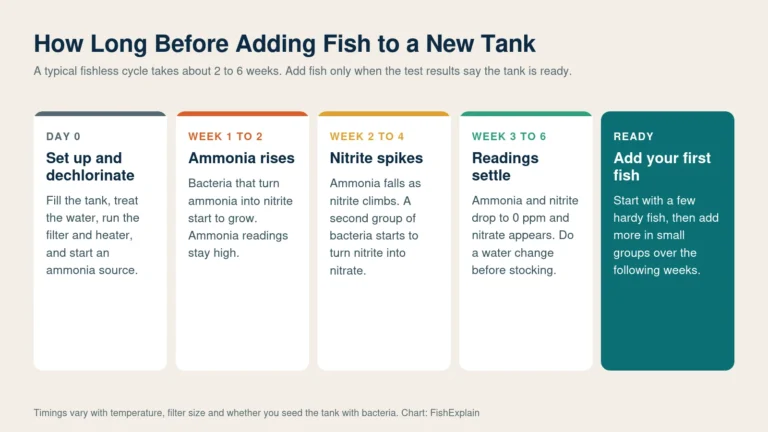
How Long to Wait Before Adding Fish to a New Tank
How long before adding fish to a new tank? Usually 2 to 6 weeks. Learn the water test results that mean it…
 Aquarium Care
Aquarium pH: How to Raise or Lower pH Safely
Aquarium pH guide: ideal ranges for freshwater fish, how KH keeps pH stable, and safe ways to raise or lower pH without…
 Aquarium Care
New Tank Syndrome: Signs, Causes and How to Prevent It
New tank syndrome kills fish in uncycled tanks. Learn the warning signs, what causes ammonia and nitrite spikes, and how to fix…