How to Clean a Fish Tank Without Harming Your Fish
How to Clean a Fish Tank Without Harming Your Fish
A safe, step by step routine for cleaning glass, gravel, decor and filters while keeping your fish and the tank’s beneficial bacteria healthy.
By Fish Explain Editorial TeamUpdated November 20, 20267 min read
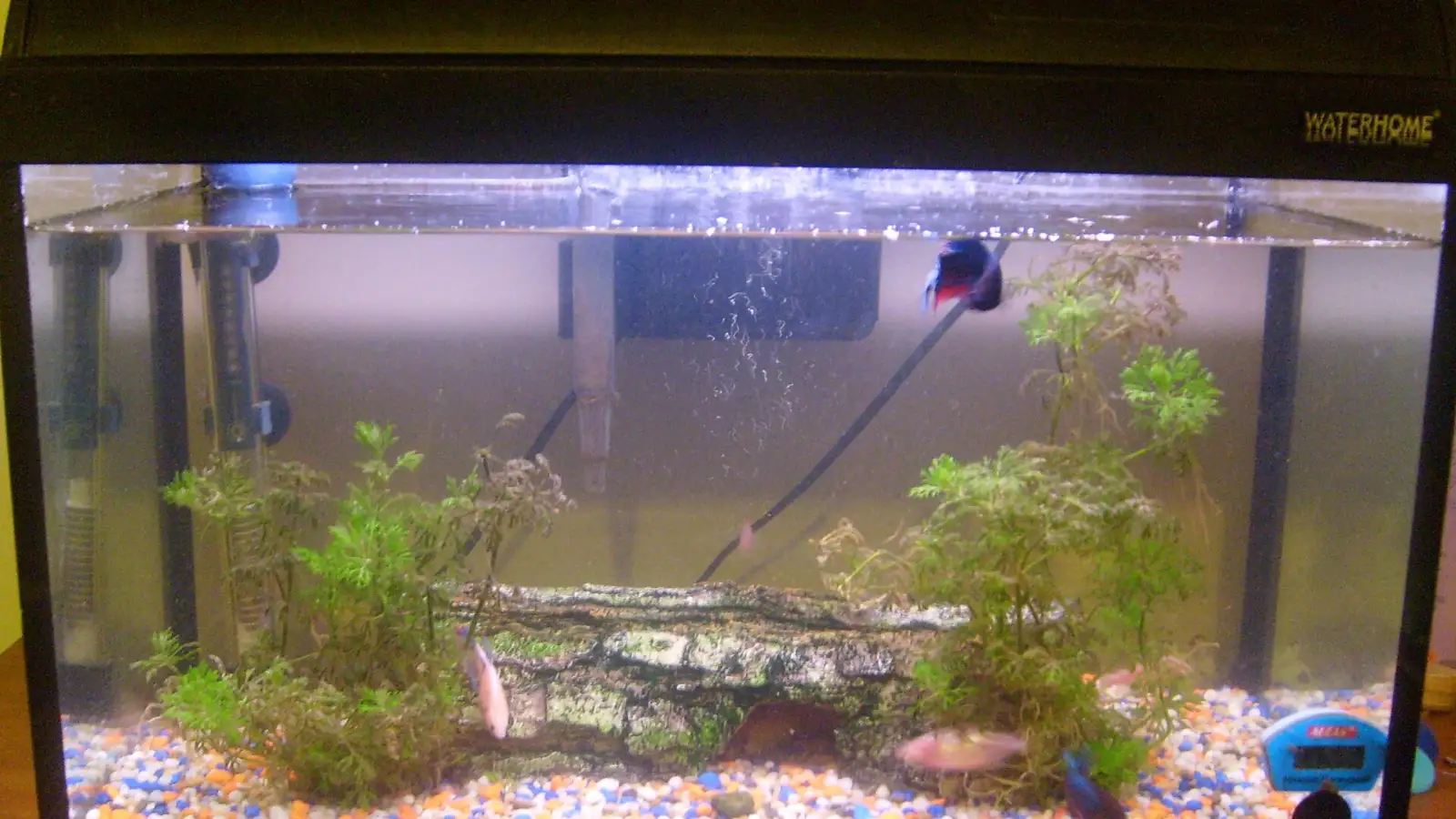
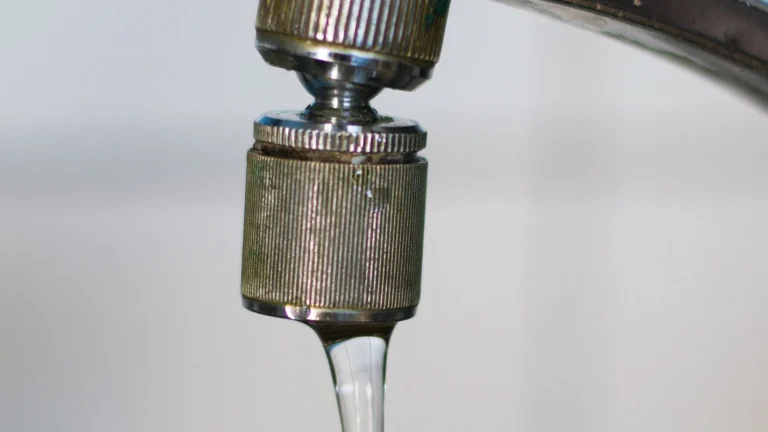
Photo: JohnstonDJ (CC BY-SA 3.0), via Wikimedia Commons (cropped)
To clean a fish tank, leave the fish in place, unplug the equipment, scrape algae off the glass, vacuum part of the gravel while removing 10 to 25 percent of the water, rinse filter media in old tank water, and refill with dechlorinated water at the same temperature. Never use soap.
On this page
- How to Clean a Fish Tank: The Basics
- Supplies You Need
- How to Clean a Fish Tank Step by Step
- How to Clean an Aquarium Filter
- How Often to Clean a Fish Tank
- Cleaning Problems and How to Fix Them
- How to Clean a Neglected Fish Tank
- Mistakes to Avoid When Cleaning a Fish Tank
- Fish Tank Cleaning FAQs
- Final Thoughts
How to Clean a Fish Tank: The Basics
Learning how to clean a fish tank is mostly about what not to do. The goal is not a sparkling, sterile tank. It is to remove waste and algae while leaving the beneficial bacteria that keep ammonia and nitrite at zero. Those bacteria live in the filter, the gravel and on every surface, so scrubbing everything at once can crash the tank and make fish sick.
For a cycled freshwater tank, a light clean every week and a filter rinse every few weeks keep most aquariums healthy. If you are new to the hobby, our guide to the aquarium nitrogen cycle explains why those bacteria matter so much.
Leave the fish in the tank
For routine cleaning, keep your fish where they are. Catching and moving fish causes more stress than a careful clean. PetMD’s guide on how to clean a fish tank gives the same advice and reserves moving fish for rare deep cleans after a serious problem.
Never use soap or household cleaners
Soap, glass cleaner, bleach residue and scented wipes can poison fish even in tiny amounts. Keep a bucket, sponge and brush that are used only for the aquarium, and clean them with plain water.
Supplies You Need
| Tool | What it does |
|---|---|
| Gravel vacuum or siphon | Removes waste from the substrate while draining water |
| Clean bucket (aquarium use only) | Holds old tank water and new treated water |
| Algae scraper or magnet cleaner | Clears algae from the inside glass |
| Soft brush or old toothbrush | Scrubs decor, rocks and filter parts |
| Water conditioner | Neutralizes chlorine and chloramine in tap water |
| Thermometer and test kit | Matches new water temperature and checks water quality |
| Towels | Catches drips and protects the floor and cabinet |
Glass versus acrylic tanks
Glass tanks can handle firm scrapers and razor blades made for aquariums. Acrylic scratches easily, so use only soft pads labeled safe for acrylic, and keep sand away from the pad when you scrub.
How to Clean a Fish Tank Step by Step
1. Switch off the equipment
Wash your hands, then unplug the heater, filter and light. Turn the heater off at least 15 minutes before the water level drops, because a hot heater exposed to air can crack.
2. Scrape algae from the glass
Clean the inside glass first so any algae that floats off gets removed with the water you drain. Work from top to bottom and pay attention to the corners.
3. Clean decorations in tank water
Lift out decor that has algae on it and scrub it in a bucket of old tank water. Live plants only need dead leaves trimmed away.
4. Vacuum the gravel
Push the gravel vacuum into the substrate, let it lift debris, then move it to the next spot. Cover about a third to half of the bottom each week rather than the whole tank at once. Keep the end of the hose away from small fish and shrimp.
5. Remove 10 to 25 percent of the water
The siphon removes water as you vacuum. Stop when you have taken out about 10 to 25 percent. Never change more than 50 percent at one time in a normal clean, since big swings can shock fish.
6. Refill with treated water
Fill the bucket with tap water at a similar temperature, add water conditioner for the full tank volume, and pour it in slowly over a plate or decor so the substrate is not stirred up. Our guide on how to dechlorinate tap water explains how much conditioner to use.
7. Restart and check
Plug the filter, heater and light back in. Check that the filter primes and runs, and confirm the temperature an hour later.
How to Clean an Aquarium Filter
The filter holds most of your beneficial bacteria, so it needs the gentlest care of all. Our comparison of the best fish tank filters covers the main filter types.
Rinse media in old tank water
Squeeze sponges and rinse biological media in a bucket of water you removed from the tank, not under the tap. Chlorine in tap water can kill the bacteria. The goal is to clear clogs, not to make the sponge look new.
How often to clean the filter
Most filters need a rinse every 2 to 4 weeks, or sooner when flow slows. Do not clean the filter on the same day as a deep gravel vacuum, so the tank never loses too much bacteria at once.
When to replace filter media
Replace sponges only when they fall apart, and then swap out only part of the media at a time. Many cartridges are sold as monthly replacements, but rinsing and reusing them keeps the bacteria colony intact.
How Often to Clean a Fish Tank
A simple schedule
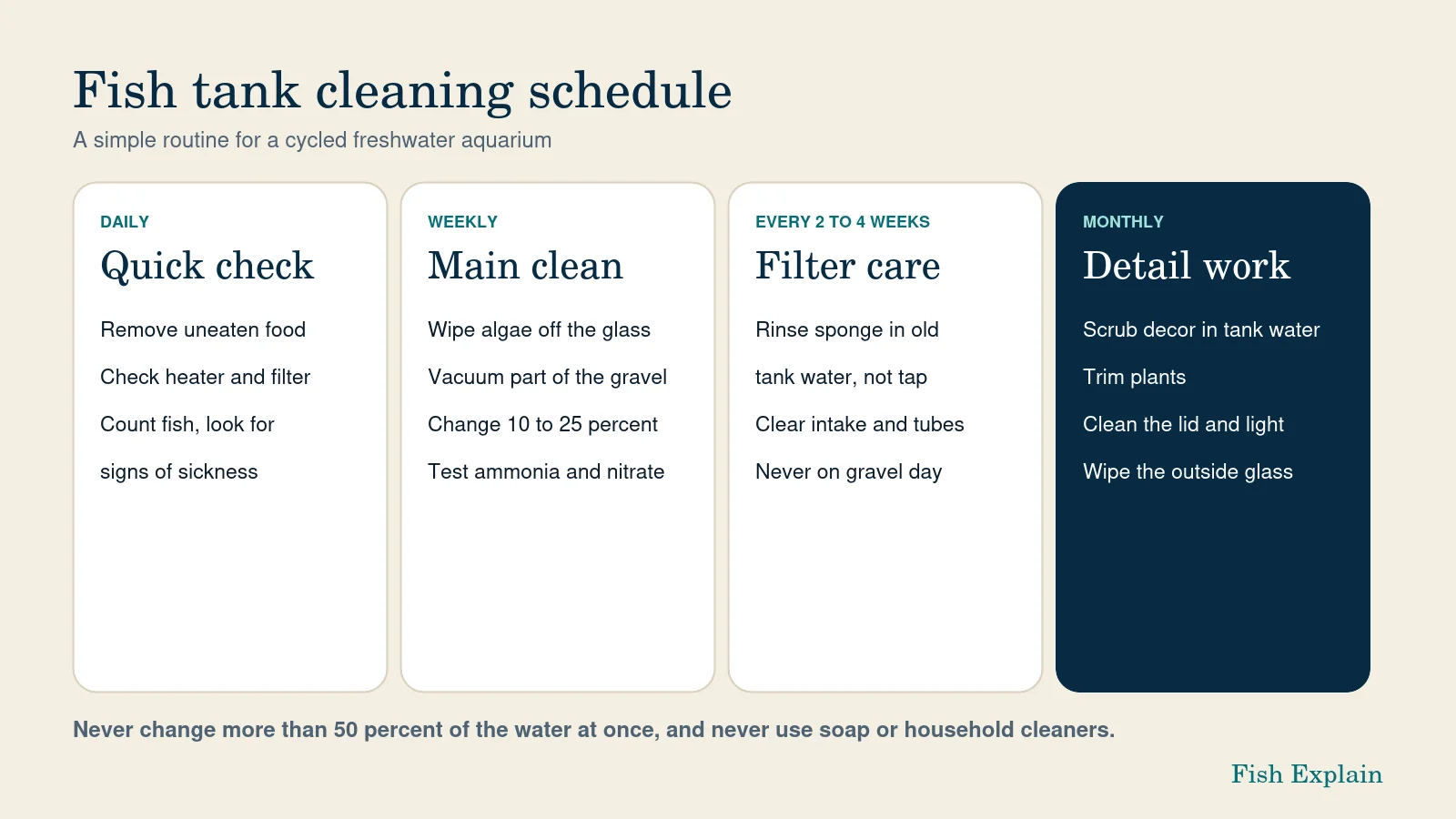
- Daily: remove uneaten food, check the heater and filter, and watch the fish
- Weekly: scrape the glass, vacuum part of the gravel and change 10 to 25 percent of the water
- Every 2 to 4 weeks: rinse the filter media in old tank water
- Monthly: scrub decor, trim plants, wipe the lid and the outside glass
Let your test kit guide you
Heavily stocked tanks, goldfish tanks and small tanks need more frequent water changes. If nitrate climbs above about 20 to 40 ppm between changes, increase the amount or frequency. Our guide to aquarium water parameters lists safe ranges. For the full routine, follow our step by step guide on how to do a fish tank water change.
Cleaning Problems and How to Fix Them
Cloudy water after cleaning
A light haze after vacuuming is usually stirred up debris and clears within a day. Milky water that lasts several days often means a bacterial bloom from cleaning too much at once. Our guide to a cloudy fish tank explains each type.
White crust and hard water stains
Mineral rings form at the waterline as water evaporates. Wipe them often with a damp pad. For heavy stains on an empty tank, plain white vinegar works well; rinse thoroughly before refilling.
Fish acting stressed after a clean
Gasping or hiding after a clean usually points to a temperature mismatch, missing conditioner or too large a water change. Test the water and check that the heater is back on.
How to Clean a Neglected Fish Tank
If a tank has gone weeks or months without care, a single big clean can do more harm than good. Fish in old water slowly adapt to high nitrate and low pH, and a sudden large change can shock them.
Bring it back over two weeks
Test the water first. Then change about 20 to 25 percent every two or three days, vacuuming a different section of gravel each time, until nitrate falls into the normal range. Rinse the filter in old tank water once, partway through, rather than on day one.
When a full teardown is needed
A full teardown is rarely needed. Reasons include a cracked tank, a substrate that smells strongly of rotten eggs when disturbed, or a disease outbreak that wiped out the tank. Move the fish to a filtered holding tank with some of the old water, keep the filter media wet in tank water, and expect to watch for ammonia for a few weeks afterward, as you would in a new setup.
Cleaning an empty tank before reuse
For a secondhand or empty tank, rinse it with hot water, remove mineral stains with plain white vinegar, rinse again and let it dry. Check the silicone seams for gaps and leak test the tank outside or in a bathtub before setting it up.
Mistakes to Avoid When Cleaning a Fish Tank
The most common errors
- Changing all the water at once
- Rinsing filter media under the tap
- Using soap or household cleaners on anything that touches the tank
- Cleaning the filter and the whole substrate on the same day
- Adding untreated tap water
Keep yourself safe too
Wash your hands after cleaning, avoid putting your hands in the tank with open cuts, and never start a siphon by mouth. Keep electrical plugs dry and use drip loops on cords. For the rest of the setup basics, see our guide on how to set up a fish tank.
Fish Tank Cleaning FAQs
Should I take my fish out to clean the tank?
No. For routine cleaning, leave fish in the tank. Catching and moving them causes more stress than a careful partial clean.
How often should I clean my fish tank?
Do a light clean with a 10 to 25 percent water change every week, and rinse the filter media every 2 to 4 weeks. Heavily stocked tanks may need more.
Can I clean a fish tank with soap?
No. Soap and household cleaners leave residues that can poison fish. Use plain water, an aquarium scraper and a brush kept only for the tank.
Should I rinse filter media with tap water?
No. Rinse it in water removed from the tank. Chlorine in tap water can kill the beneficial bacteria that live in the filter.
Why is my fish tank cloudy after cleaning?
A light haze is usually stirred up debris and clears within a day. Cloudiness that lasts longer is often a bacterial bloom from cleaning too much at once.
Final Thoughts
Small and steady beats big and rare
The best way to clean a fish tank is a little at a time. Scrape the glass, vacuum part of the gravel and change 10 to 25 percent of the water each week, rinse the filter in old tank water every few weeks, and never use soap. Your fish stay in place, the beneficial bacteria stay intact, and the water stays clear.
Keep exploring
More fish guides

Keep exploring
 Aquarium Care
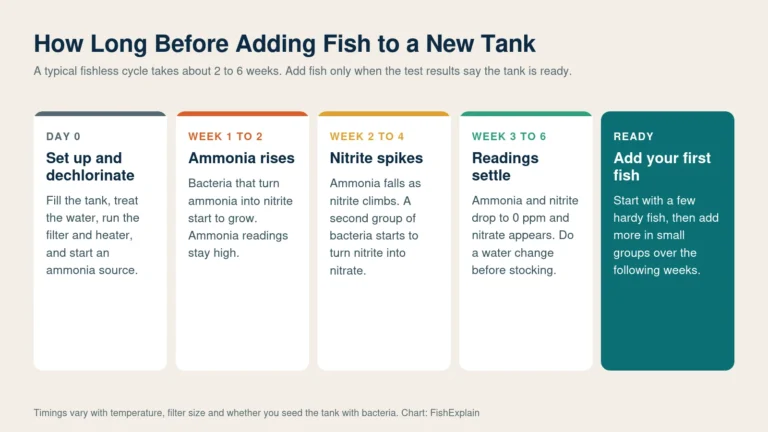
How Long to Wait Before Adding Fish to a New Tank
How long before adding fish to a new tank? Usually 2 to 6 weeks. Learn the water test results that mean it…
 Aquarium Care
Aquarium pH: How to Raise or Lower pH Safely
Aquarium pH guide: ideal ranges for freshwater fish, how KH keeps pH stable, and safe ways to raise or lower pH without…
 Aquarium Care
New Tank Syndrome: Signs, Causes and How to Prevent It
New tank syndrome kills fish in uncycled tanks. Learn the warning signs, what causes ammonia and nitrite spikes, and how to fix…