What Does It Mean to Cycle a Fish Tank?
To cycle a fish tank means growing colonies of beneficial bacteria in the filter before you add a full load of fish. These bacteria turn toxic ammonia from fish waste into nitrite, and then into much safer nitrate. Learning how to cycle a fish tank is the single best way to avoid sick and dying fish in a new aquarium.
The process behind it is the nitrogen cycle. If you want the science in plain terms, read our explainer on the aquarium nitrogen cycle. This guide is the hands-on part: what to buy, what to dose, what to test and when the tank is ready.
Why new tanks need cycling
A brand new filter has almost no bacteria. If you add fish straight away, ammonia builds up faster than the bacteria can grow. According to a University of Florida IFAS fact sheet on ammonia, a new biological filter needs six to eight weeks to build enough bacteria to process ammonia and nitrite well. Tank cycling gets that work done before fish are at risk.
The two main methods
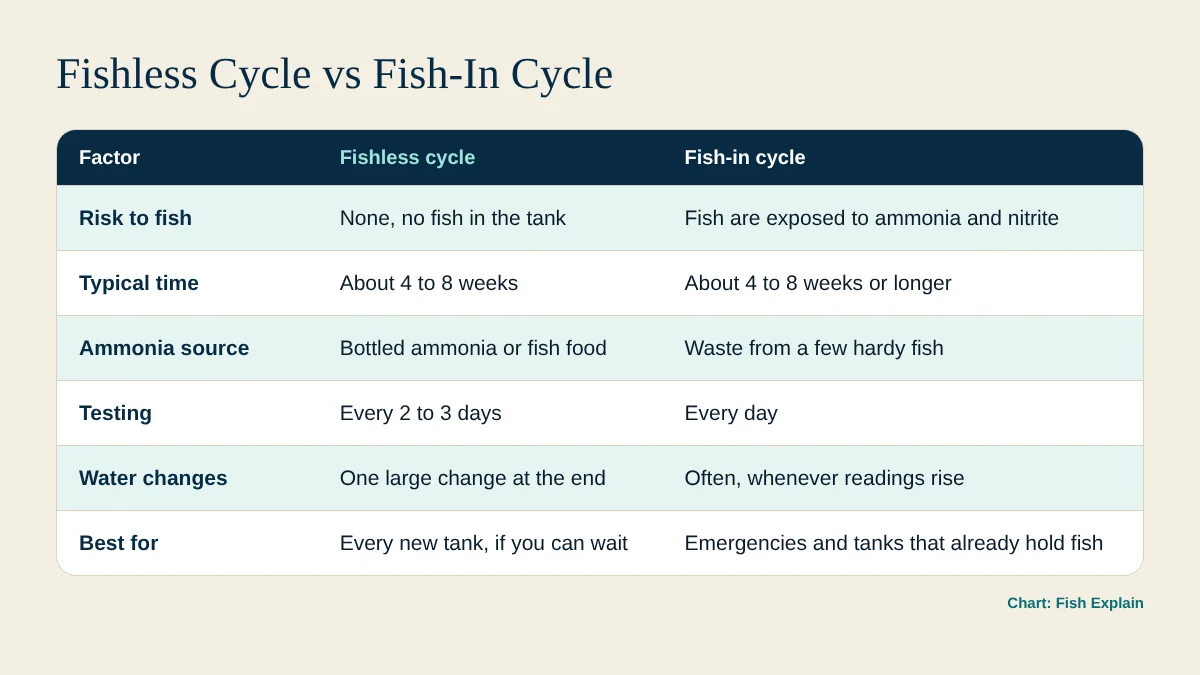
- Fishless cycle: you feed the bacteria with an ammonia source and no fish are exposed. This is the method we recommend.
- Fish-in cycle: a few hardy fish provide the ammonia while you test daily and change water to keep levels low.
What You Need Before You Start
Set up the tank fully first: filter, heater, substrate, decor and dechlorinated water. Our guide on how to set up a fish tank walks through each step in order.
Equipment checklist
- A running filter sized for the tank. See our best fish tank filters guide if you have not chosen one.
- A heater for tropical tanks, set to the temperature your fish will need. Our fish tank heater guide covers sizing.
- A liquid test kit for ammonia, nitrite, nitrate and pH.
- A water conditioner that removes chlorine and chloramine.
- An ammonia source: pure liquid ammonia or ammonium chloride made for cycling, or a pinch of fish food.
- Optional: a bottled nitrifying bacteria product or filter media from an established tank.
Choosing an ammonia source
If you use household ammonia, it must be pure, with no scents, dyes or surfactants. A simple test is to shake the bottle: if it foams, do not use it. Ammonium chloride sold for fishless cycling is easier to dose accurately. Rotting fish food works too, but it is slower and messier.
How to Do a Fishless Cycle Step by Step
A fishless cycle is safe for fish and gives you a filter that can handle a full stocking from day one. Follow these steps.

Step 1: Dose ammonia to about 2 ppm
Add ammonia a few drops at a time, wait an hour for it to mix, then test. Stop when the reading is about 2 ppm. Write down how many drops or milliliters it took, because you will repeat that dose later. Avoid very high doses, since too much ammonia can slow the bacteria you are trying to grow.
Step 2: Add bacteria if you have them
Bottled bacteria or a sponge from a healthy tank can cut weeks off the wait. Add them after the ammonia dose so the bacteria have food right away.
Step 3: Test every two to three days
Record ammonia, nitrite and nitrate each time. For the first week or two, ammonia will stay high and nothing else will change. That is normal.
Step 4: Re-dose when ammonia drops
Once nitrite appears and ammonia falls toward zero, add your measured dose again to bring ammonia back to about 2 ppm. Keep doing this every time ammonia reaches zero so the bacteria never run out of food.
Step 5: Watch for nitrate
Nitrite usually climbs high, then falls as the second group of bacteria grows. When nitrite starts dropping and nitrate rises, you are close.
Step 6: Run the 24 hour test
Dose to 2 ppm. If both ammonia and nitrite read 0 ppm 24 hours later, and this happens two or three days in a row, the tank is cycled.
Step 7: Water change, then add fish
Do a large water change to bring nitrate down, ideally below about 20 ppm, and treat the new water with conditioner. Add your fish within a day or two, or keep dosing ammonia until they arrive so the bacteria do not starve.
How to Do a Fish-In Cycle Safely
A fish-in cycle makes sense if you already have fish in a new tank, such as after an impulse purchase or an emergency move. It works, but it takes daily effort.
Keep the stock very light
Start with only a few small, hardy fish for the tank size. Our guide on how many fish fit in a 20 gallon tank shows how stocking scales, and during cycling you want far fewer than the final number.
Feed lightly and test daily
Feed once a day, only what the fish eat in a minute or two. Test ammonia and nitrite every day.
Change water whenever readings rise
If ammonia or nitrite reads above about 0.25 ppm, do a 25 to 50 percent water change with dechlorinated water at the same temperature. Some water conditioners also bind ammonia for a short time, which gives the fish extra protection between changes.
Know the warning signs
Gasping at the surface, clamped fins, red or inflamed gills and lethargy point to ammonia or nitrite stress. Change water at once. Our guide to common fish diseases helps you tell water problems from infections.
How Long to Cycle a Fish Tank
Most tanks take four to eight weeks to cycle. The exact time depends on how well you meet the bacteria’s needs.
Things that speed up cycling
| Factor | What to do |
|---|---|
| Temperature | Keep the water warm, in the upper 70s to low 80s °F, during a fishless cycle |
| Oxygen | Run the filter around the clock and keep the surface moving |
| Seeded media | Add a used sponge or media from a healthy, disease-free tank |
| Bottled bacteria | Dose as the label directs, together with an ammonia source |
| Live plants | Fast-growing plants add surfaces for bacteria and absorb some ammonia |
Things that slow it down
Chlorine or chloramine in untreated tap water, very soft or acidic water, cold water, and ammonia or nitrite doses that are far too high all slow the bacteria. So does switching the filter off at night.
Common Tank Cycling Problems and Fixes
Almost every cycle hits a bump. These are the most common ones and how to fix them.
The cycle is stuck
If nothing changes for two weeks or more, test pH and KH. Nitrifying bacteria use up carbonate, and when pH falls into the low 6s the cycle often stalls. A partial water change usually restores buffering. Our article on spring or distilled water for a fish tank explains why mineral-free water can cause this problem.
Nitrite is off the chart
Very high nitrite can slow the bacteria that remove it. Do a large water change to bring it down, then dose ammonia at half strength until nitrite starts falling.
Cloudy water during cycling
A milky haze is often a bacterial bloom, which usually clears on its own within days. Read our guide to a cloudy fish tank if the haze is green or brown, or does not clear.
Algae appears
Ammonia and nitrate feed algae as well as bacteria. Keep the light off or on a short schedule during a fishless cycle, then clean the glass before adding fish.
After the Cycle: Keeping Your Tank Stable
A cycled tank still needs care. The bacteria colony only grows as large as the waste it receives, so sudden changes can overwhelm it.
Add fish in stages
If you did a fish-in cycle, add new fish a few at a time and wait one to two weeks between groups. Test ammonia and nitrite a few days after each addition.
Protect the filter bacteria
Rinse filter media in old tank water during water changes, never under the tap. Replace media in stages rather than all at once.
Keep up with water changes
Weekly partial water changes of about 20 to 25 percent keep nitrate low and replace the minerals the bacteria use. Test weekly at first, then whenever fish act strangely.
How to Cycle a Fish Tank FAQs
How long does it take to cycle a fish tank?
Most tanks take four to eight weeks. Warm water, good oxygen and seeded filter media or bottled bacteria can shorten that, while cold or very soft water slows it down.
How do I know when my fish tank is cycled?
Dose ammonia to about 2 ppm. If ammonia and nitrite both read 0 ppm after 24 hours, and nitrate is present, the tank is cycled.
Can I cycle a tank in 24 hours?
No product reliably creates a fully cycled tank in a day. Bottled bacteria and seeded media help, but you should still test until ammonia and nitrite stay at zero.
Is a fishless cycle better than a fish-in cycle?
Yes, for most new tanks. A fishless cycle never exposes fish to ammonia or nitrite. A fish-in cycle works if you keep stock light, test daily and change water often.
Do I need to do a water change after a fishless cycle?
Yes. A large water change lowers the nitrate that built up during cycling. Treat the new water with conditioner and add fish within a day or two.
Final Thoughts
Patience builds a healthy tank
Knowing how to cycle a fish tank is the difference between a new aquarium that thrives and one that loses fish in the first month. A fishless cycle with ammonia dosed to about 2 ppm is the safest route, while a careful fish-in cycle works when fish are already in the tank. Test often, keep the bacteria fed and oxygenated, and wait for zero ammonia and zero nitrite before you stock fully. For the full setup process, return to our guide on how to set up a fish tank or browse more aquarium care guides.