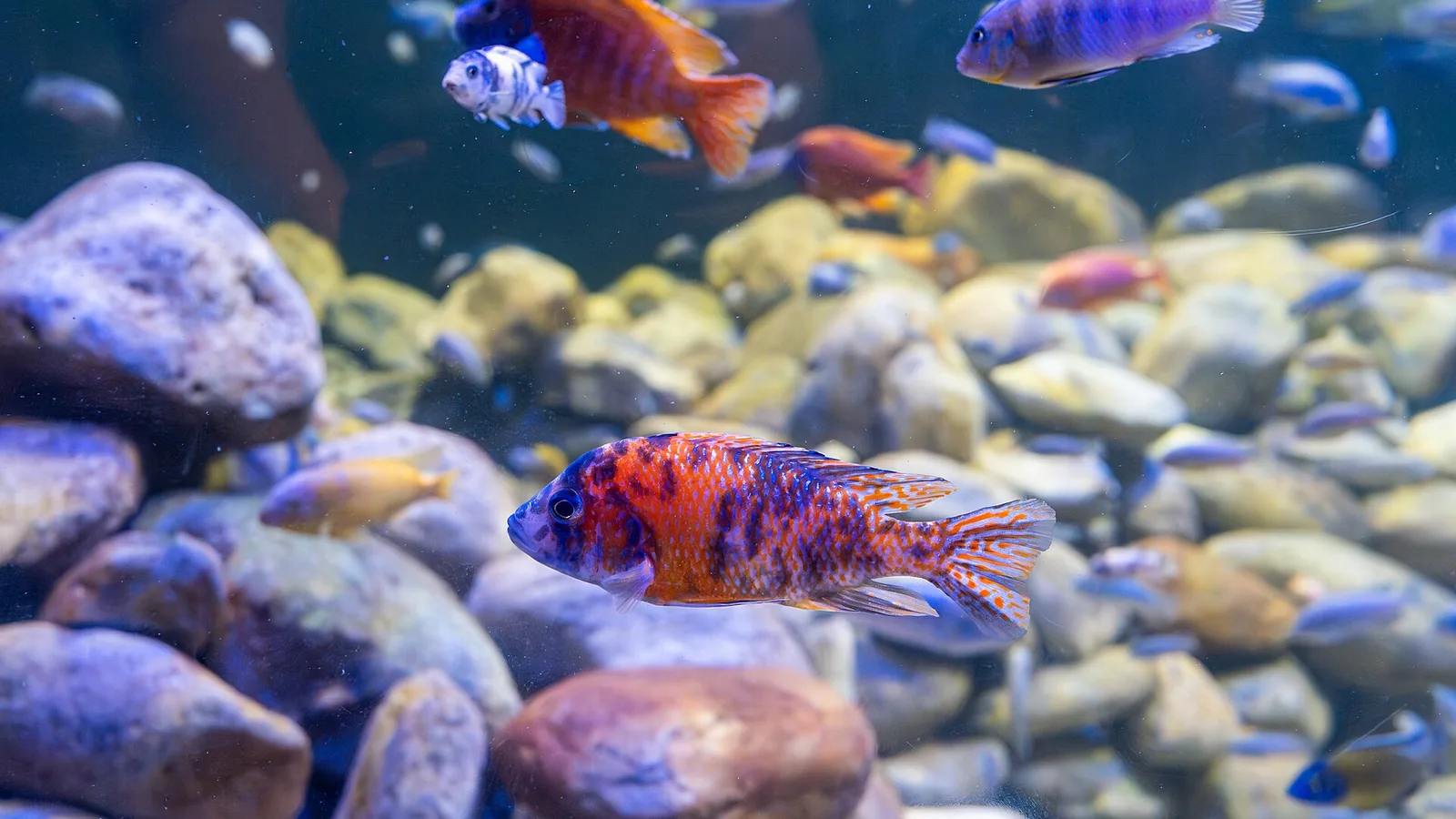
African Cichlids: The Short Answer
African cichlids are some of the most colorful freshwater fish you can keep. Many males glow blue, yellow, orange or red, and they behave in complex, fascinating ways. They also fight, dig and grow bigger than many buyers expect. This guide covers the main groups from each lake, the water they need, how to build and stock the tank, what to feed each group, which species mix well, and how breeding and common diseases work.
What Are African Cichlids?
Cichlids form the family Cichlidae. The FishBase family profile for Cichlidae counts about 1,800 species worldwide and more than 900 valid species in Africa alone. In the aquarium trade, though, “African cichlids” almost always means fish from three great lakes in East Africa:
- Lake Malawi. Home of the mbuna, peacocks and haps that fill most store tanks.
- Lake Tanganyika. Home of Tropheus, shell dwellers, julies and the large frontosa.
- Lake Victoria. Home of many smaller haplochromine cichlids, a few of which reach the hobby.
Lakes Malawi and Tanganyika lie in the Great Rift Valley, so their fish are often called Rift Lake cichlids. Each lake holds hundreds of cichlid species, and most live nowhere else. West African cichlids such as kribensis are African too, but they prefer softer water and belong in a different kind of tank.
Three habits shape how you keep African lake cichlids. Most are mouthbrooders, so the female carries eggs and fry in her mouth. Many males hold territories and chase rivals hard. And most need water far harder and more alkaline than a typical community tank.
Lake Malawi Cichlids: Mbuna, Peacocks and Haps
Lake Malawi cichlids dominate the hobby. Stores sell three main groups, and they need quite different setups. Mixing the wrong groups is the most common beginner mistake.
Mbuna: Rock-Dwelling Grazers
Mbuna live among rocks and graze algae and the tiny animals living in it. They are small, usually 3 to 5 inches, but very active and territorial. Popular species include the yellow lab, red zebra, demasoni, golden mbuna and Cynotilapia afra. Calm species such as the yellow lab and rusty cichlid make the best starting point. The Seriously Fish profile of the yellow lab describes it as relatively peaceful and suited to many hard water communities.
At the other end, demasoni and golden mbuna are among the most aggressive species in the group. They attack fish several times their size and are fierce toward their own kind. Mbuna tanks therefore use lots of rock, a crowded stocking plan and several females per male.

Peacocks: Open-Water Sand Sifters
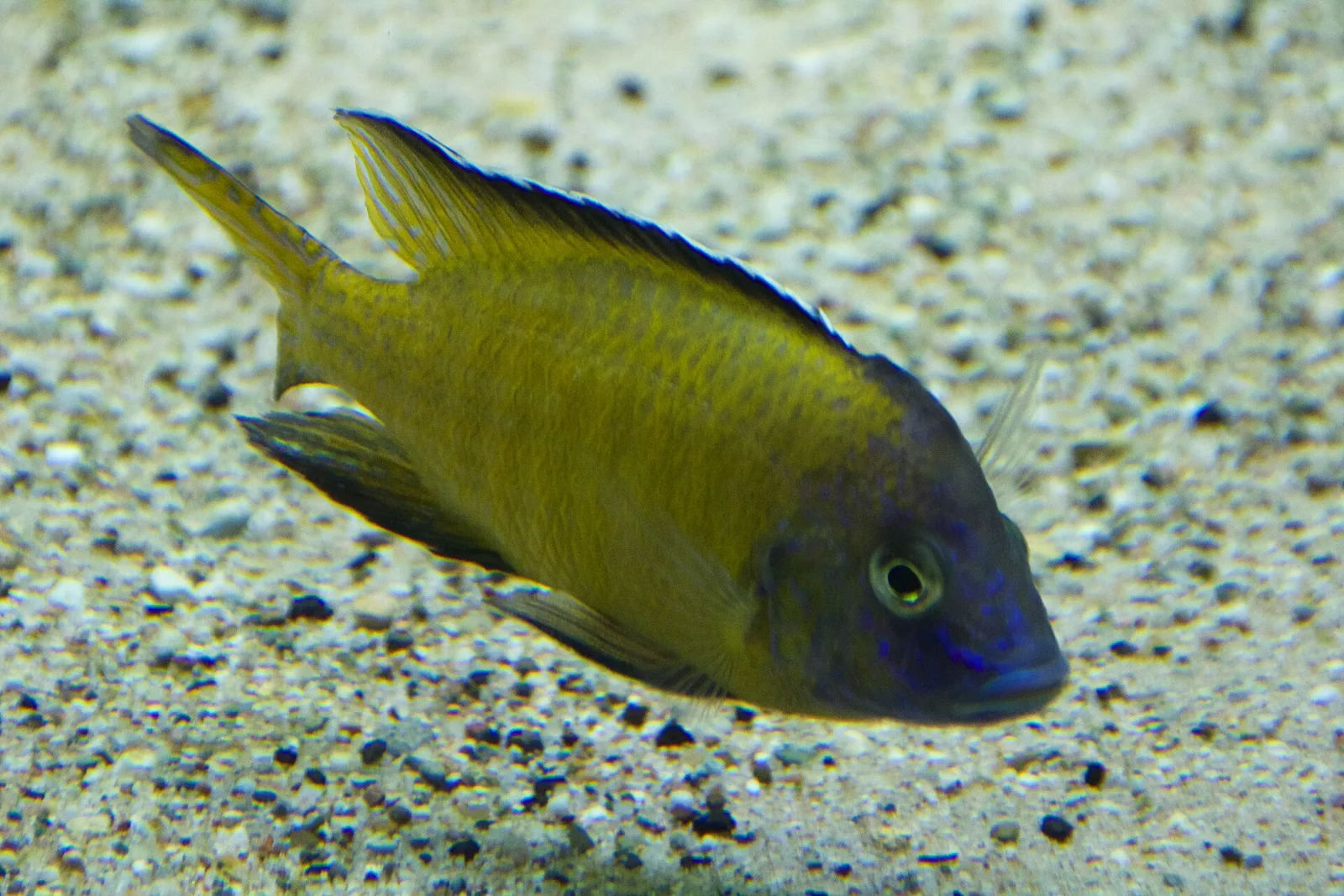
Peacocks belong to the genus Aulonocara. Males show electric blues, yellows and reds, while females are much duller. They hover over open sand and detect tiny movements with enlarged sensory pores on the head. Then they take a mouthful of sand and sift out food. Fine sand is therefore essential.
Peacocks are calmer than mbuna. Seriously Fish calls most mbuna excessively boisterous and unsuitable as peacock tank mates. Males also attack fish with similar colors, and most Aulonocara can hybridize, so keep one peacock species per tank unless the fish look very different.
Haps: Larger Open-Water Cichlids
“Haps” is hobby shorthand for many larger open-water Malawi cichlids. The group includes the electric blue hap, venustus, Protomelas and the zooplankton-eating utaka of the genus Copadichromis. Many reach 6 to 10 inches, and some are predators that will eat small mbuna. Haps share tanks well with peacocks and with each other when sizes match. They need more open swimming space than mbuna.

Lake Tanganyika Cichlids
Lake Tanganyika cichlids tend to be less flashy than Malawi species, but their behavior is more varied. The lake holds tiny snail-shell dwellers, cave-dwelling julies, open-water shoaling fish and big, slow predators. Each needs a different layout, so plan the tank around one or two niches.
- Tropheus. Algae grazers that live in large groups. Seriously Fish recommends buying 15 to 20 fish, warns that groups of 5 or 6 may fight to the death, and says never to add new fish to an established group. They are very prone to bloat.
- Shell dwellers. Multies reach about 2 inches. Each fish claims an empty snail shell, and a pair can live in an 18 inch tank.
- Cyprichromis. Very peaceful open-water fish that should live in a shoal of at least eight. They use the upper half of the tank, which suits a deep aquarium.
- Calvus. A flat-sided predator of rocky areas. It is peaceful toward fish it cannot swallow but shy, so it should not live with mbuna.
- Frontosa. The humphead frontosa grows to about 10 inches long. It lives in groups of five or more and needs a tank at least 96 inches long.

Lake Victoria Cichlids
Lake Victoria’s cichlids are a famous case of rapid evolution. Researchers at the University of Bern report that more than 500 species evolved there in about 16,000 years, after the lake dried out and refilled. A 2024 study in Biology Letters notes that roughly 40% of the endemic cichlid species were lost by the 1980s. Eutrophication, fishing and introduced species such as the Nile perch are the suggested causes.
Only a handful of Victorian species are traded, often from hobbyist breeding programs. Pundamilia nyererei is the best known. Males are red and yellow with dark bars and are aggressive toward each other. Seriously Fish suggests a tank at least 48 inches long, one male with at least three females, and notes that it can live with many mbuna. Avoid mixing different Pundamilia species, which can interbreed.
Water Chemistry: pH, Hardness and Temperature
Rift Lake water is hard and alkaline, and African cichlids need the same in the aquarium. Published species profiles give these typical ranges:
- Lake Malawi: pH about 7.5 to 9.0, general hardness (GH) 10 to 25 dGH, 73 to 84°F. Most mbuna sit at 75 to 82°F.
- Lake Tanganyika: pH about 7.5 to 9.5, GH 8 to 25 dGH, 73 to 81°F. Tropheus prefer the top of the pH range, about 8.0 to 9.5.
- Lake Victoria: pH about 7.0 to 8.5, GH 4 to 15 dGH, 73 to 81°F.
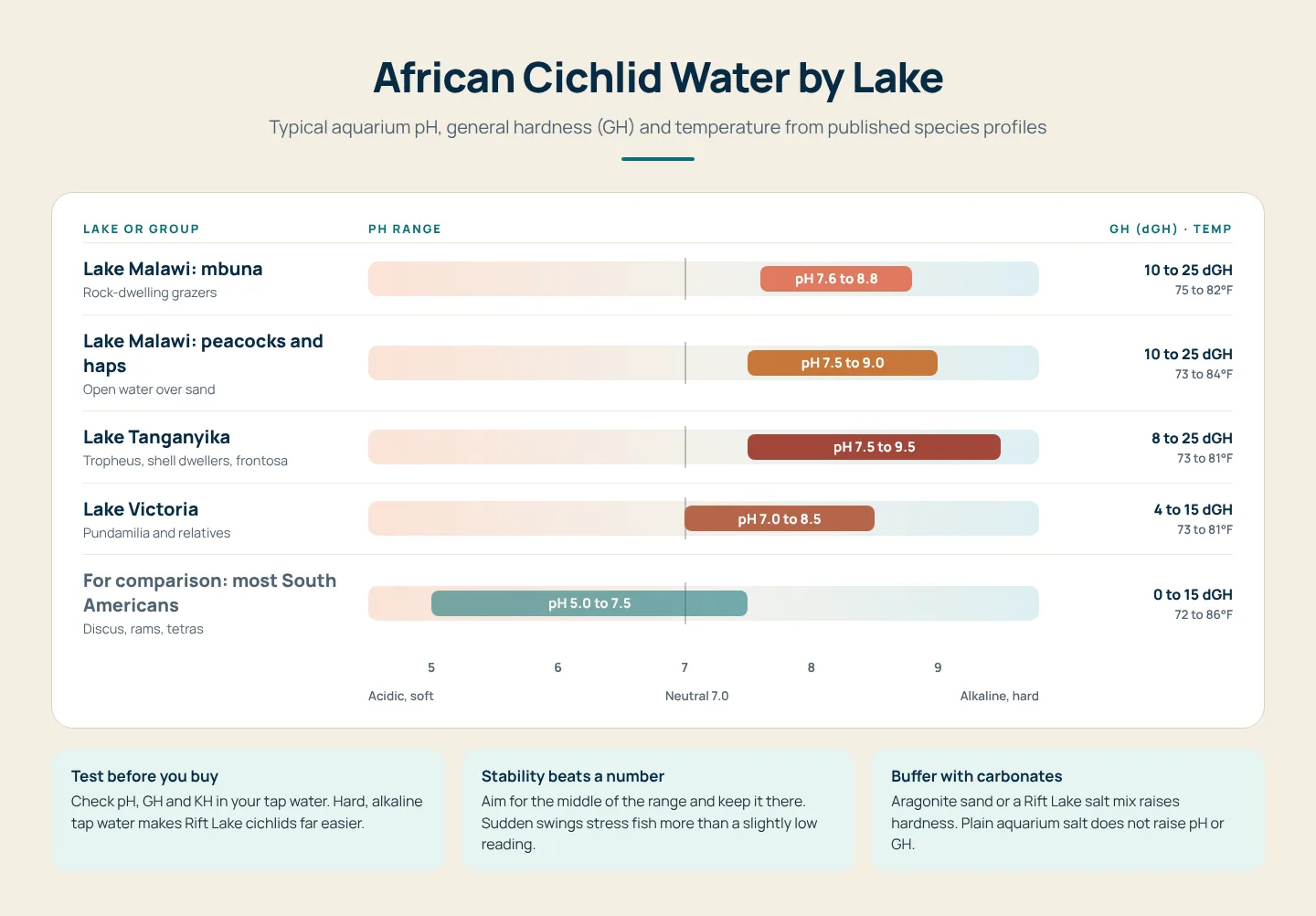
Test your tap water for pH, GH and KH before you buy fish. If it is already hard and alkaline, you may only need a good dechlorinator. If it is soft, raise hardness with aragonite sand, crushed coral or a Rift Lake salt mix made for cichlids. Plain aquarium salt does not raise pH or hardness. Pure distilled or RO water is a poor choice on its own, as our guide to spring, distilled and tap water for fish tanks explains.
Above all, keep conditions stable. A steady pH of 7.8 is far better than one that jumps between 7.4 and 8.6. Match the temperature and pH of new water to the tank during every water change.
Tank Size and Setup
Tank Size
Length matters more than gallons, because it gives fish room to escape a bully. Seriously Fish profiles recommend these minimum base sizes:
- Calm mbuna such as yellow labs: about 36 by 18 inches, or roughly 40 gallons.
- Aggressive mbuna such as demasoni and golden mbuna: 48 by 18 inches, about 54 gallons, as an absolute minimum.
- Peacocks: 48 by 18 inches, about 64 gallons. Larger haps such as the electric blue hap need about 60 inches.
- Tanganyika shell dwellers: about 18 inches for a pair of multies.
- Frontosa groups: 96 by 24 by 24 inches or more.
Small tanks rarely work. Mbuna sold at 1 to 2 inches grow quickly, and a 20 gallon tank cannot hold a stable group. If your tank is that size, see our guide to stocking a 20 gallon tank or our list of the best nano fish for small tanks instead.
Rockwork and Sand
For mbuna, fill much of the tank with piles of rock arranged into caves, with small open areas between. Peacocks and haps need fewer rocks and more open sand. Tanganyika layouts depend on the species: rock walls for julies and Tropheus, open sand and shells for shell dwellers.
- Use fine sand. Peacocks sift it for food, and many species dig.
- Place rocks directly on the bottom glass, then add sand around them. Digging fish cannot undermine rocks set this way.
- Build stable piles and test each one for wobble before adding fish.
- Expect plants to be uprooted or eaten. Tough plants such as anubias and java fern, attached to rock, have the best chance.

Filtration and Water Changes
African cichlid tanks carry a heavy bioload, especially crowded mbuna tanks. Aim for a filter turnover of four to five times the tank volume per hour, and keep the water well oxygenated. Canister filters and large hang-on-back filters both work. Our guide to the best fish tank filters compares the options for big, messy fish.
Change 30 to 50% of the water every week, as Seriously Fish recommends for peacocks. Never add African cichlids to a tank that has not finished cycling. Leftover food and heavy stocking can also cloud the water fast, and our guide to a cloudy fish tank explains how to fix it.
Heater, Lid and Lighting
Use a heater sized for the tank and hold 75 to 82°F for most species. Fit a tight lid, since chased fish can jump. Normal aquarium lighting is fine. Tanganyika species such as Synodontis petricola show themselves more under dim light.
Stocking to Control Aggression
Most African cichlid problems come from stocking, not from water. Each group needs its own plan.
Mbuna: Crowd the Tank
Seriously Fish advises that an mbuna tank “should be overcrowded to reduce aggression and territory formation.” In a lightly stocked tank, one dominant male claims most of the space and can chase one or two weaker fish to death. In a crowded tank with many caves, no fish can hold a big territory, and chasing is spread across many targets.

Follow these rules for a crowded mbuna tank:
- Keep one male with three or more females of each species. For the zebra mbuna, Maylandia zebra, Seriously Fish suggests only one male in any tank under about 53 gallons.
- Mix colors and patterns. Males attack fish that look like rivals, so avoid two species with the same barred or blue pattern.
- Avoid same-genus mixes that may hybridize, such as two Melanochromis species.
- Add fish in groups, and rearrange the rocks when you do. This resets territories so new fish are not singled out.
- Remove a bully if one fish keeps injuring others. A single problem male can wreck an otherwise stable tank.
Peacocks and Haps: Harems, Not Crowds
Peacocks and haps need open space more than crowding. In all but the largest tanks, keep one male peacock with four to six females. An all-male peacock tank is popular for color, but it needs a large tank, males with different colors and close watching.
Tanganyika Cichlids: Plan by Species
Tanganyika species follow their own rules. Tropheus need big groups bought together, shell dwellers need more shells than fish, and Cyprichromis need a shoal of eight or more. Do not overstock Tanganyika tanks the way you would an mbuna tank.
Diet by Group and Malawi Bloat
Feeding is where the three Malawi groups differ most. Mbuna and Tropheus graze algae from rocks. Peacocks, haps and many Tanganyika species eat small animals. Feed each group to match:
| Group | Natural diet | Staple food | Extras | Avoid |
|---|---|---|---|---|
| Mbuna | Algae and tiny animals grazed from rocks | Spirulina or vegetable-based flakes and pellets | Blanched spinach; a little live or frozen food | Beefheart and other red meat; rich, meaty foods as a staple |
| Tropheus | Algae grazed from rocks | Vegetable-based foods such as spirulina flakes | Blanched spinach, nori | Any animal meat |
| Peacocks | Small invertebrates sifted from sand | Fine-grade, high-quality prepared foods | Frozen bloodworm, brine shrimp | One large meal a day; feed small portions |
| Utaka (Copadichromis) | Zooplankton in open water | Small live, frozen and dried foods | Baby brine shrimp, some spirulina | Large, coarse foods |
| Predatory haps | Small fish and invertebrates | Quality pellets | Frozen shrimp and other meaty frozen foods | Beefheart and other red meat |
| Tanganyika predators | Invertebrates and small fish | Meaty frozen foods | Live foods; calvus often refuses dried food | Relying on dried food alone |
Seriously Fish’s mbuna profiles say vegetable matter, such as spirulina flakes and blanched spinach, should form a large part of the diet. They warn against beefheart and other red meat, which disrupts digestion. Feed small amounts once or twice a day, and remove anything left uneaten after a few minutes.
Malawi Bloat
Malawi bloat is a digestive disease seen mostly in plant-eating Rift Lake cichlids such as mbuna and Tropheus. Early signs are a listless fish that loses interest in food or spits it back out. Later the belly swells. Once swelling is obvious, many fish cannot be saved.
The exact cause is not fully understood. Diets poor in greens and fiber but rich in protein and fat are linked to it, as are poor water quality and stress. Some keepers blame starchy, low-fiber foods instead. The safe approach is the same either way: a plant-based, high-fiber staple fed in small portions to mbuna and Tropheus, with meaty foods kept for the species that need them.
Metronidazole is the usual treatment and works best mixed into food while the fish still eats. Isolate the fish in a hospital tank, and ask an aquatic vet for dosing advice.
Compatible African Cichlid Species
The table lists popular African cichlids with Seriously Fish sizes and minimum tank sizes. Sizes are standard length, measured without the tail. “Good with” and “Avoid with” summarize each profile’s tank mate advice. Always check that new species share the same water and diet.
| Species | Group | Adult size (SL) | Minimum tank | Temperament | Good with | Avoid with |
|---|---|---|---|---|---|---|
| Yellow lab Labidochromis caeruleus | Malawi mbuna | About 4 in | 41 gal (36 in) | Mild for an mbuna | Calm haps, peacocks, rusty cichlids, other quiet mbuna | Very aggressive mbuna |
| Rusty cichlid Iodotropheus sprengerae | Malawi mbuna | About 4 in | 21 gal for one male; 48 in for more | One of the least aggressive mbuna | Peacocks, Protomelas, Copadichromis, yellow labs | Large, boisterous mbuna |
| Cynotilapia afra Cynotilapia afra | Malawi mbuna | About 4 in | 39 in long | Belligerent, territorial | Other robust mbuna in a crowded tank | Peacocks and utaka |
| Golden mbuna Melanochromis auratus | Malawi mbuna | About 4 in | 54 gal minimum | Very aggressive | Robust mbuna with a different pattern | Peacocks, utaka, other Melanochromis |
| Demasoni Pseudotropheus demasoni | Malawi mbuna | About 3 in | 54 gal minimum | Very aggressive | Robust mbuna with a different pattern | Peacocks, utaka, other barred blue fish |
| Grant’s peacock Aulonocara stuartgranti | Malawi peacock | About 5 in | 64 gal (48 in) | Fairly peaceful | Copadichromis, calm haps, quiet mbuna | Most mbuna, other Aulonocara |
| Utaka (Borley’s hap) Copadichromis borleyi | Malawi hap | About 8 in | 60 in long | Generally peaceful | Peacocks, calm haps | Rowdy mbuna |
| Electric blue hap Sciaenochromis fryeri | Malawi hap | About 8 in | 80 gal (60 in) | Robust | Venustus, Protomelas, Copadichromis | Mbuna, similarly colored fish |
| Venustus Nimbochromis venustus | Malawi hap | About 10 in | 54 gal for one fish | Predatory | Larger mbuna, other large haps | Any fish small enough to eat |
| Tropheus Tropheus moorii | Tanganyika | About 6 in | 48 in for one; far more for a group | Squabbles with its own kind | Julidochromis and other algae grazers | Shy fish, meat-fed tank mates |
| Cyprichromis Cyprichromis leptosoma | Tanganyika | 4 to 5 in | 64 gal (48 in), deep | Very peaceful | Julidochromis, Altolamprologus, shell dwellers | Mbuna |
| Calvus Altolamprologus calvus | Tanganyika | About 5 in | Large tank | Peaceful toward fish it cannot eat | Cyprichromis, other calm Tanganyikans | Mbuna, small fish |
| Multies Neolamprologus multifasciatus | Tanganyika | About 2 in | 10 gal (18 in) for a pair | Guards its shell | Brichardi, small julies, Cyprichromis | Large or digging bullies |
| Frontosa Cyphotilapia frontosa | Tanganyika | About 10 in | 228 gal (96 in) for a group | Peaceful, eats small fish | Other large, calm Tanganyikans | Small fish |
| Nyererei Pundamilia nyererei | Lake Victoria | About 3 in | 48 in long | Males aggressive | Many mbuna | Other Pundamilia |
| Dwarf lake Synodontis Synodontis petricola | Tanganyika catfish | About 5 in | 21 gal (36 in), group of 4+ | Peaceful | Rift Lake mouthbrooders | Fish small enough to eat |
Several combinations work well. A crowded mbuna tank might hold yellow labs, rusty cichlids and Cynotilapia afra, each with several females. A peacock and hap tank might combine Grant’s peacocks, an utaka and an electric blue hap. A Tanganyika tank might pair shell dwellers on the sand with a shoal of Cyprichromis above.
Non-Cichlid Tank Mates
Few non-cichlids handle Rift Lake water and behavior. The dwarf lake Synodontis is one of the best: it is peaceful, likes hard water and should live in a group of four or more. Seriously Fish also notes that yellow labs can live with hard water rainbowfish and some cyprinids. Note that Synodontis petricola is a brood parasite in the wild and can lay eggs among a mouthbrooder’s eggs, so do not count on raising fry in a mixed tank.
Tank Mates to Avoid
Some pairings fail almost every time. Avoid these:
- Soft-water fish. Discus, angelfish, rams and most tetras want soft, acidic water and calm tank mates.
- Small or slow community fish. Bettas, fancy guppies and small tetras get chased, nipped or eaten.
- Goldfish. They are cool-water fish with very different temperature and diet needs.
- Peacocks with most mbuna. Mbuna bully peacocks and keep them hiding.
- Shy Tanganyikans with mbuna. Cyprichromis and calvus should not share a tank with mbuna.
- Look-alike species. Males attack fish with similar colors and may hybridize with close relatives.
- Tropheus with meat eaters. Tropheus need a plant diet, so meaty foods for tank mates put them at risk.
- Large predators with small fish. Venustus, frontosa and calvus eat any fish that fits in their mouth.
Breeding Basics: How Mouthbrooding Works
Most Lake Malawi and Lake Victoria cichlids in the hobby are maternal mouthbrooders. Lake Tanganyika has mouthbrooders such as Tropheus and Cyprichromis, plus substrate spawners such as shell dwellers, julies and calvus.
How a Malawi Spawning Works
- The male claims a site. He cleans a flat rock or a pit in the sand and displays in his brightest colors.
- The female lays eggs. She lays a few eggs at the site and quickly picks them up in her mouth.
- The eggs are fertilized. In many mbuna, egg-shaped spots on the male’s anal fin draw the female close to fertilize the eggs in her mouth.
- She broods the young. The female carries the eggs and fry for about three to four weeks. Yellow lab females hold about 5 to 30 eggs.
- Free-swimming fry are released. The young leave her mouth swimming and can eat baby brine shrimp and crushed flake.

Caring for a Holding Female
A holding female has a swollen throat and eats little or nothing. Tropheus females can hold their brood for more than four weeks. Stress may make a female spit out or swallow the brood, so keep the tank calm. Some keepers move her to a quiet tank near the end of brooding. Others leave her and give the fry plenty of rock cover, accepting that some will be eaten.
Breed only in a harem of one male and several females. A single female takes all of the male’s attention and may be killed. Keep species apart if they could hybridize.
Common African Cichlid Diseases
Most health problems in African cichlid tanks start with stress from aggression, poor water or the wrong food. Learn the signs early:
- Malawi bloat. Hiding, refusing food and a swollen belly, mainly in mbuna and Tropheus. See the diet section above.
- Ich. White spots like salt grains, often after new fish arrive. Our guide to ich on fish covers heat and medication treatment.
- Injuries and fin rot. Torn fins and missing scales from fights can become infected. Fix the aggression first, then treat the infection.
- Hole in the head. Small pits on the head and lateral line, linked to flagellate parasites, high nitrate and poor nutrition.
- Ammonia and nitrite stress. Gasping, red gills and lethargy in crowded or newly set up tanks. Test the water before reaching for medicine.
Quarantine new fish for a few weeks before adding them to the main tank. Our chart of common fish diseases matches symptoms to causes and treatments. For any fish that keeps declining, an aquatic vet is the best next step.
African Cichlid FAQs
Are African cichlids good for beginners?
Some are. Yellow labs and rusty cichlids are among the calmer mbuna and suit a first Lake Malawi tank. Species such as demasoni and golden mbuna are very aggressive and better for experienced keepers. Every African cichlid tank needs hard, alkaline water, plenty of rock and strong filtration.
How many African cichlids should be in a tank?
Mbuna do best in a crowded tank where no fish can claim a large territory. Keep one male with three or more females of each species. Peacocks and haps need normal stocking with one male to four to six females. Heavy stocking only works with strong filtration and weekly water changes.
Can peacocks live with mbuna?
Usually not. Most mbuna are too boisterous for peacocks, which are calmer open-water fish. The quieter mbuna, such as yellow labs and rusty cichlids, are the main exceptions and can share a large tank with peacocks.
Can you mix Lake Malawi and Lake Tanganyika cichlids?
It is possible in a few cases, but one lake per tank is safer. Both lakes need hard, alkaline water, yet many Tanganyika species are shy and get bullied by mbuna. Tropheus also need a strict plant diet that clashes with meat-eating tank mates.
What pH do African cichlids need?
Most Lake Malawi cichlids do well at a pH of about 7.5 to 9.0, and Lake Tanganyika species at about 7.5 to 9.5. Lake Victoria cichlids accept a slightly lower range of about 7.0 to 8.5. Keep the pH stable rather than chasing an exact number.
What causes Malawi bloat?
The exact cause is not fully understood. It mostly affects plant-eating cichlids such as mbuna and Tropheus. Diets low in greens and fiber but rich in protein and fat, poor water quality and stress are all linked to it. Metronidazole given in food is the usual treatment.
How long does a female African cichlid hold eggs in her mouth?
Most Lake Malawi mouthbrooders carry the eggs and young for about three to four weeks. Tropheus females can hold their brood for more than four weeks. The female eats little or nothing during this time, so she needs calm surroundings.
Do African cichlids need a heater?
In most homes, yes. Most species do best between about 75 and 82°F, and peacocks tolerate up to about 84°F. A heater holds the temperature steady, which matters as much as the exact number.


