What Size Heater Do I Need for My Fish Tank? Wattage Chart
What Size Heater Do I Need for My Fish Tank? Wattage Chart
Use the watts per gallon rule, a simple chart and two worked examples to pick the right aquarium heater wattage for any tank from 5 to 125 gallons.
By Fish Explain Editorial TeamUpdated November 10, 20269 min read
Illustration: Fish Explain
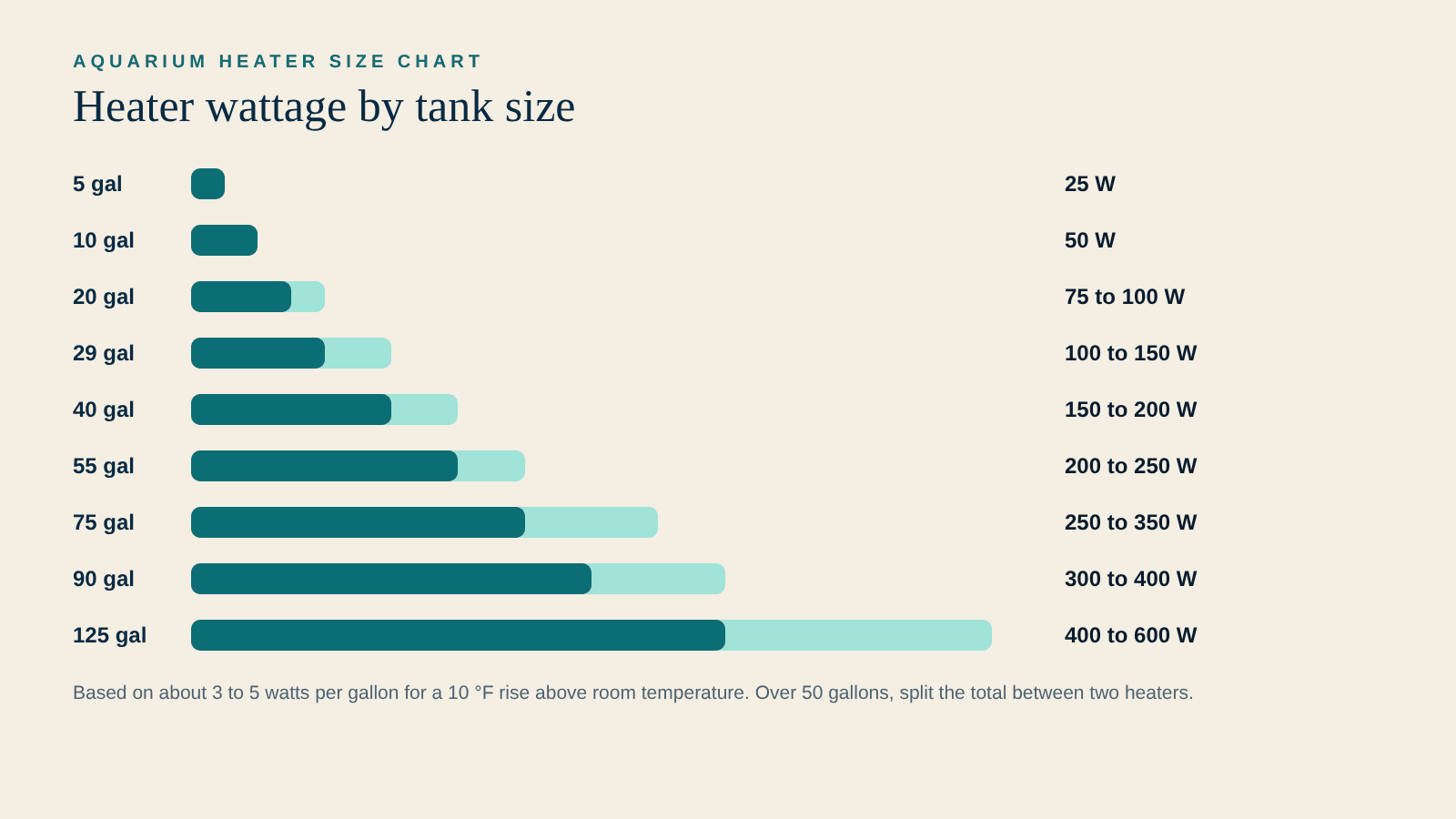
Most fish tanks need about 3 to 5 watts of heater power per gallon of water. That means about 25 watts for a 5 gallon tank, 50 watts for a 10 gallon, 75 to 100 watts for a 20 gallon, 100 to 150 watts for a 29 gallon and 200 to 250 watts for a 55 gallon. Pick the higher number if your room is cool or the tank has no lid, and split the wattage between two heaters in tanks over about 50 gallons.
On this page
What Size Heater for a Fish Tank: The Watts per Gallon Rule
If you are wondering what size heater for fish tank setups you need, start with one simple rule: about 3 to 5 watts of heater power for every gallon of water. A 20 gallon tank therefore needs roughly 60 to 100 watts, and a 40 gallon tank needs roughly 120 to 200 watts. Heaters are sold in set sizes such as 25, 50, 75, 100, 150, 200 and 300 watts, so you round to the nearest model that fits the range.
This guide builds on our main fish tank heater guide, which covers heater types, placement and the best temperature for common fish. Here we focus on one question: how many watts your tank needs.
Why the rule is a range
A heater does not just warm the water once. It has to keep replacing the heat the tank loses to the room. The colder the room and the warmer you want the water, the more heat escapes and the more watts you need. That is why a tank in a heated living room can run on 3 watts per gallon, while the same tank in a cool basement may need 5 watts per gallon or more.
What the wattage number means
Wattage is the heater’s power, not its temperature. A 100 watt heater and a 50 watt heater can both be set to 78 °F. The 100 watt model simply reaches that temperature faster and can hold it against a bigger gap between room and water. The built in thermostat switches the heater on and off to stay at your setting.
Aquarium Heater Wattage Chart by Tank Size
This aquarium heater wattage chart assumes you want to raise the water about 10 °F above room temperature, for example from a 68 °F room to 78 °F water, in a tank with a lid.
| Tank size | Recommended heater | Cold room or open top |
|---|---|---|
| 5 gallons | 25 W | 25 to 50 W |
| 10 gallons | 50 W | 50 to 75 W |
| 20 gallons | 75 to 100 W | 100 to 150 W |
| 29 gallons | 100 to 150 W | 150 to 200 W |
| 40 gallons | 150 to 200 W | 200 to 300 W |
| 55 gallons | 200 to 250 W (2 heaters) | 300 to 400 W (2 heaters) |
| 75 gallons | 250 to 350 W (2 heaters) | 400 to 500 W (2 heaters) |
| 90 gallons | 300 to 400 W (2 heaters) | 450 to 600 W (2 heaters) |
| 125 gallons | 400 to 600 W (2 heaters) | 600 to 800 W (2 heaters) |
Small tanks under 10 gallons
Nano tanks hold so little water that a heater that is too strong can push the temperature up quickly. For tanks of about 6 gallons or less, a heater of 25 watts or less is usually right. Many small heaters for betta tanks come preset to about 78 °F, which suits most tropical nano fish. Our betta fish care guide explains the full setup for a small heated tank.
Tanks over 50 gallons
Once a tank passes about 50 gallons, the total wattage is usually split across two heaters. A 75 gallon tank that needs 300 watts, for example, would use two 150 watt heaters. Long tanks also heat more evenly with one heater near each end.
How to Work Out the Heater Size You Need
You can size a heater in a few minutes with a cheap thermometer and some simple math.
Step by step
- Find the real water volume. Use the tank’s gallon rating. Rock, sand and wood take up some space, so the real volume is a little lower, which gives you a small safety margin.
- Measure the coldest room temperature. Check the room on a cold night or early morning, not in the afternoon.
- Choose your target water temperature. Most tropical community fish do well at about 75 to 80 °F.
- Subtract to find the temperature rise. Target temperature minus room temperature is the rise the heater must hold.
- Pick watts per gallon. Use about 2.5 to 3 watts per gallon for a rise of 5 °F, about 3 to 5 watts per gallon for 10 °F, and about 5 to 7.5 watts per gallon for 15 °F or more.
- Multiply and round. Gallons times watts per gallon gives the total. Round to the nearest heater size sold.
Worked example: 20 gallon tank
Your room falls to 68 °F at night and you keep tetras at 78 °F. That is a 10 °F rise. At 5 watts per gallon, 20 gallons times 5 equals 100 watts, so a 100 watt heater is the right heater size for a 20 gallon tank in that room. In a warmer 72 °F room, the rise is only 6 °F and a 75 watt heater would do. If you are still planning what to keep, see how many fish fit in a 20 gallon tank.
Worked example: 55 gallon tank
A 55 gallon tank in a 65 °F room, kept at 78 °F, needs a 13 °F rise. At about 5 watts per gallon, 55 times 5 equals 275 watts. Two 150 watt heaters, one at each end, give 300 watts in total with a little spare capacity.
Factors That Change Fish Tank Heater Size
The chart is a starting point. These four factors can push your fish tank heater size up or down.
Room temperature
This matters most. A tank in a basement, by a drafty window or near an air conditioner vent loses heat faster than one in a warm room. Tanks on the bottom shelf of a rack also run cooler than those on top, since warm air rises.
Lid or open top
An open top tank loses heat through evaporation, so plan on roughly 20 percent more wattage. A glass lid or hood holds in heat and cuts water loss. Our guide to fish tank covers and lids compares the main types.
Tank material and shape
Acrylic insulates a little better than glass, so an acrylic tank holds heat slightly longer. Long, shallow tanks have more surface area than tall tanks of the same volume, so they can lose heat faster through the top.
Target temperature for your fish
Fish that like it warm, such as discus and German blue rams at 80 °F or more, need a bigger rise and more watts. Hardy fish kept at 74 to 76 °F need less. Our list of tropical freshwater fish shows typical temperatures for popular species. Lights, filters and pumps also add a little heat, which helps in small tanks.
One Large Heater or Two Smaller Heaters?
For small and medium tanks, one correctly sized heater is fine. For larger tanks, two heaters are the safer choice.
Why two heaters are safer
Heaters can fail in two ways: they stop heating, or the thermostat sticks on. With two smaller heaters, one failing off still leaves the other to slow the temperature drop. One failing on heats the water more slowly than a single large heater would, which gives you more time to notice. Aquarium Co-Op recommends this approach in its heater buying guide, using two 100 watt heaters instead of one 200 watt model as its example.
Where to place them
Put each heater near steady water flow, such as close to the filter outlet, so warm water spreads through the tank. In a long tank, place one at each end. Always use a separate thermometer on the far side of the tank to check that the whole tank is at the right temperature.
Common Heater Sizing Mistakes
Most heater problems come from a few simple mistakes.
Buying a heater that is too small
An undersized heater runs nonstop and still cannot reach your setting on cold nights. The water swings in temperature, which stresses fish and can lead to illness such as ich. If your heater light rarely switches off, it is probably too small.
Buying a heater that is far too big
A much larger heater than needed is not more reliable. If its thermostat fails on, it can heat a small tank to a dangerous level within hours. For large heaters in small tanks, an external temperature controller adds a backup shut off.
Trusting the dial alone
Heater dials are often a few degrees off. Set the heater, wait a day, then check a separate thermometer and adjust. Unplug the heater before water changes and let it cool before you lift it out, so the glass is not exposed to air while hot. For a full new tank checklist, see how to set up a fish tank.
Aquarium Heater Size FAQs
What size heater do I need for a 20 gallon tank?
Most 20 gallon tanks need a 75 to 100 watt heater. Choose 75 watts in a warm room and 100 watts if the room drops below about 68 °F or the tank has no lid.
What size heater do I need for a 10 gallon tank?
A 50 watt heater suits most 10 gallon tanks. In a warm home a 25 to 50 watt model is enough, while a cold room calls for the full 50 watts.
How many watts per gallon does an aquarium heater need?
Plan on about 3 to 5 watts per gallon. Use the low end for small temperature rises in warm rooms and the high end, or more, for cold rooms and open top tanks.
Can an aquarium heater be too big for a tank?
Yes. An oversized heater warms the water very fast, so if its thermostat sticks in the on position it can overheat the tank before you notice. Stay close to the chart or add an external temperature controller.
Should I use two heaters in a large tank?
For tanks over about 50 gallons, two smaller heaters are safer than one large one. Split the total wattage between them and place one at each end of the tank for even heat.
Final Thoughts
Size for your coldest day
Start with 3 to 5 watts per gallon, then adjust for your room, lid and fish. Size the heater for the coldest night of the year, not an average day, and use two heaters once you pass about 50 gallons. If you are still choosing the tank itself, our fish tank buying guide covers sizes, types and the equipment you will need.
Keep exploring
More fish guides

Keep exploring
 Aquarium Care
How Long to Wait Before Adding Fish to a New Tank
How long before adding fish to a new tank? Usually 2 to 6 weeks. Learn the water test results that mean it…
 Aquarium Care
Aquarium pH: How to Raise or Lower pH Safely
Aquarium pH guide: ideal ranges for freshwater fish, how KH keeps pH stable, and safe ways to raise or lower pH without…
 Aquarium Care
New Tank Syndrome: Signs, Causes and How to Prevent It
New tank syndrome kills fish in uncycled tanks. Learn the warning signs, what causes ammonia and nitrite spikes, and how to fix…