Aquarium Lighting Guide: How Much Light Your Fish Tank Needs
Aquarium Lighting Guide: How Much Light Your Fish Tank Needs
How many hours your aquarium light should be on, which type of light to buy, and how to balance light for fish, plants and algae.
By Fish Explain Editorial TeamUpdated November 20, 20267 min read
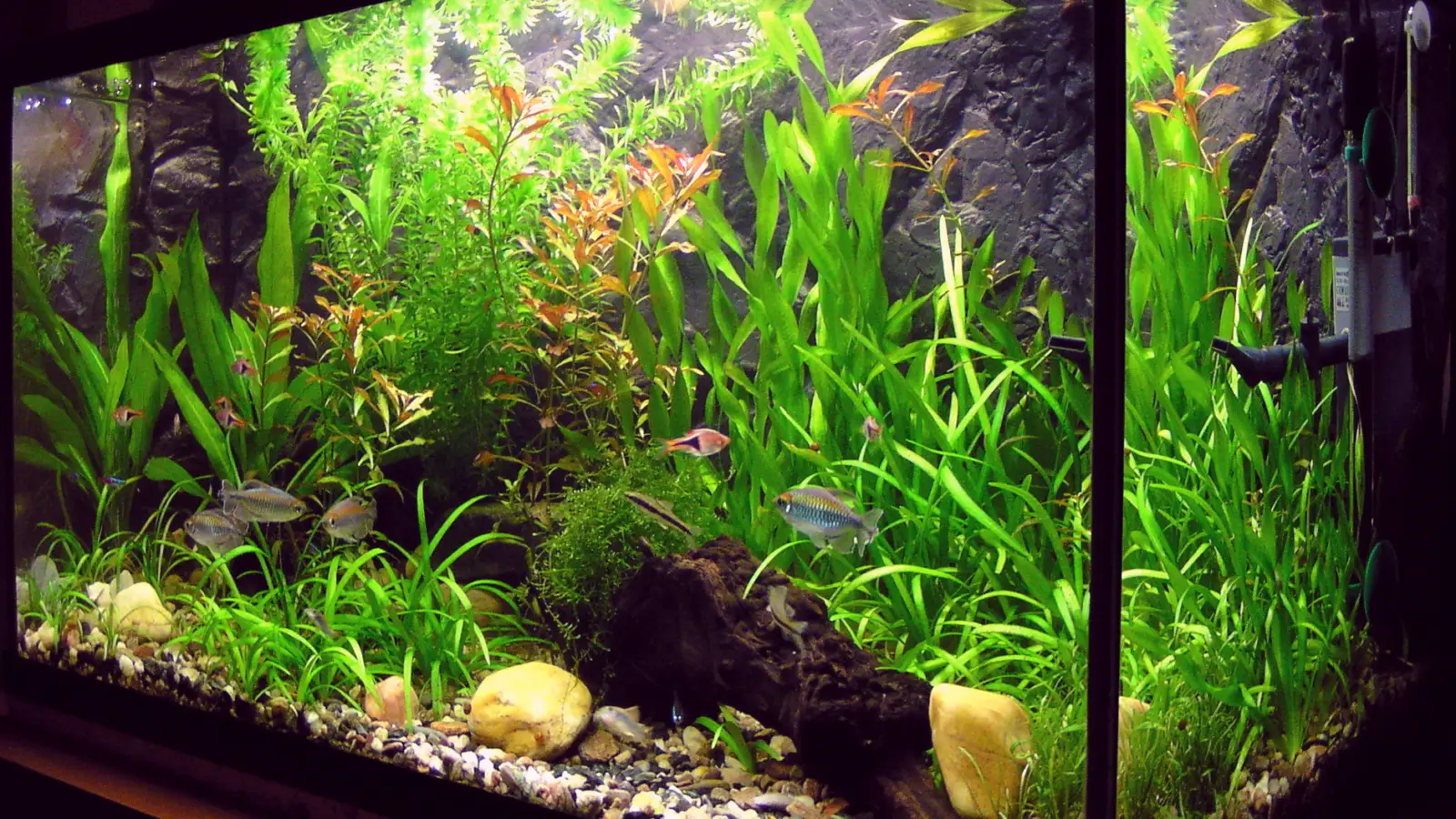
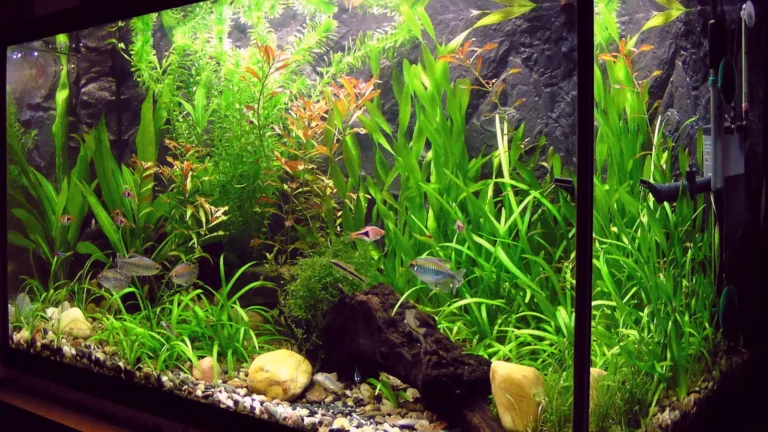
Photo: Aleš Tošovský (public domain), via Wikimedia Commons (cropped)
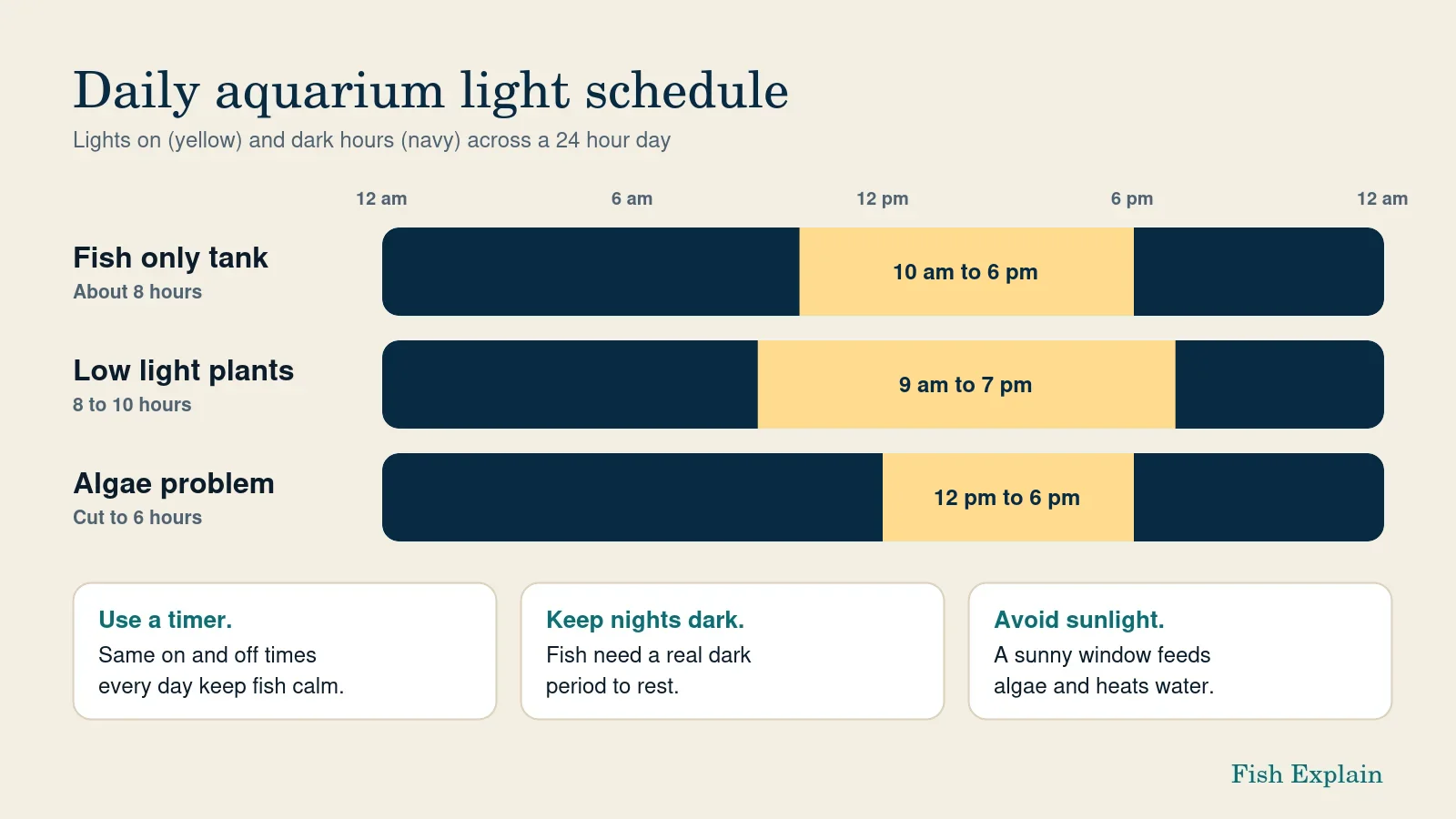
Most aquarium lighting setups need about 8 hours of light a day for a fish only tank and 8 to 10 hours for a planted tank. Use an LED aquarium light on a timer, keep the tank out of direct sunlight, and cut back to about 6 hours if algae starts to spread.
On this page
Aquarium Lighting Basics
Good aquarium lighting does three jobs: it lets you see your fish, it gives fish a steady day and night rhythm, and it feeds any live plants in the tank. Most freshwater tanks need about 8 hours of light a day, while planted tanks usually need 8 to 10 hours. The right fixture and a simple timer matter far more than buying the brightest light on the shelf.
Lighting is also the setting most closely tied to algae. Too much light, or light left on too long, is one of the most common reasons a new tank turns green. If you are still choosing a tank, our fish tank buying guide explains which kits come with a usable light and which need an upgrade.
Do fish need light at all?
Fish do not need strong light to survive, but they do need a regular cycle of light and darkness. In the wild, daylight sets when fish feed, rest and breed. A tank with no clear day and night pattern, or with a light that stays on around the clock, can leave fish stressed and more prone to illness.
Why plants change everything
Live plants use light for photosynthesis, so a planted tank needs a fixture with enough intensity to reach the substrate. A fish only tank with plastic or silk plants only needs enough light for viewing, which is why a basic kit light is usually fine for it.
How Long to Leave an Aquarium Light On
The simplest rule is to match your tank type to a set number of hours, then adjust based on how the plants and glass look after two or three weeks.
| Tank type | Light per day | Notes |
|---|---|---|
| Fish only, no live plants | About 8 hours | Enough for viewing and a normal day cycle |
| Low light plants (anubias, java fern, mosses) | 8 to 10 hours | Start at 8 and raise slowly if growth is poor |
| Medium to high light planted tank | 8 to 10 hours, sometimes more | Usually paired with fertilizer and sometimes CO2 |
| Tank with an algae problem | Cut to about 6 hours | Hold the shorter period until algae settles |
Aqueon’s aquarium lighting guide gives a similar starting point: about eight hours for a fish only tank and a longer period for planted tanks. Treat these as starting numbers, not fixed laws.
Use a timer for a steady routine
An outlet timer or a light with a built in schedule is the easiest upgrade you can make. Fish settle faster when the lights come on and go off at the same times every day, and you never have to remember to switch them off at night.
Splitting the photoperiod
Some keepers use a siesta, such as four hours on, a two hour break, then four more hours on. This can help a little with algae in planted tanks, but a single block of 8 hours works well for most beginners and is easier to manage.
Types of Aquarium Lights
Most aquarium lights sold today are LED fixtures, but you will still see fluorescent tubes on older tanks and secondhand kits.
LED aquarium lights
LED lights use little power, run cool, last for years and come in slim designs that sit on the rim or hang above the tank. Many models let you change color, brightness and timing from a controller or an app. For almost every new setup, an LED fixture is the best value.
Fluorescent tubes (T5 and T8)
Fluorescent tubes spread light evenly and once powered most planted tanks. They run warmer, use more electricity and lose output over time, so many keepers replace the tubes about once a year. They still work, but most people switch to LED when a tube or ballast fails.
Full spectrum and color
Fixtures with red, green and blue channels make fish colors look richer and support plant growth. A daylight white of around 6,500 K looks natural to most people. Blue night lights or moonlights are mainly for viewing and should be dim if you use them at all.

How Much Light a Planted Tank Needs
The old “watts per gallon” rule came from fluorescent tubes and does not work for LEDs, which produce far more light per watt. Today, plant keepers talk about PAR, a measure of the usable light that reaches the plants.
Low, medium and high light
- Low light: enough for anubias, java fern, cryptocorynes, mosses and floating plants. Most kit LEDs on tanks up to about 16 inches deep fall here.
- Medium light: suits most stem plants and many carpeting plants when you add root tabs or liquid fertilizer.
- High light: needed for demanding red plants and dense carpets, and almost always paired with CO2 injection and regular dosing.
Tank depth matters
Light weakens as it travels through water, so a deep or tall tank needs a stronger fixture than a shallow one of the same volume. If you keep a tall tank, check the product page for the depth the light is rated for. Our guide to tall fish tanks covers this in more detail.
Balance light with nutrients
More light makes plants grow faster only if they also have enough nutrients and carbon. When light runs ahead of nutrients, algae takes the spare energy. That is why beginners usually get the best results with a low or medium light and easy plants.
Aquarium Lighting and Algae
Algae is a normal part of any lit tank, but a sudden bloom usually points to too much light, too many nutrients, or both.
Common lighting mistakes
- Leaving the light on for 12 hours or more on a fish only tank
- Placing the tank where direct sunlight hits it for part of the day
- Running a strong planted tank light over a tank with few plants
- Forgetting to switch off the light at night
How to fix green water and algae
Cut the light to about 6 hours, keep up with weekly water changes, feed a little less and test for nitrate and phosphate. Adding fast growing plants such as hornwort or floating plants helps them outcompete algae. If the water itself has turned green or cloudy, our guide to a cloudy fish tank explains each color and its cause.
Where to Place Your Fish Tank and Light
Keep the tank out of direct sunlight
A sunny window can heat the water by several degrees in an afternoon and feeds algae in a way no timer can control. A spot on an inside wall, away from heating and cooling vents, gives you full control over light and temperature.
Lids, glass covers and light
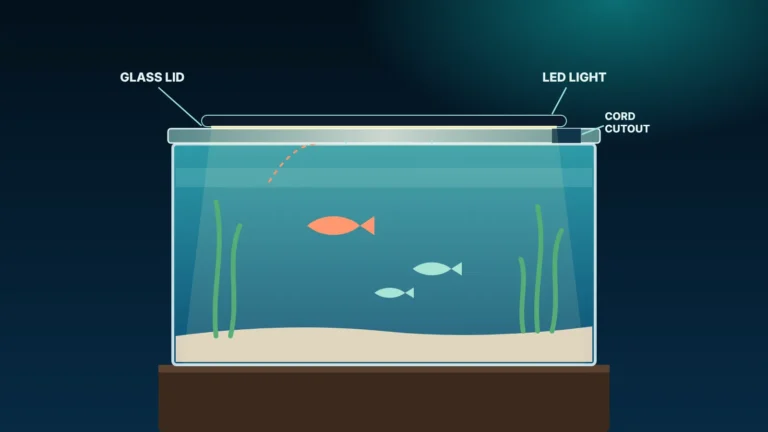
A glass lid keeps fish from jumping and slows evaporation, but it also blocks some light and gathers mineral spots over time. Wipe it during routine cleaning so it does not dim the tank. Our guide to fish tank covers and lids compares open top and covered setups.
Keep water and power apart
Use a drip loop on every power cord, keep plugs above the tank level and never let splashes reach the fixture. If you also run a fish tank heater, plug it into a separate outlet on the same power strip with a ground fault outlet if possible.
How to Choose an Aquarium Light
Match the fixture to the tank
Pick a light that covers most of the tank length so you do not get dark corners. For a fish only tank, any decent LED made for aquariums is enough. For live plants, choose a model labeled as a planted tank light and check the depth rating.
Features worth paying for
- A built in timer or app schedule
- Adjustable brightness so you can start low and increase slowly
- Sunrise and sunset ramping, which avoids startling fish when the light turns on
- A splash resistant design and a solid mounting bracket
Starting light for a new tank
During the first weeks, keep the light at about 6 to 8 hours while the tank cycles and plants settle. New tanks often get a brown or green algae phase, and a shorter light period keeps it small. Our guide on how to set up a fish tank covers the rest of the first month.
Aquarium Lighting FAQs
How many hours a day should an aquarium light be on?
About 8 hours suits most fish only tanks, and 8 to 10 hours suits most planted tanks. Use a timer so the light turns on and off at the same times every day.
Is it OK to leave an aquarium light on all night?
No. Fish need a dark period to rest, and a light left on all night stresses fish and feeds algae. Switch the main light off at night, and keep any night light very dim.
Do fish need light at night?
No. Fish rest in darkness. A dim moonlight is optional for viewing nocturnal fish, but it is not needed for their health.
What color light is best for a fish tank?
A full spectrum or daylight white LED of around 6,500 K looks natural and supports plants. Fixtures with red and blue channels make fish colors look brighter.
Can too much light kill fish?
Light rarely harms fish directly, but too much light causes algae blooms, and direct sunlight can overheat the water. Both problems can stress or harm fish over time.
Final Thoughts
Simple, steady light works best
Good aquarium lighting is mostly about consistency. Choose an LED that suits your tank depth and plants, run it on a timer for about 8 hours a day, keep the tank out of direct sunlight and adjust slowly if algae appears. For more equipment advice, start with our fish tank buying guide.
Keep exploring
More fish guides
Keep exploring
 Aquarium Care
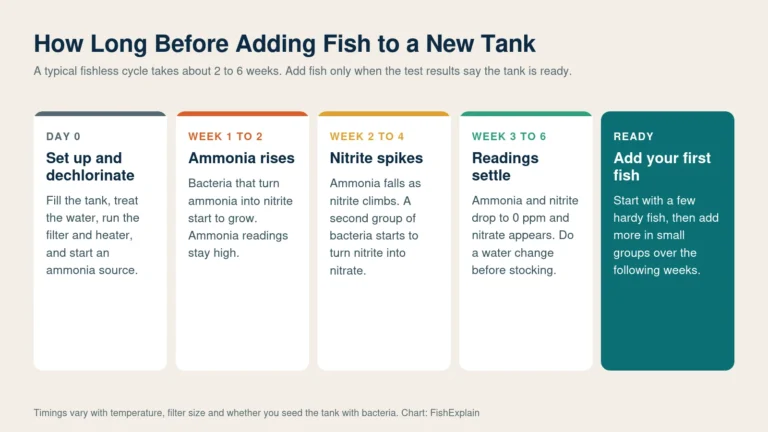
How Long to Wait Before Adding Fish to a New Tank
How long before adding fish to a new tank? Usually 2 to 6 weeks. Learn the water test results that mean it…
 Aquarium Care
Aquarium pH: How to Raise or Lower pH Safely
Aquarium pH guide: ideal ranges for freshwater fish, how KH keeps pH stable, and safe ways to raise or lower pH without…
 Aquarium Care
New Tank Syndrome: Signs, Causes and How to Prevent It
New tank syndrome kills fish in uncycled tanks. Learn the warning signs, what causes ammonia and nitrite spikes, and how to fix…