Tall Fish Tanks: Pros, Cons and Best Fish for Them
Tall Fish Tanks: Pros, Cons and Best Fish for Them
A tall aquarium saves floor space and shows off tall fish and plants, but it has less surface area and is harder to maintain. Here is how tall tanks compare with long tanks and which fish suit them best.
By Fish Explain Editorial TeamUpdated November 9, 202610 min read
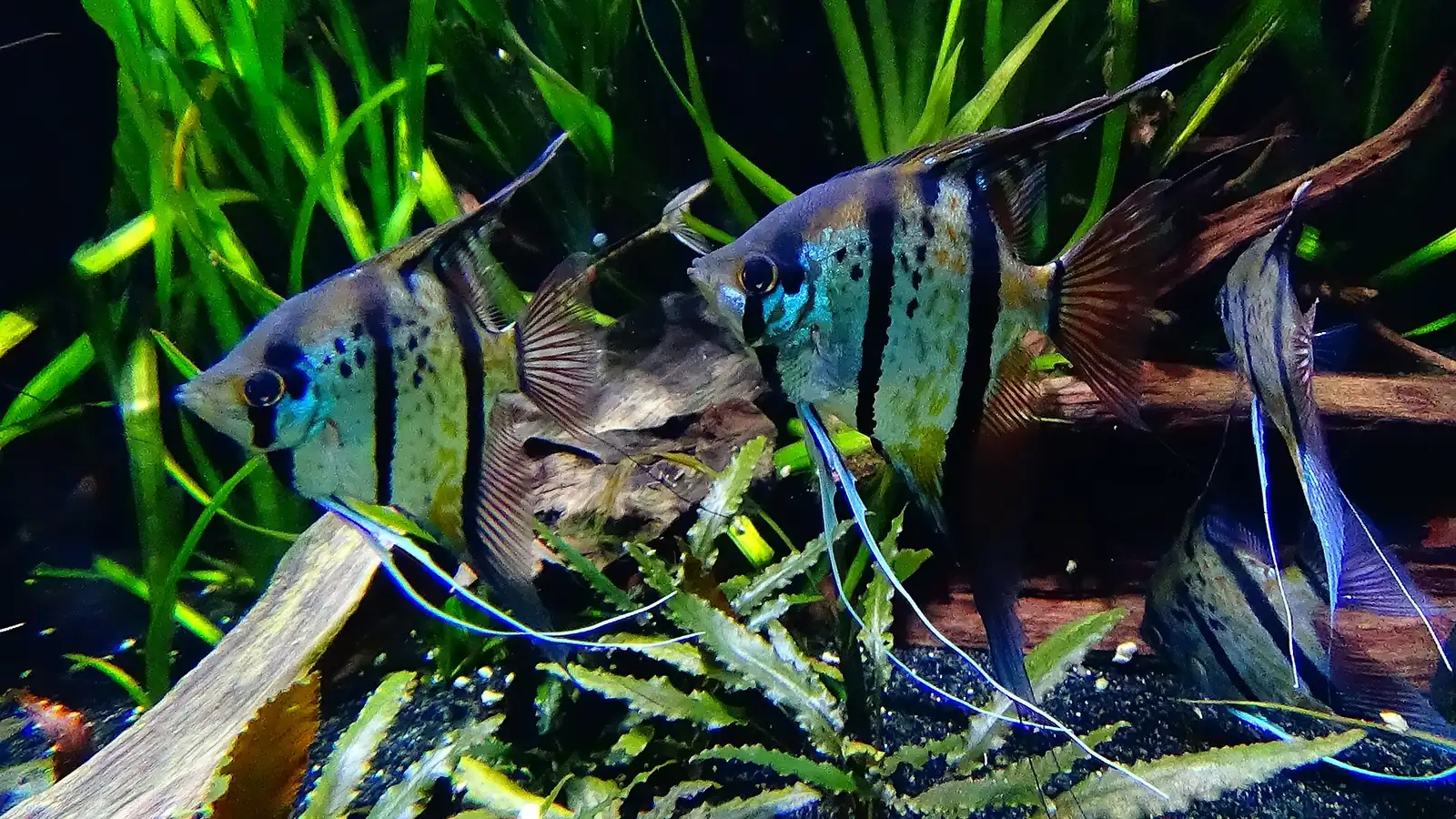
Photo: Cedricguppy – Loury Cédric (CC BY-SA 4.0), via Wikimedia Commons (cropped)
A tall fish tank is an aquarium that is taller than it is deep from front to back, such as a 20 gallon high, 29 gallon or 37 gallon tank. It takes up less floor space and suits tall-bodied fish like angelfish and discus, plus tall plants. The trade off is a smaller water surface, so it holds fewer fish than a long tank of the same volume and needs good surface movement, a strong light and long-handled tools.
On this page
What Is a Tall Fish Tank?
A tall fish tank is any aquarium where the height is the main dimension on show. Most are standard rectangles with extra height, while others are hexagons, bow fronts or narrow column aquariums. The appeal is simple: you get a striking vertical display on a small footprint, which works well in apartments, offices and narrow alcoves.
If you are still deciding on a size or shape, start with our fish tank buying guide, which covers every common tank style. This page focuses on what changes when a tank grows upward instead of outward.
Tall, standard and column aquariums
A standard tank is roughly as tall as it is deep, or a little taller. A tall tank adds several inches of height on the same footprint. A column aquarium takes this further, with a narrow fish tank footprint and a height that can be close to double the width. Hexagon tanks are a popular column style because you can view them from several sides.
Common tall tank sizes
Manufacturers sell several standard sizes in a tall format. The figures below are typical outer dimensions for US glass tanks, and brands vary slightly, so always check the exact model.
| Tank | Typical size (L x W x H) | Water surface |
|---|---|---|
| 20 gallon high | 24 x 12 x 16 in | 288 sq in |
| 29 gallon | 30 x 12 x 18 in | 360 sq in |
| 37 gallon | 30 x 12 x 22 in | 360 sq in |
| 45 gallon tall | 36 x 12 x 24 in | 432 sq in |
| 90 gallon | 48 x 18 x 24 in | 864 sq in |
Notice that the 29 gallon and 37 gallon tanks share the same 30 x 12 inch footprint. The extra 8 gallons in the 37 gallon all come from height, so its water surface does not grow at all.
Pros of a Tall Aquarium
A tall aquarium has real strengths, especially for keepers with limited floor space or a love of tall fish.
Small footprint, big display
A tall tank fits more water into a narrow space. On a 30 inch stand you can choose a 29 gallon or a 37 gallon tank, and the taller one gives a bolder look without needing more floor. Our guide to fish tanks with stands explains how to match the stand to the tank weight.
Room for tall-bodied fish
Some fish are built to be tall. Freshwater angelfish have long dorsal and anal fins that make them taller than they are long, and discus have round, flat bodies. Both look and behave best with plenty of vertical swimming room.
Space for tall plants and hardscape
Height lets you grow plants that would fold over in a shallow tank, such as Vallisneria, Amazon swords and tall stem plants. Upright driftwood branches and rock towers also look natural and give mid-water fish places to shelter.
Cons of a Tall Fish Tank
The downsides of a tall fish tank all come back to one fact: you get more depth but no extra surface or floor.
Less surface area for oxygen
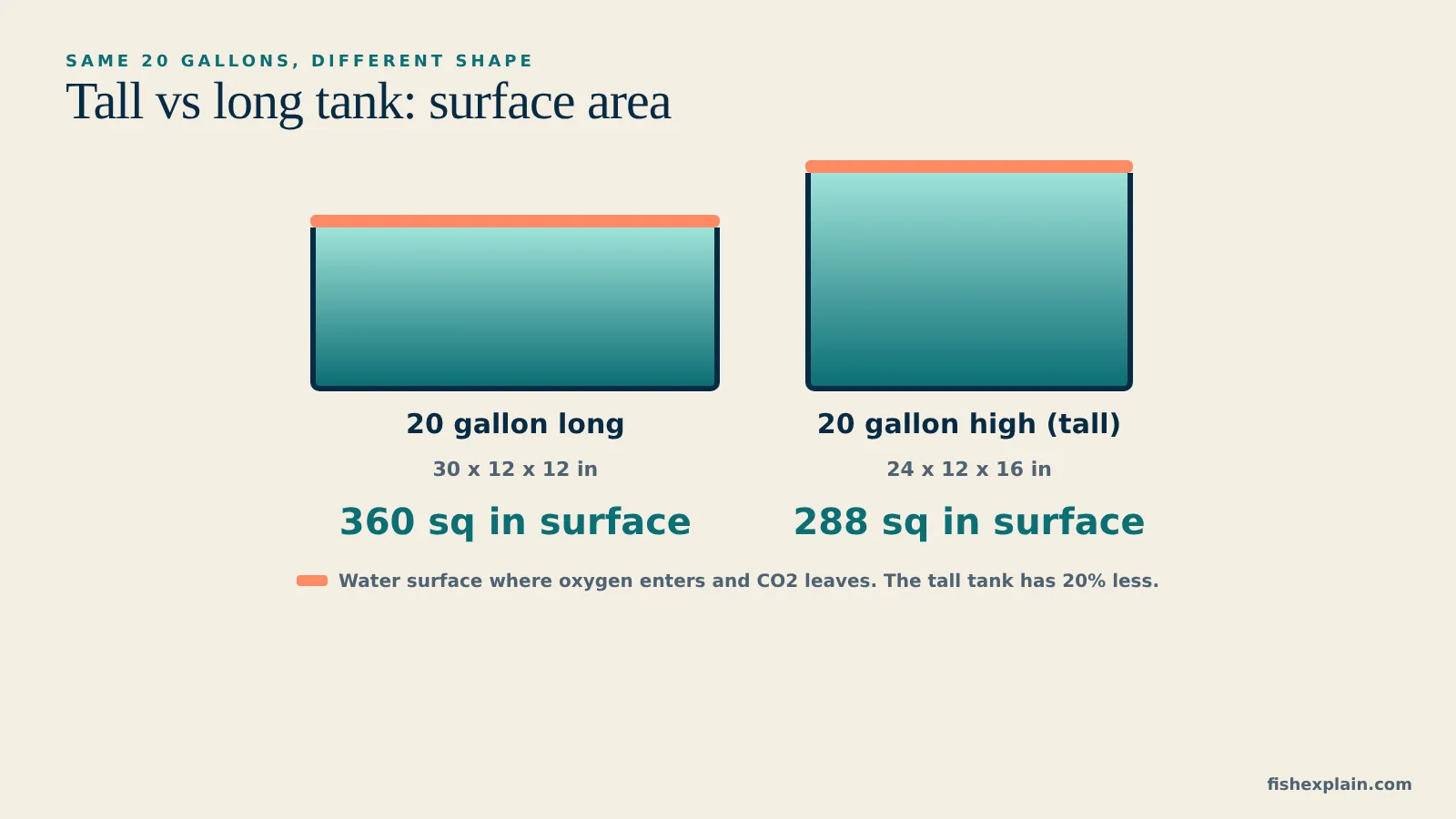
Oxygen enters the water and carbon dioxide leaves it at the surface. A tall tank has less surface for each gallon than a long tank, so gas exchange is slower. The diagram below compares two 20 gallon tanks with the same volume but different shapes.
Harder to reach and clean
On a tank 22 to 24 inches tall, most people cannot reach the substrate without getting a shoulder wet. Planting, gravel cleaning and catching fish all take longer. Long-handled scrapers, tongs and a gravel vacuum with a long tube solve most of this.
Light has to travel further
Water absorbs and scatters light, so the bottom of a tall tank is dimmer than the top. A basic kit light may be enough for low light plants such as Java fern and Anubias, but carpeting plants on the bottom of a 24 inch tank usually need a stronger LED.
Less floor space for bottom dwellers
Corydoras, loaches and other bottom fish care about floor area, not height. A tall tank with a 24 x 12 inch base gives them the same floor as a 15 gallon tank, so plan bottom dweller numbers by footprint.
Best Fish for a Tall Fish Tank
The best fish for a tall aquarium are tall-bodied, calm swimmers and species that use the upper and middle water. Fast fish that like to dash end to end are better in a long tank.
| Fish | Adult size | Typical minimum tank | Swimming level |
|---|---|---|---|
| Freshwater angelfish | About 6 in long, taller with fins | 29 to 30 gallon tall for a pair | Middle |
| Discus | 6 to 8 in | 55 gallon or larger for a group | Middle |
| Pearl gourami | 4 to 5 in | 29 to 30 gallon | Top and middle |
| Honey gourami | About 2 in | 10 gallon | Top |
| Marbled hatchetfish | About 1.5 in | 20 gallon, group of 6 or more | Top |
| Rummy-nose tetra | About 2 in | 20 gallon, group of 6 or more | Middle |
Freshwater angelfish
Angelfish are the classic tall tank fish. They grow to around 6 inches long, and their fins make them even taller, so a deep tank with tall plants suits them well. Many keepers choose a tank at least 18 to 20 inches tall for adults. Angelfish are cichlids and can eat very small fish such as neon tetras once grown, so pick tank mates with care. Our guide to cichlid fish types covers their relatives.
Discus
Discus are tall, round cichlids that need warm, clean, soft water and a calm tank. They do best in groups, which means a large tank, so a tall 55 gallon or a 75 to 90 gallon tank is a better match than a small column. See our discus fish tank setup guide for water and temperature details.

Gouramis
Pearl and honey gouramis spend much of their time near the top and middle of the tank and breathe air from the surface with their labyrinth organ. They are peaceful, slow and look good among tall plants. Keep the water line a little below the rim and use a lid so the air above the water stays warm.
Hatchetfish and other surface fish
Hatchetfish live right under the surface and use the top layer of a tall tank. They are strong jumpers, so a tight fish tank cover is a must. They pair well with mid-water tetras and a few bottom fish to fill each level.
Fish to avoid in a tall tank
Skip very active, long-distance swimmers such as zebra and giant danios unless the tank is also long. Avoid large or messy fish such as goldfish and oscars, which need floor space and strong filtration. Territorial bottom fish, such as rainbow sharks, also struggle when the floor is small.
How Many Fish Can a Tall Tank Hold?
A tall tank usually holds fewer fish than a long tank with the same gallon rating. Volume still matters for diluting waste, but surface area limits how much oxygen the water can take in, and floor area limits how many bottom fish can claim territory.
Stock by surface and footprint, not just gallons
The old one inch of fish per gallon rule ignores shape. A better approach is to compare your tank with a standard tank that has the same footprint. A 37 gallon tank has the same 30 x 12 inch base as a 29 gallon, so a stocking plan that suits a 29 gallon is a safe starting point for the 37 gallon. The extra height then gives tall fish more room rather than space for more fish.
Worked example: 20 gallon high vs 20 gallon long
A 20 gallon long measures about 30 x 12 inches, which gives 360 square inches of surface. A 20 gallon high measures about 24 x 12 inches, which gives 288 square inches. The tall tank has about 20% less surface, so plan for roughly 20% fewer small fish, or add an air stone and strong surface flow. Our guide on how many fish fit in a 20 gallon tank gives sample stocking lists you can scale down.
How to Set Up a Tall Aquarium
A tall aquarium is set up like any other tank, with a few changes to filtration, lighting and tools.
Filtration and surface movement
Choose a filter rated for the full volume and aim its outflow so it ripples the surface. Hang on back filters work well on tall tanks up to about 20 inches, while canister filters suit taller tanks because the intake can reach lower. An air stone near the bottom pushes water up and adds movement at the top. Our comparison of the best fish tank filters covers each type.
Heating
Warm water rises, so a tall tank can be a degree or two cooler at the bottom. Mount the heater low and near the filter flow so warm water mixes through the whole column. Our fish tank heater guide explains sizing and placement.
Lighting
Pick an LED that the maker rates for your tank depth, not just its length. Low light plants such as Java fern, Anubias and cryptocorynes do well in tall tanks with a standard light. Grow demanding plants near the top, on driftwood or rocks, where light is strongest.
Aquascaping and tools
Slope the substrate from back to front and place tall plants and upright wood at the back. Leave open mid-water for angelfish or discus. Keep a long algae scraper, long tongs and a long gravel vacuum tube by the tank so routine care stays quick.
Tall vs Long Fish Tank: Which Should You Buy?
Choose a tall fish tank when floor space is tight and you want tall fish or plants. Choose a long tank when you want more fish, active schooling species or easy maintenance. If you want the best of both, look at bigger tanks in our large fish tank guide, where 75 and 90 gallon tanks offer both length and height.
| Factor | Tall tank | Long tank |
|---|---|---|
| Floor space used | Small | Larger |
| Surface area per gallon | Lower | Higher |
| Fish capacity | Lower for the volume | Higher for the volume |
| Best fish | Angelfish, discus, gouramis | Danios, barbs, rasboras, bottom dwellers |
| Maintenance | Harder to reach the bottom | Easier |
| Lighting needs | Stronger light for the bottom | Standard light is often enough |
Tall Fish Tank FAQs
Are tall fish tanks bad for fish?
No, as long as you stock them for their surface area and footprint. A tall tank simply holds fewer fish than a long tank of the same volume. Good surface movement and suitable fish make a tall aquarium a healthy home.
What fish are best for a tall aquarium?
Tall-bodied and calm fish do best, such as freshwater angelfish, discus, pearl and honey gouramis, and hatchetfish. Pair them with mid-water schooling fish like rummy-nose tetras to fill each level.
Is a 29 gallon tank considered tall?
A 29 gallon tank is often grouped with tall tanks. It has the same 30 x 12 inch footprint as a 20 gallon long but stands about 18 inches high, so the extra water comes from height.
Do tall fish tanks need an air pump?
Not always, but an air stone helps. A tall tank has less surface for its volume, so an air pump or a filter outflow that ripples the surface keeps oxygen levels up, especially in warm water.
How do you clean the bottom of a tall fish tank?
Use a gravel vacuum with a long tube, a long-handled algae scraper and aquarium tongs. These let you reach the substrate and lower glass without putting your arm deep into the water.
Final Thoughts
Pick a tall tank for the right fish
A tall fish tank is a great choice when floor space is limited and you want to keep angelfish, discus, gouramis or tall plants. Stock it by its footprint and surface area, keep the surface moving and invest in a good light and long tools. If you want a busy community of fast schooling fish, a long tank of the same volume will serve you better.
Keep exploring
More fish guides
Keep exploring
 Aquarium Care
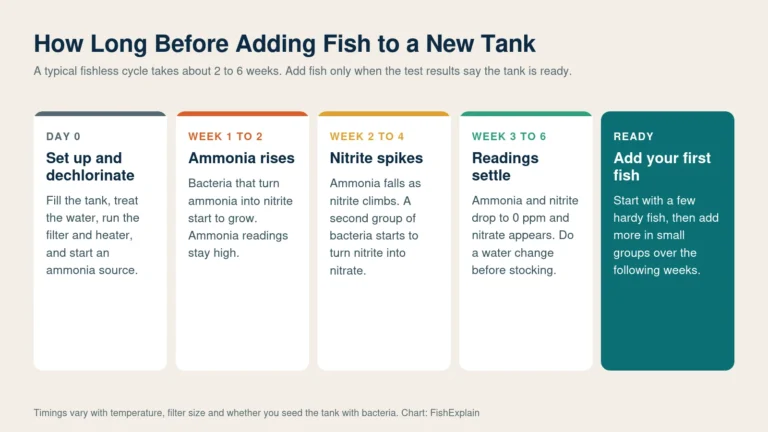
How Long to Wait Before Adding Fish to a New Tank
How long before adding fish to a new tank? Usually 2 to 6 weeks. Learn the water test results that mean it…
 Aquarium Care
Aquarium pH: How to Raise or Lower pH Safely
Aquarium pH guide: ideal ranges for freshwater fish, how KH keeps pH stable, and safe ways to raise or lower pH without…
 Aquarium Care
New Tank Syndrome: Signs, Causes and How to Prevent It
New tank syndrome kills fish in uncycled tanks. Learn the warning signs, what causes ammonia and nitrite spikes, and how to fix…