What Makes a Freshwater Fish Cool?
Cool freshwater fish are species that look, move or sense the world in ways most community fish do not. Some find food with weak electric fields, some breathe air, and some swim upside down or glide across the surface. This list covers 20 of the best unusual species, with their adult size, the tank they need and how hard they are to keep, so you can pick one that suits your setup instead of one that outgrows it.
If you are still choosing your first fish, start with our guide to the best freshwater fish for fish tanks. The species below are for keepers who want something different.
Unusual senses
Elephantnose fish and black ghost knifefish produce weak electric fields and read the changes around them to find food and move in the dark. Hillstream loaches cling to rocks in fast water, and archerfish knock insects off leaves with jets of water.
Strange shapes and behavior
Glass catfish have see-through bodies, ropefish look like small eels, and upside-down catfish feed belly-up under leaves and wood. These are the freshwater creatures that make visitors stop in front of a tank.
Cool does not have to mean difficult
Several unique freshwater fish on this list are hardy and small. Others need huge tanks or a specialist diet. The care level in each entry tells you which is which.
Cool Freshwater Fish at a Glance
Use this table to shortlist species by size and tank. Sizes are typical adult lengths in aquariums, and tank sizes are minimums for an adult, not a juvenile.
| Species | Adult size | Minimum tank | Care level |
|---|---|---|---|
| Celestial pearl danio | 1 in | 10 gal | Easy |
| Scarlet badis | 0.8 in | 10 gal | Moderate |
| Pea puffer | 1.25 in | 10 gal | Moderate |
| Marbled hatchetfish | 1.5 in | 20 gal long | Moderate |
| Glass catfish | 3 in | 30 gal | Moderate |
| Kuhli loach | 4 in | 20 gal | Easy |
| Reticulated hillstream loach | 2.5 in | 20 gal long | Moderate |
| Zebra pleco | 3 in | 20 gal | Advanced |
| Upside-down catfish | 4 in | 30 gal | Easy |
| Elephantnose fish | 9 in | 55 gal | Advanced |
| African butterflyfish | 5 in | 30 gal | Moderate |
| Ropefish | 15 in | 55 gal | Moderate |
| Senegal bichir | 12 in | 55 gal | Easy |
| Peacock eel | 12 in | 55 gal | Moderate |
| Leopard bush fish | 6 in | 40 gal | Moderate |
| Clown loach | 12 in | 125 gal | Moderate |
| Black ghost knifefish | 18 in | 125 gal | Advanced |
| Archerfish | 10 in | 75 gal, brackish | Advanced |
| Motoro stingray | 18 in disc | 180 gal or more | Expert |
| Silver arowana | 3 ft | 250 gal or more | Expert |
Cool Freshwater Fish for Small and Medium Tanks
These nine species stay small enough for tanks of 10 to 30 gallons, which makes them the easiest way to add something unusual without buying a new aquarium.
1. Celestial pearl danio (Danio margaritatus)
This tiny fish from Myanmar only reached the aquarium hobby in the mid 2000s. It has a dark blue body covered in pearl spots and bright orange fins. Keep a group of eight or more in a planted tank, and expect the males to spar and show off their fins. It also suits unheated rooms that stay in the low to mid 70s °F.
2. Scarlet badis (Dario dario)
At under an inch long, the scarlet badis is one of the smallest fish in the hobby. Males are striped in red and blue, while females are plain silver. It is shy and usually refuses flakes, so plan on live or frozen foods such as baby brine shrimp. Keep it in a calm nano tank with dense plants.
3. Pea puffer (Carinotetraodon travancoricus)
The pea puffer is a true freshwater pufferfish from southern India. It watches you through the glass, hunts snails and changes color with mood. It is also a fin nipper, so it does best in a species-only tank. Our freshwater puffer fish guide covers diet and tank setup in detail.
4. Marbled hatchetfish (Carnegiella strigata)
Hatchetfish have a deep, keel-shaped chest and a flat back, which lets them sit right under the surface. They can leap out of the water to escape danger, so a tight lid is essential. Keep at least six together with floating plants and gentle flow.
5. Glass catfish (Kryptopterus vitreolus)
The glass catfish is almost completely transparent, so you can see its spine through its body. It is a peaceful schooling fish that hangs in midwater, and a lone glass catfish often hides and stops eating. Keep a group of six or more with calm tank mates.
6. Kuhli loach (Pangio kuhlii)
Kuhli loaches look like small striped eels and spend the day burrowing in sand or tangled in plant roots. They are peaceful, hardy and fun to watch at feeding time. Keep five or more on a soft sand substrate.
7. Reticulated hillstream loach (Sewellia lineolata)
This flat, spotted loach looks like a tiny stingray stuck to the glass. It lives in fast mountain streams in Vietnam and grazes algae from rocks. Give it strong flow, high oxygen and water on the cooler side, around 68 to 75 °F.
8. Zebra pleco (Hypancistrus zebra)
The black and white stripes of the zebra pleco make it one of the most wanted catfish in the hobby. It comes from a short stretch of the Rio Xingu in Brazil, which restricts its export, so most fish on sale are captive bred and expensive. It needs warm, well oxygenated water, caves to hide in and meaty foods.
9. Upside-down catfish (Synodontis nigriventris)
This small catfish from the Congo basin spends much of its time swimming belly-up, feeding from the underside of leaves and wood. It is peaceful, hardy and happiest in a small group with plenty of driftwood.
Unique Freshwater Fish for Larger Tanks
These seven species need 40 gallons or more as adults. A large fish tank gives them room to move and keeps water quality stable as they grow.

10. Elephantnose fish (Gnathonemus petersii)
The elephantnose fish uses its long, trunk-like chin to probe sand for worms. It also produces a weak electric field to sense its surroundings, and researchers have found that its chin works like an electric fingertip for sensing objects. It needs soft sand, dim light, peaceful tank mates and a diet of bloodworms and other small invertebrates.
11. African butterflyfish (Pantodon buchholzi)
With wide pectoral fins that spread like wings, this surface hunter waits for insects to land on the water. It can jump, so the lid must fit tightly. Feed floating foods and keep it with fish too large to fit in its mouth.
12. Ropefish (Erpetoichthys calabaricus)
Ropefish are long, eel-like fish from West and Central Africa that breathe air from the surface. They are gentle with similar sized fish but will eat small tetras. They are also skilled escape artists, so seal every gap around the filter and heater cords.
13. Senegal bichir (Polypterus senegalus)
Bichirs belong to an ancient line of fish with simple lungs and a row of small dorsal finlets. The Senegal bichir is the hardiest of the group and a good first oddball fish. It hunts at night, so keep it with fish too big to swallow.
14. Peacock eel (Macrognathus siamensis)
This spiny eel has a pointed snout and a row of eyespots along its back fin. It buries itself in sand with only its head showing. Feed it bloodworms and other frozen foods, and use sand rather than sharp gravel.
15. Leopard bush fish (Ctenopoma acutirostre)
The leopard bush fish drifts slowly like a dead leaf, then lunges at small fish. Its spotted body and huge mouth give it a striking look. It suits a dim, heavily planted tank with tank mates too big to eat.
16. Clown loach (Chromobotia macracanthus)
Clown loaches are bright orange with black bands and make clicking sounds when they feed. They grow slowly but can reach about 12 inches, and they need a group of five or more. Plan for a tank of 125 gallons or more in the long run.
Exotic Freshwater Aquarium Fish for Experienced Keepers
These four exotic freshwater aquarium fish are amazing to see but demand large tanks, careful feeding and, in some cases, a legal check before you buy.
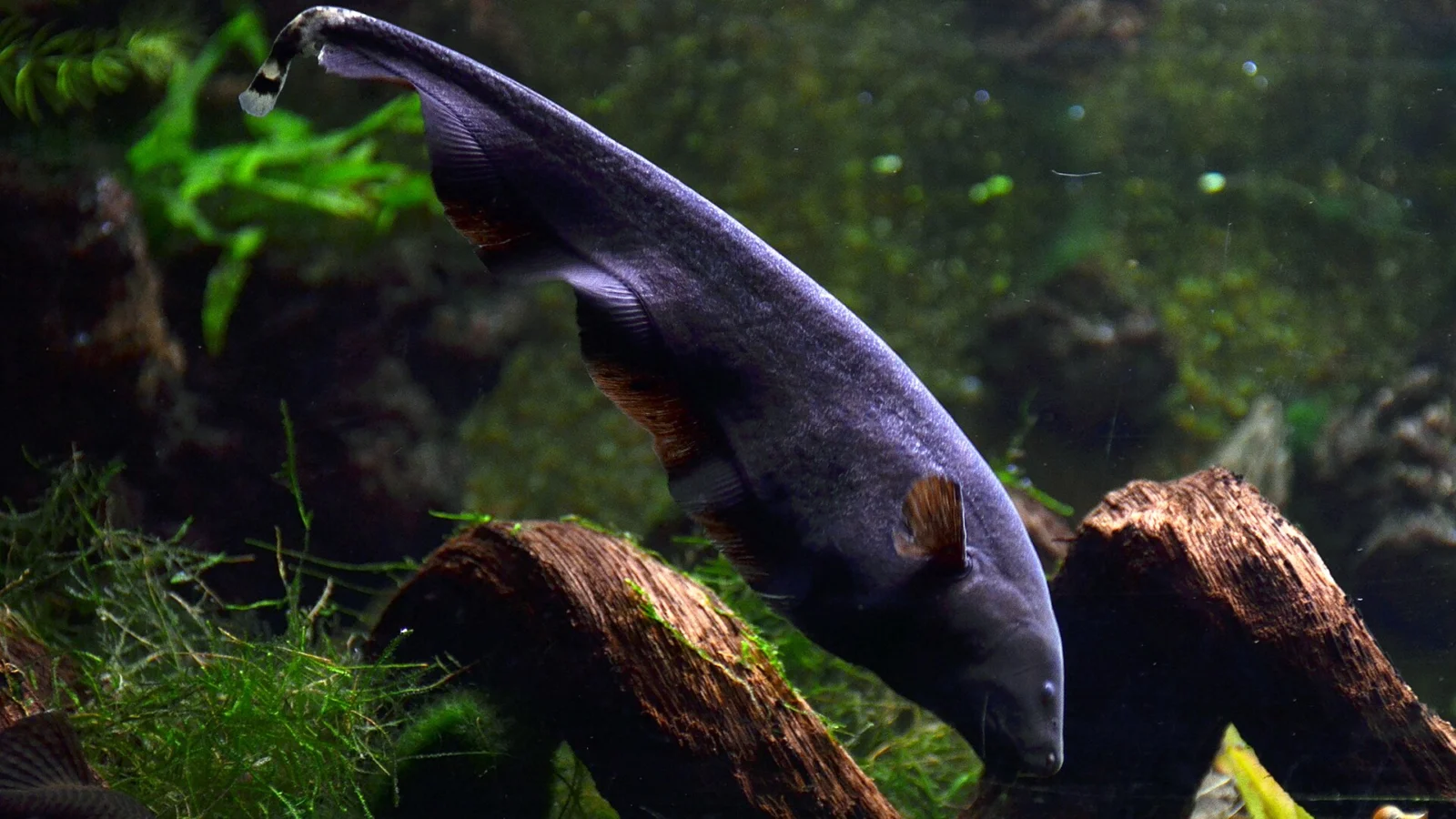
17. Black ghost knifefish (Apteronotus albifrons)
This velvet black fish from South America has no tail fin. It moves by rippling one long fin under its body and can swim backward as easily as forward. Like the elephantnose, it uses a weak electric field to hunt at night. It can reach about 18 inches and needs a long tank with tubes or caves to hide in.
18. Archerfish (Toxotes jaculatrix)
Archerfish shoot jets of water to knock insects off branches above the surface. Young fish tolerate fresh water, but adults do best in brackish water, so they need their own setup with a low water line and overhanging plants.
19. Motoro stingray (Potamotrygon motoro)
Freshwater stingrays are bottom dwellers with a venomous tail barb. The motoro grows a disc around 18 inches across and needs a tank with a very large footprint, spotless water and meaty foods. Some US states restrict or ban freshwater stingrays, so check with your state wildlife agency first.
20. Silver arowana (Osteoglossum bicirrhosum)
The silver arowana is a surface predator from the Amazon that can grow to about three feet and jump to catch prey. It is only suitable for very large custom tanks. Its relative, the Asian arowana, is protected under the US Endangered Species Act and cannot legally be kept as a pet in the United States.
How to Choose and Keep Unusual Freshwater Fish
Most problems with oddball fish come from buying a cute juvenile without planning for the adult. A little research up front saves both the fish and your budget.
Plan for the adult size
Ropefish, clown loaches and knifefish are often sold at two or three inches. Check the adult size in the table above and make sure your tank, filter and heater can handle it.
Check tank mates
Many unusual species are night hunters that eat anything that fits in their mouth. Others, such as pea puffers, nip fins. If you want a bold centerpiece with fewer surprises, a cichlid such as the severum fish gives lots of personality in a community of larger fish.
Feed specialists properly
Elephantnose fish, scarlet badis and pea puffers often ignore flakes. Stock frozen bloodworms, brine shrimp or live foods before you bring them home, and feed in the evening for nocturnal species.
Check the law before you buy
Stingrays, some large predators and a few invasive species are regulated in parts of the United States. Ask the store about the fish’s origin and confirm that it is legal where you live.
Cool Freshwater Fish FAQs
What is the coolest freshwater fish for a beginner?
The Senegal bichir, kuhli loach and upside-down catfish are hardy, unusual and forgiving. For small tanks, the celestial pearl danio is a colorful and easy choice.
What freshwater fish can breathe air?
Bichirs, ropefish and many labyrinth fish such as bettas and gouramis can gulp air from the surface. Air-breathing fish still need clean, oxygenated water and access to the surface.
What is the most exotic freshwater aquarium fish?
Freshwater stingrays, arowanas and black ghost knifefish are among the most exotic. They need very large tanks and experienced care, and some are regulated in parts of the US.
Are unusual freshwater fish hard to keep?
Some are, some are not. Kuhli loaches and upside-down catfish are easy, while elephantnose fish, zebra plecos and stingrays need stable water, special diets and large or specialized tanks.
Can cool freshwater fish live in a community tank?
Many can, including glass catfish, kuhli loaches and hatchetfish. Predators such as bichirs and leopard bush fish eat small fish, and pea puffers nip fins, so choose tank mates carefully.
Final Thoughts
Pick the fish that fits your tank
The best cool freshwater fish is one you can keep for its full life. For small tanks, celestial pearl danios, kuhli loaches and upside-down catfish add personality with little risk. For bigger setups, a Senegal bichir or ropefish brings a prehistoric look. Save stingrays and arowanas for when you have the space and experience. For more ideas, browse our guide to freshwater fish for fish tanks and our aquarium fish species section.