What Counts as a Large Fish Tank?
A large fish tank is usually any aquarium of 75 gallons or more. At that size you move past the usual beginner kits into tanks that weigh well over half a ton when full, need a purpose-built stand, and give you room for bigger fish, larger schools and proper aquascapes. The most popular large aquarium fish tank sizes in the US are the 75, 90, 120, 125, 150 and 180 gallon standards.
This guide compares those sizes, explains what each one suits, and walks through the setup and running costs so you can plan a big tank with confidence.
Why go big?
More water means more stability. Temperature, pH and waste levels change more slowly in 100 gallons than in 20, so small mistakes such as a missed feeding or a late water change do less harm. A large tank also lets you keep active swimmers and fish that grow past 5 or 6 inches, which would be cramped in a standard 55 gallon.
What changes at this size
The main differences are weight, equipment size and maintenance time. A fish tank large enough for big cichlids or a show planted tank needs a stronger stand, two heaters or one larger unit, a high-capacity filter and a reliable way to move a lot of water during changes. None of this is hard, but it needs planning before the tank arrives.
Large Fish Tank Sizes Compared
Standard glass tanks come in a small set of shapes. Most are either 48 inches long (75, 90 and 120 gallon) or 72 inches long (125, 150 and 180 gallon). The depth from front to back is what most changes how the tank looks and how much room fish have to turn.
Standard dimensions and weight
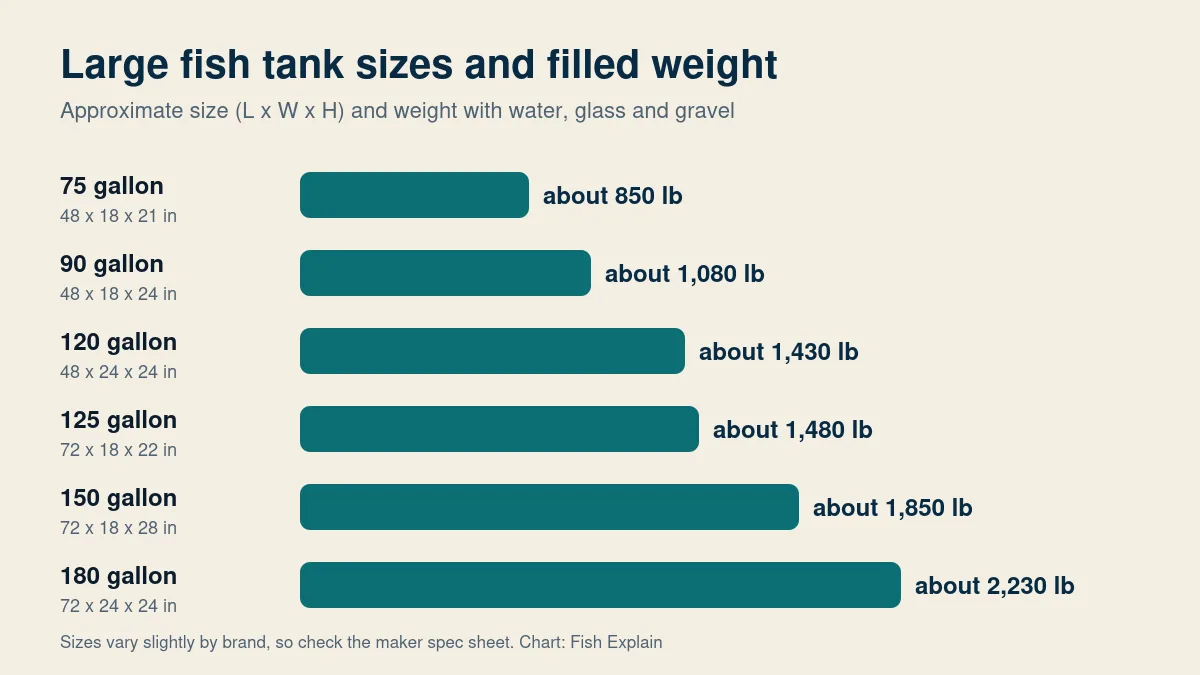
Sizes vary a little by brand, so always check the spec sheet for your exact model. The figures below are typical for standard glass tanks and include water, glass and a normal layer of gravel.
| Tank size | Typical size (L x W x H) | Approx. filled weight | Best for |
|---|---|---|---|
| 75 gallon | 48 x 18 x 21 in | About 850 lb | First large tank, community fish, mbuna |
| 90 gallon | 48 x 18 x 24 in | About 1,080 lb | Taller fish such as angelfish |
| 120 gallon | 48 x 24 x 24 in | About 1,430 lb | Aquascapes, wide rock work, groups of cichlids |
| 125 gallon | 72 x 18 x 22 in | About 1,480 lb | Long schools, fast swimmers, African cichlids |
| 150 gallon | 72 x 18 x 28 in | About 1,850 lb | Tall displays, larger fish |
| 180 gallon | 72 x 24 x 24 in | About 2,230 lb | Big fish, mixed communities, show tanks |
Length, depth or height: what matters most
For most fish, length and depth matter more than height. A 75 and a 90 gallon share the same 48 by 18 inch footprint, so the extra 15 gallons in the 90 is mostly height. That suits tall-bodied fish and plants, but bottom dwellers and fast swimmers get no extra floor space. The 120 gallon keeps the 4 foot length but adds 6 inches of depth, which makes aquascaping much easier. If your fish swim hard from end to end, a 6 foot tank such as the 125 is the better choice.

How to Choose the Right Large Aquarium Fish Tank
Start with the fish you want, then the space you have. Our fish tank buying guide covers tank types in general. For a large aquarium fish tank, these are the questions that decide the size.
Match the tank to your fish
- Big schools of small fish: a 75 gallon gives tetras, rasboras and rainbowfish plenty of swimming room.
- Angelfish and discus: taller tanks such as the 90 or 150 gallon suit their tall bodies and long fins.
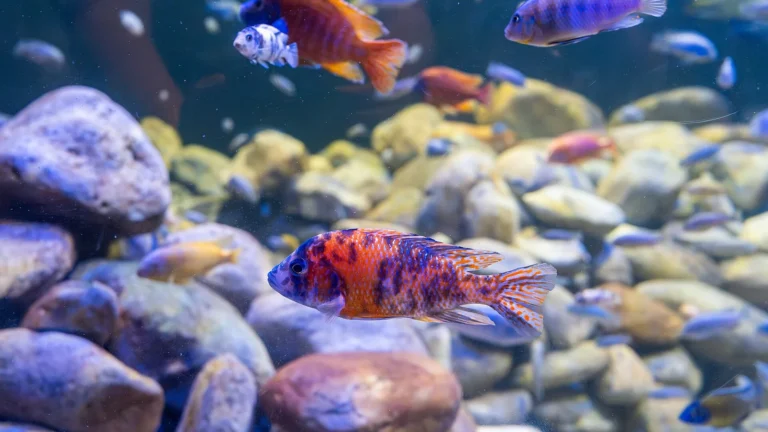
- African cichlids: active, territorial fish do best in 4 to 6 foot tanks with lots of rock. See our guide to African cichlids for species and stocking ideas.
- Large single fish: fish that reach a foot or more need the depth of a 120 or 180 gallon so they can turn around comfortably.
Glass or acrylic
Glass is cheaper, resists scratches and is the standard choice up to about 180 gallons. Acrylic weighs far less and is stronger against knocks, which helps with very large or unusual shapes, but it scratches easily when you clean it. For most home tanks in this size range, glass is the practical pick.
Open top or lidded
Large tanks are often sold without a lid. Many fish jump, especially cichlids, rainbowfish and hatchetfish, so plan for a glass lid or mesh cover. A lid also cuts evaporation, which saves top-up work and helps the heater.
Setting Up a Large Fish Tank
The setup steps are the same as for any tank, just on a bigger scale. Our step by step guide on how to set up a fish tank covers the full process. Here are the parts that need extra care with a big aquarium.
Stand and floor
According to the US Geological Survey, fresh water weighs about 8.3 pounds per gallon, so a full 125 gallon tank is heavier than many pianos. Use a stand rated for the tank, never ordinary furniture. Our guide to choosing a fish tank with stand explains weight ratings and leveling. Place the stand against a load-bearing wall with the long side across the floor joists, and ask a builder to check the floor if the tank will go upstairs.
Filtration
A common target is a filter that turns over the full tank volume about four to five times per hour. For a large tank, that usually means one or two canister filters or a sump. Two filters give you a backup if one fails. Our guide to the best fish tank filters compares the main types.
Heating
Tropical tanks need steady warmth. Splitting the wattage between two heaters at opposite ends spreads heat evenly and reduces the risk if one sticks on or fails. Our fish tank heater guide explains wattage and placement.
Moving water on maintenance day
A 25 percent water change on a 125 gallon tank is about 31 gallons, which is a lot of buckets. A long siphon hose that connects to a sink faucet makes changes far quicker. Always treat new tap water with a dechlorinator before it goes in.
Large Fish Tank Costs
The glass box is often the smallest part of the bill. Stands, filters, heaters, lighting, substrate, rock and the fish themselves add up fast, and running costs continue every month.
Setup costs
Prices vary widely by brand and region, so compare a few stores before you buy. Retailers such as Petco regularly run aquarium sales that cut the price of standard glass tanks, including larger sizes, so it can pay to wait for one. Budget for these items on top of the tank:
| Item | What to plan for |
|---|---|
| Stand | Rated for the full filled weight, often the second biggest cost |
| Filter | One or two canisters, or a sump with a return pump |
| Heaters | Two heaters for tropical tanks |
| Lid and light | Glass lid or mesh cover plus an LED light that spans the length |
| Substrate and rock | Large tanks need a lot, often 100 pounds or more |
| Water care | Test kit, dechlorinator, siphon hose and buckets |
Running costs: a worked example
Electricity is the main ongoing cost. The US Energy Information Administration projects an average US residential price of about 18.2 cents per kilowatt hour in 2026. Using that price, here is a simple estimate for a heated 125 gallon tank:
- Heaters: 400 watts in total, running about 6 hours a day in a warm room, uses 2.4 kWh a day, or about 72 kWh a month. That is about $13.
- Filter: a 30 watt canister running all day uses about 22 kWh a month, or about $4.
- Light: a 60 watt LED on for 8 hours a day uses about 14 kWh a month, or about $3.
That adds up to roughly $20 a month in power. A colder room, an open top or a higher local price will push it up. Food, water conditioner and replacement filter media are extra.
Stocking and Caring for a Large Tank
A big tank gives you more choice, but it does not remove the need to stock slowly and keep water clean.
Cycle first, then stock in stages
A new tank needs a colony of beneficial bacteria before it can handle fish waste, and our guide to the aquarium nitrogen cycle explains how that works. Cycle the tank first, then add fish in small groups over several weeks so the bacteria can keep up. Adding a full load of fish on day one is the most common way to lose fish in a new large aquarium.
Weekly routine
- Test ammonia, nitrite and nitrate, especially in the first few months.
- Change 20 to 30 percent of the water each week, or as your nitrate readings suggest.
- Clean the glass and vacuum the substrate in sections.
- Rinse filter sponges in old tank water, never under the tap, and stagger cleaning when you run two filters.
Common mistakes with large tanks
The most common problems are buying fish that outgrow even a big tank, skipping the stand check, and underestimating maintenance time. If the water turns hazy after setup, our guide to a cloudy fish tank explains the usual causes.
Large Fish Tank FAQs
What size is considered a large fish tank?
Most keepers treat 75 gallons and up as a large fish tank. Common large sizes are the 75, 90, 120, 125, 150 and 180 gallon standards, which are 48 or 72 inches long.
How much does a large fish tank weigh when full?
Plan for about 10 pounds per gallon once water, glass and gravel are included. A 75 gallon tank is about 850 pounds and a 125 gallon tank is close to 1,500 pounds when set up.
Is a 75 or 125 gallon tank better for beginners?
A 75 gallon is the easier first large tank because it is lighter, cheaper to equip and fits a 4 foot stand. A 125 gallon suits active fish that need a 6 foot swimming length.
Can my floor hold a large fish tank?
Most ground floors handle a 75 gallon tank without trouble. For larger tanks, or any big tank on an upper floor, place it against a load-bearing wall across the joists and ask a builder or structural engineer to check.
How much does it cost to run a large fish tank each month?
For a heated 125 gallon tank, power for heaters, a filter and an LED light often comes to around $20 a month at the average 2026 US electricity price. Colder rooms and higher local rates cost more.
Final Thoughts
Plan the space, then the fish
A large fish tank rewards careful planning. Pick the footprint that suits your fish, confirm the floor and stand can take the weight, and budget for filtration, heating and monthly power. Get those basics right and a 75 to 180 gallon tank is often easier to keep stable than a small one. For more equipment guides, visit our aquarium care section.