Rarest Fish in the World: The Short Answer
Most fish species number in the millions. A few number in the dozens. This guide covers 15 of the rarest fish in the world, from tiny spring fish to river giants. For each one, you will find its IUCN Red List status, where it lives, why it is rare and, when a reliable count exists, how many are left. We also explain what makes a fish rare, how conservation works and what the law says about keeping rare species in an aquarium.
The 15 Rarest Fish at a Glance
The table sums up all 15 species. Status comes from the IUCN Red List as shown on FishBase. CR means Critically Endangered, the highest risk level for species still living in the wild. EN means Endangered. Sizes are maximum lengths, so most fish stay smaller.
| Species | IUCN status | Where it lives | Max. size | Main threat |
|---|---|---|---|---|
| Devils Hole pupfish Cyprinodon diabolis | CR | One cave pool, Nevada | 1.3 in | Tiny habitat, falling water levels |
| Alabama cavefish Speoplatyrhinus poulsoni | CR | Key Cave, Alabama | 2.8 in | Groundwater change, loss of bat guano |
| Red handfish Thymichthys politus | CR | Two reef patches, Tasmania | 3.5 in | Urchin barrens, warming seas |
| Red-finned blue-eye Scaturiginichthys vermeilipinnis | CR | Desert springs, Queensland | 1 in | Invasive mosquitofish |
| Tequila splitfin Zoogoneticus tequila | EN | Teuchitlán River, Mexico | 3 in | Pollution, habitat loss |
| West Indian Ocean coelacanth Latimeria chalumnae | CR | Deep slopes, Comoros and East Africa | 6.6 ft | Deep-water bycatch |
| Mekong giant catfish Pangasianodon gigas | CR | Mekong River basin | About 10 ft | Overfishing, dams |
| Giant freshwater stingray Urogymnus polylepis | EN | Mekong, Chao Phraya, Borneo | 7.9 ft wide | Fishing, river damage |
| Ganges shark Glyphis gangeticus | CR | Rivers and estuaries, South Asia | 6.7 ft | Fishing, pollution |
| Smalltooth sawfish Pristis pectinata | CR | Atlantic coasts; U.S. mainly Florida | 18 ft | Bycatch, mangrove loss |
| Angelshark Squatina squatina | CR | East Atlantic; Canary Islands stronghold | 8 ft | Trawl bycatch |
| Chinese sturgeon Sinosturio sinensis | CR | Yangtze River and China’s coast | 11 ft | Dams, pollution |
| Adriatic sturgeon Huso naccarii | CR | Po River basin and Adriatic | 6.6 ft | Dams, past overfishing |
| Sakhalin taimen Parahucho perryi | CR | Sakhalin, Hokkaido, Russian Far East | 6.6 ft | Habitat loss, bycatch, poaching |
| Asian arowana Scleropages formosus | EN | Blackwater rivers, Southeast Asia | 3 ft | Collection, habitat loss |
Two sturgeons in the table were moved to new genera in 2025. You will still see them listed under their old name, Acipenser, in many sources.
15 of the Rarest Fish in the World
The list starts with species whose entire wild population fits in a single pool or reef and moves on to large fish that once filled whole river systems. The map shows where each one lives.

1. Devils Hole pupfish (Cyprinodon diabolis)
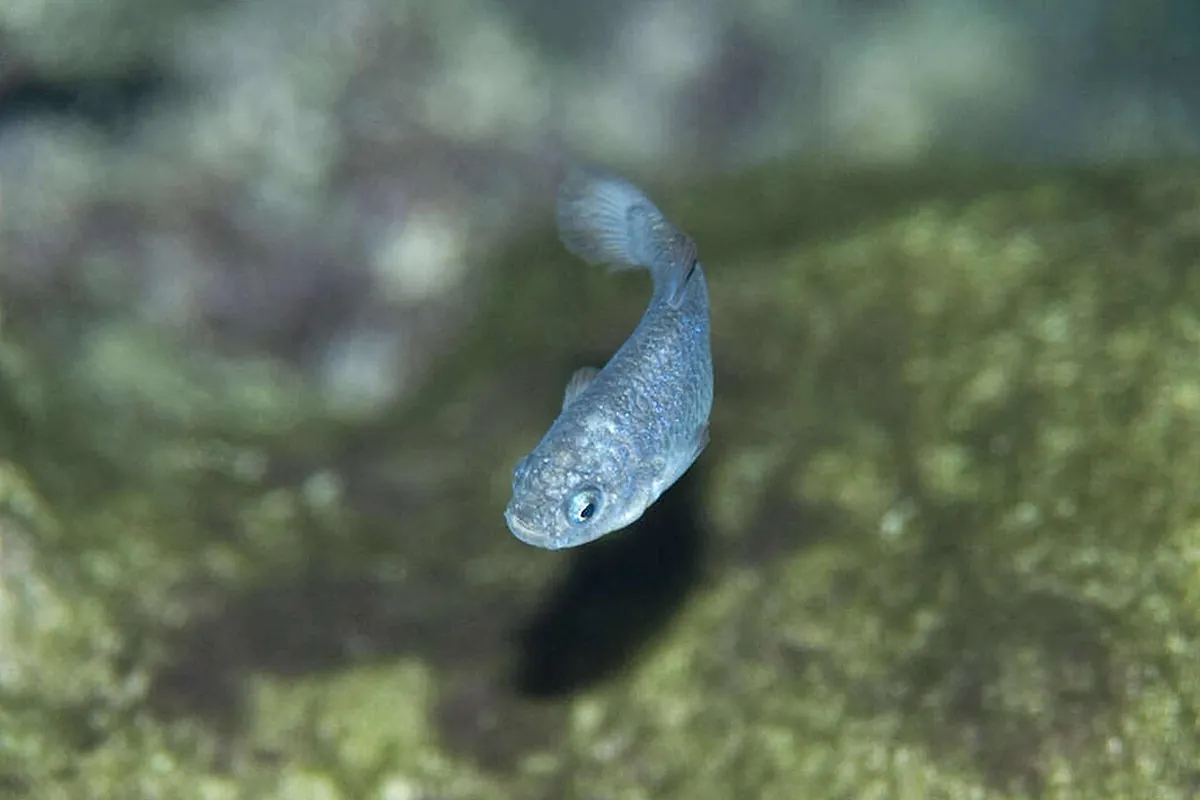
The Devils Hole pupfish lives in one place on Earth: Devils Hole, a deep, water-filled limestone cave in Ash Meadows, Nevada, managed as part of Death Valley National Park. It is a tiny fish, reaching about 1.3 inches, and breeding males turn bright blue. It feeds and spawns on a shallow rock shelf near the surface, so even small drops in water level hurt it.
Biologists count the population each spring and fall. In the mid-1990s, spring counts topped 200 fish. The count fell to 35 in 2013, climbed to 191 in spring 2024, then dropped to just 38 in spring 2025, according to a National Park Service news release. Spring 2026 brought a partial rebound to 77 fish. A backup population lives in a 100,000-gallon tank at the Ash Meadows Fish Conservation Facility, built to copy the cave.
Quick facts: CR · Devils Hole, Nevada · 1.3 in · 38 counted in spring 2025, 77 in spring 2026
2. Alabama cavefish (Speoplatyrhinus poulsoni)
The Alabama cavefish has no eyes and almost no color, so it looks pinkish white. It is known only from a few underground pools in Key Cave, in northwestern Alabama, now protected as Key Cave National Wildlife Refuge. Adults reach about 2.8 inches.
Scientists estimate that fewer than 100 Alabama cavefish exist, and surveys usually spot only a handful on each visit. The cave food web runs on guano from a colony of gray bats, so anything that harms the bats, such as white-nose syndrome, also threatens the fish. Changes in groundwater quality and level are the other big risk. The species has been listed as endangered under the U.S. Endangered Species Act since 1988.
Quick facts: CR · Key Cave, Alabama · 2.8 in · estimated fewer than 100
3. Red handfish (Thymichthys politus)
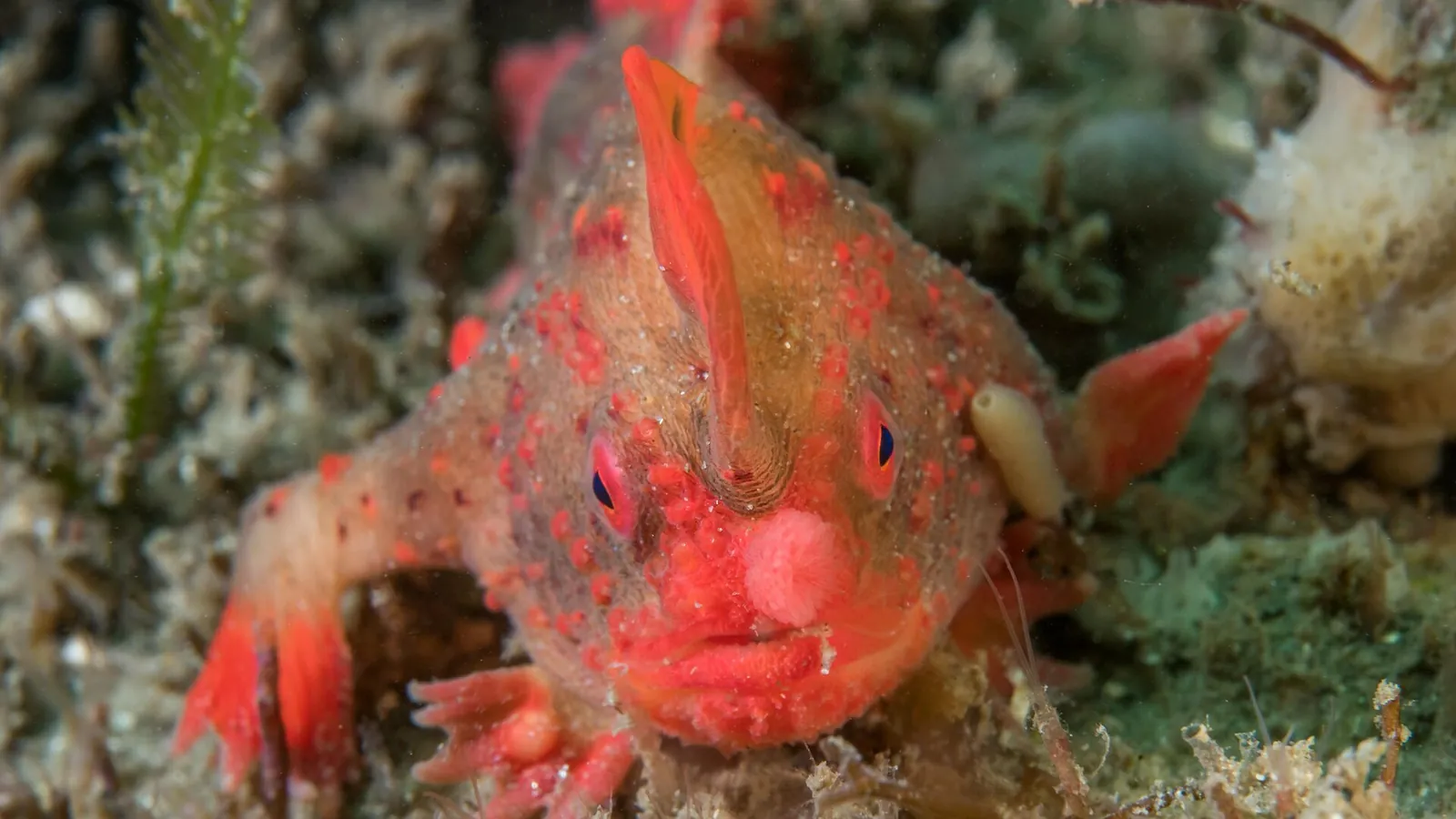
The red handfish is a small, lumpy anglerfish relative that “walks” over the seabed on handlike fins instead of swimming. It grows to about 3.5 inches. It was once locally common across southeastern and northern Tasmania. Today, only two known colonies remain in Frederick Henry Bay, near Hobart, and each lives on a reef patch no larger than a soccer field.
Researchers believe the two colonies hold about 100 adults. The main threats are sea urchins that strip reefs bare, warming seas, pollution from the shore and the risk of poaching for the aquarium trade. With so few breeding adults, one bad event could wipe out a colony.
Quick facts: CR · Frederick Henry Bay, Tasmania · 3.5 in · about 100 adults
4. Red-finned blue-eye (Scaturiginichthys vermeilipinnis)
The red-finned blue-eye is Australia’s smallest freshwater fish at about 1 inch long. Scientists described it in 1991. Its only wild home is a group of shallow springs fed by the Great Artesian Basin on Edgbaston Reserve in central western Queensland. Some of these pools are only about 3 inches deep, and the total area of springs holding the fish is under half a hectare, roughly 1.2 acres.
The biggest threat is the eastern gambusia, or mosquitofish, an invasive species that takes over springs and eats eggs and young. The blue-eye has already disappeared from seven springs after gambusia arrived. Bush Heritage Australia, which owns the reserve, has fenced springs, moved fish to new pools and set up captive-bred insurance groups. Its captive-bred stock on the property has grown from 180 fish in 2018 to an estimated 250 to 500.
If you keep small fish, this species is smaller than many favorites in our list of the best nano fish for small tanks.
Quick facts: CR · Edgbaston springs, Queensland · about 1 in · wild habitat under half a hectare
5. Tequila splitfin (Zoogoneticus tequila)
The tequila splitfin is a small livebearer from the Teuchitlán River near Guadalajara, Mexico. Males reach about 2.4 inches and females about 3 inches. Scientists described it in 1998. A wild group of fewer than 50 adults was found in 2001, but it later died out, and the species survived only in aquariums.
Researchers at the Universidad Michoacana in Mexico bred thousands of fish in a large outdoor pond, then released them back into the river. The reintroduced population grew to more than 800 fish. Thanks to that work, the IUCN moved the species from Critically Endangered to Endangered in 2019.
Quick facts: EN · Teuchitlán River, Jalisco · up to 3 in · more than 800 after reintroduction

6. West Indian Ocean coelacanth (Latimeria chalumnae)
Coelacanths were known only from fossils until a fishing boat landed one off South Africa in 1938. Since then, the species has been found off the Comoros, Madagascar, Mozambique and South Africa. The best known population lives on steep volcanic slopes off Grand Comoro and Anjouan. A second species lives in Indonesia.
The FishBase profile of the coelacanth lists it at depths of about 490 to 2,300 feet, most often 590 to 820 feet. It can reach about 6.6 feet and 210 pounds. It breeds very slowly, and females may give birth only every two or three years. That means even a few fish caught by accident in deep-water gear can hurt the population. It is listed on CITES Appendix I, which bans commercial international trade.
Quick facts: CR · Comoros and East Africa · 6.6 ft · lives 490 to 2,300 ft deep

7. Mekong giant catfish (Pangasianodon gigas)
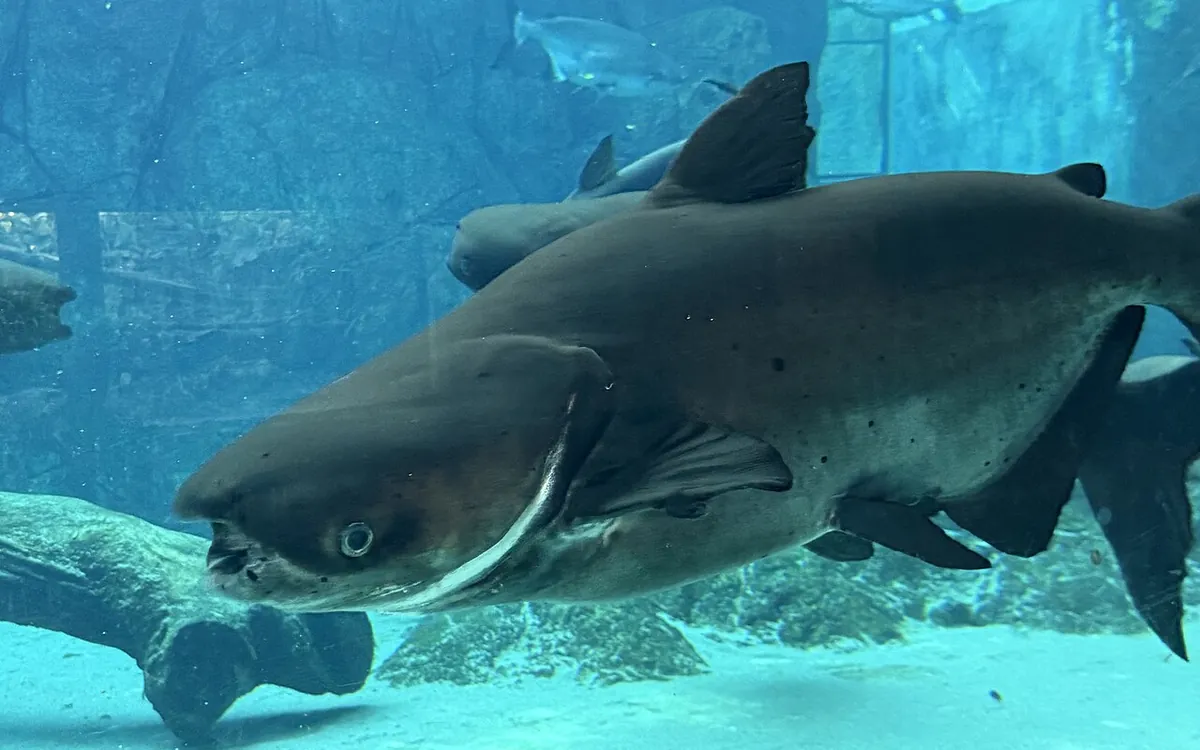
The Mekong giant catfish is one of the largest freshwater fish on Earth. FishBase lists a maximum weight of about 770 pounds, and a female caught in Thailand in 2005 weighed 646 pounds. Adults have no teeth and feed mostly on algae.
The fish once ranged along most of the Mekong, from Vietnam to China’s Yunnan Province. Today, it survives in small, scattered groups, mainly in the middle Mekong and Cambodia’s Tonlé Sap system. Overfishing and dams that block its spawning migrations are the main threats. It is listed on CITES Appendix I.
Quick facts: CR · Mekong basin · up to about 10 ft · migrates upstream to spawn
8. Giant freshwater stingray (Urogymnus polylepis)
This huge, flat ray lives on sandy and muddy bottoms in large rivers and estuaries of Southeast Asia and Borneo. FishBase lists a maximum width of about 7.9 feet. In June 2022, a female caught and released in the Mekong in Cambodia weighed about 660 pounds, making it the largest freshwater fish ever recorded.
Females give birth to only one to four pups at a time. Heavy fishing and damage to its river habitat have caused steep declines, at least in central Thailand and Cambodia. Its long tail carries a venomous spine, so fishers handle it with care.
Quick facts: EN · Mekong, Chao Phraya and Borneo rivers · up to 7.9 ft across · 1 to 4 pups per litter
9. Ganges shark (Glyphis gangeticus)
The Ganges shark is a true river shark. It lives in the Ganges and Hooghly river systems of India and Bangladesh, with records from other rivers and estuaries around the northern Indian Ocean. It reaches about 6.7 feet. Its tiny eyes suggest it hunts in murky, silty water.
Scientists know very little about its biology, and confirmed records are scarce. It is often confused with the bull shark, which also enters rivers. Fishing pressure and the decline of its river habitat are the main threats. The IUCN assessed it as Critically Endangered in 2021, and it is listed on CITES Appendix II, so international trade needs permits.
Quick facts: CR · Ganges and Hooghly rivers · 6.7 ft · biology poorly known
10. Smalltooth sawfish (Pristis pectinata)
Sawfish are rays with a long, flat snout edged with teeth, called a rostrum. The smalltooth sawfish has 20 to 32 teeth on each side. It once lived along Atlantic coasts from the United States to Uruguay and West Africa. It has vanished from much of that range, and the largest confirmed fish was about 18 feet long.
In the United States, it now lives mainly off southwest Florida, where young sawfish shelter in shallow mangrove nurseries. The U.S. population has been listed as endangered under the Endangered Species Act since 2003, and NOAA states that it is illegal to catch or harm one. Coastal development and bycatch in nets and on hooks are the main threats. The species is also listed on CITES Appendix I.
Quick facts: CR · Atlantic coasts, mainly Florida in the U.S. · 18 ft · nursery areas in mangroves

11. Angelshark (Squatina squatina)
The angelshark looks like a cross between a shark and a ray. It lies buried in sand with only its eyes showing, then snaps up passing fish. Females can reach about 8 feet. It was once common across the northeast Atlantic, from Scandinavia to northwest Africa, and in the Mediterranean and Black Seas.
Because it sits still on the seabed, it was caught in large numbers by bottom trawls and nets. FishBase notes that its range and numbers have declined severely across its whole range. The Canary Islands are now considered its most important stronghold.
Quick facts: CR · East Atlantic, Mediterranean and Canary Islands · 8 ft · ambush hunter on sand

12. Chinese sturgeon (Sinosturio sinensis)
The Chinese sturgeon is one of the largest sturgeons in the world, with adults reaching 6.6 to 16 feet and up to about 1,100 pounds. It lives along China’s coast and once swam about 2,000 miles up the Yangtze to spawn.
Dams changed everything. The Gezhouba Dam, built in the early 1980s, cut adults off from their old spawning grounds upstream. Pollution and changes in river temperature added to the damage. The World Sturgeon Conservation Society reports that the last recorded natural spawning, in 2015, involved only 22 fish. China now protects the species strictly and releases hatchery-raised young into the Yangtze.
Quick facts: CR · Yangtze River and China’s coast · up to 16 ft · 22 fish in the last recorded natural spawning
13. Adriatic sturgeon (Huso naccarii)
The Adriatic sturgeon lives in the Adriatic Sea and the lower reaches of rivers that drain into it, especially the Po River in northern Italy. It can pass 6.6 feet. Unlike many sturgeons, it spends most of its life in rivers rather than at sea.
Dams, past overfishing and pollution pushed it so close to the edge that the IUCN once listed it as Extinct in the Wild. In 2022, it was moved back to Critically Endangered after young fish were found in a northern Italian river. That likely shows natural breeding by fish released during decades of restocking. It is a small sign of hope, but the wild population is still tiny.
Quick facts: CR · Po River basin and Adriatic Sea · over 6.6 ft · once listed Extinct in the Wild
14. Sakhalin taimen (Parahucho perryi)
The Sakhalin taimen is a large, ancient member of the salmon family. It lives in rivers, lakes and coastal waters of Sakhalin Island, the Kuril Islands and the Russian Far East, plus Hokkaido in Japan. Some fish stay in fresh water, while others move between rivers and the sea. It is a top predator that eats other fish.
The species matures slowly and has lost much of its habitat to logging, farming and oil and gas development. Bycatch in salmon fisheries, poaching and trophy fishing add pressure. The IUCN assessment estimated that it survives at less than 5% of its historic numbers.
Quick facts: CR · Sakhalin, Hokkaido and Russian Far East · up to 6.6 ft · under 5% of historic numbers
15. Asian arowana (Scleropages formosus)
The Asian arowana, or dragon fish, lives in slow, tea-colored blackwater rivers and swamps in Southeast Asia. It grows to about 3 feet. Its long body and large scales give it a dragon-like look, and red and gold color forms are highly prized, especially in East Asia.
Demand from collectors and the loss of forest swamps drove wild numbers down. The species is listed as Endangered and is on CITES Appendix I. Legal international trade now comes from registered captive-breeding farms, but wild populations remain under pressure.
Quick facts: EN · Southeast Asian blackwater rivers · 3 ft · CITES Appendix I
What Makes a Fish Rare?
Rarity is not just about low numbers. A fish can be rare because its home was always tiny, or because people pushed a once-common species to the edge. Most fish on this list face more than one of these problems.
A Tiny Natural Range
The Devils Hole pupfish, Alabama cavefish and red-finned blue-eye each evolved in one isolated habitat. Their numbers were never huge, and they have nowhere else to go if that habitat changes. A dry year, a falling water table or one invasive species can be enough to push them toward extinction. Many lake fish face a milder version of the same risk. Most Lake Malawi cichlids in our guide to African cichlids live nowhere else on Earth.
Slow Growth and Late Breeding
Sturgeons, sawfish, coelacanths and taimen live long and breed late. The Sakhalin taimen takes years to mature, and coelacanths give birth only every few years. A species like this cannot bounce back quickly once adults are removed.
Dams and Blocked Migrations
Big river fish such as sturgeons and the Mekong giant catfish travel long distances to spawn. Dams block those routes and change water flow and temperature. In 2022, the IUCN reported that the Chinese paddlefish, another Yangtze giant, is extinct.
Fishing and Bycatch
Flat, slow or bottom-dwelling fish are easy to catch by accident. Angelsharks, sawfish and giant stingrays all suffer heavy bycatch. A sawfish’s toothed snout tangles easily in nets.
Invasive Species and Habitat Change
Introduced predators and competitors can wipe out small populations fast. Mosquitofish in Australia’s springs are one example. On the reefs of Tasmania, urchin barrens have removed the cover and food that red handfish need.
How the IUCN Red List Ranks Rare Fish
The International Union for Conservation of Nature (IUCN) runs the Red List, the main global system for rating extinction risk. Experts assess each species against set rules, such as how fast it is declining, how small its range is and how many mature adults remain.
- Least Concern and Near Threatened: not currently at high risk.
- Vulnerable: high risk of extinction in the wild.
- Endangered: very high risk. The tequila splitfin, giant freshwater stingray and Asian arowana sit here.
- Critically Endangered: extremely high risk. Twelve of the 15 fish on this list are in this category.
- Extinct in the Wild: survives only in captivity. The Adriatic sturgeon was once listed here, and the tequila splitfin lived only in aquariums for years.
- Extinct: no individuals remain.
Some assessments are old. The coelacanth was last assessed in 2000 and the Sakhalin taimen in 2006, so their real status may differ today. Being hard to see is also not the same as being rare. Many deep-sea fish are seldom seen only because people rarely visit their habitat.
How Rare Fish Are Being Saved
Several species on this list still exist because of focused rescue work. Most programs combine four tools.
Captive Insurance Populations
Backup groups in captivity protect a species if the wild population crashes. The Devils Hole pupfish has a purpose-built refuge tank near the cave. The tequila splitfin survived entirely in captivity before it was returned to its river. Captive-bred red-finned blue-eyes now help restock Edgbaston’s springs.
Protecting the Habitat
No fish recovers if its home keeps degrading. Key Cave is closed to the public and protected as a wildlife refuge. On Edgbaston Reserve, livestock were removed, feral pigs controlled and barriers installed to keep mosquitofish out of key springs.
Fishing and Trade Rules
Laws stop the killing and limit the trade. In the United States, it is illegal to catch or harm an endangered smalltooth sawfish. CITES, the global treaty on wildlife trade, bans commercial international trade in wild Appendix I species such as the coelacanth, Mekong giant catfish and sawfish.
Restocking Rivers
Hatcheries raise young fish and release them into the wild. China releases young Chinese sturgeon into the Yangtze, and Italy’s restocking of the Adriatic sturgeon is starting to show signs of natural breeding.
Can You Keep Rare Fish in an Aquarium?
For almost every fish on this list, the answer is no. Most are protected by national law, many are on CITES Appendix I, and several grow far too large for a home tank. A few rare species are kept by hobbyists, but only through legal, captive-bred sources.
What CITES Means for Fishkeepers
- Appendix I: commercial international trade in wild fish is banned. Captive-bred fish from registered facilities can be traded with permits. Examples: Asian arowana, coelacanth, Mekong giant catfish and sawfish.
- Appendix II: trade is allowed but needs permits to make sure it is legal and sustainable. All sturgeons and the Ganges shark are listed here.
- Not listed: many rare fish are not on CITES at all, but national laws still protect them. The Devils Hole pupfish and Alabama cavefish are covered by the U.S. Endangered Species Act.
U.S. Rules and the Asian Arowana
The Asian arowana is the rare fish most fishkeepers ask about. It is widely kept in Asia, where farms registered with CITES sell microchipped fish with certificates. In the United States, however, the species has been listed as endangered under the Endangered Species Act since 1976, and imports have been banned since then. A trade group petitioned the U.S. Fish and Wildlife Service in 2025 to allow imports of farm-bred fish, but no change has been reported. Until the rules change, a U.S. hobbyist cannot legally buy one. Federal law also makes it a crime to trade fish taken or sold in breach of other wildlife laws.
Even legal “monster fish” are a huge commitment. Our guide to freshwater puffer fish shows how a large species such as the mbu puffer can need a tank of about 500 gallons.
Hobbyists Who Help Rare Fish
Home aquarists can play a real part. The tequila splitfin survived because people kept it in tanks and ponds. In Europe, the Citizen Conservation program links private keepers with zoos and other institutions to maintain reserve populations of threatened fish. These programs track every fish, share husbandry notes and keep careful breeding records.
How to Choose Fish Responsibly
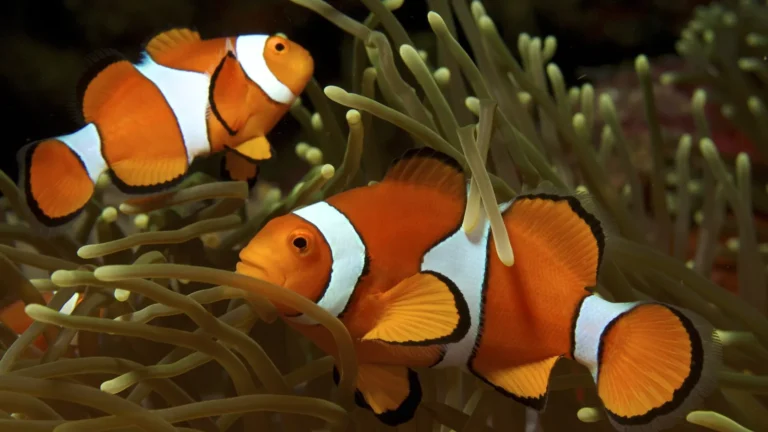
- Buy captive-bred fish whenever possible. Most popular marine species are still wild caught, but clownfish are a good exception, as our clownfish care guide explains.
- Ask the seller for the scientific name and the fish’s origin. Avoid wild-caught rarities with no paperwork.
- Choose species that suit your tank for their whole life. Our overview of cichlid fish types compares adult sizes and needs.
- Never release aquarium fish into the wild. Introduced fish are one of the reasons species like the red-finned blue-eye are in trouble.
Rarest Fish FAQs
What is the rarest fish in the world?
The Devils Hole pupfish is usually named the rarest fish in the world. Its entire wild population lives in one cave pool in Nevada. Biologists counted only 38 fish in spring 2025 and 77 in spring 2026. The red handfish, with about 100 adults, and the Alabama cavefish, with an estimated fewer than 100, are close contenders.
How many Devils Hole pupfish are left?
Biologists counted 38 Devils Hole pupfish in spring 2025, one of the lowest counts on record. The spring 2026 count rose to 77. Numbers swing from year to year, so a backup population is kept at the Ash Meadows Fish Conservation Facility in a large tank designed to copy the cave.
Is the coelacanth still alive today?
Yes. Coelacanths were known only from fossils until one was caught off South Africa in 1938. Two living species are known. The West Indian Ocean coelacanth lives on deep slopes off the Comoros and East Africa and is listed as Critically Endangered. The second species lives in Indonesian waters.
Can you legally own a rare fish?
Usually not. Most fish on this list are protected by national laws or listed on CITES Appendix I, which bans commercial international trade in wild fish. Some rare species, such as the Asian arowana, are farmed and sold legally in parts of Asia, but U.S. law has banned arowana imports since 1976.
Why are sturgeons so endangered?
Sturgeons grow slowly, breed late and often migrate long distances up rivers to spawn. Dams block those routes, and demand for their eggs as caviar led to heavy fishing. In 2022, an IUCN assessment found that most sturgeon species are threatened and that the Chinese paddlefish, a close relative, is extinct.
What is the largest rare freshwater fish?
The giant freshwater stingray holds the record. In June 2022, a female weighing about 660 pounds was caught and released in the Mekong River in Cambodia. Before that, the record belonged to a Mekong giant catfish of 646 pounds, caught in Thailand in 2005. Both species are threatened with extinction.
How can aquarium keepers help rare fish?
Buy captive-bred fish when you can, and ask sellers for scientific names and origins. Never release aquarium fish or plants into the wild, since invasive species harm rare natives. You can also join a species program or hobby group that keeps threatened fish in carefully tracked breeding populations.