Molly Fish Care: Types, Tank Setup and Breeding
Molly fish care is easy if you match their water. Keep mollies in a cycled tank of at least 20 gallons (29 gallons or more for sailfins) at 75 to 80°F, with hard, alkaline water: pH 7.5 to 8.5 and high GH and KH. Feed a mix of quality flakes and plant based foods once or twice a day, keep two to three females for every male, and expect live fry every 30 to 60 days. With good care, mollies live about 3 to 5 years.
Mollies are lively, colorful livebearers that suit most community aquariums. They graze algae, accept almost any food and breed without help. Good molly fish care comes down to one thing many beginners miss: mollies need harder, more alkaline water than most tropical fish.
This guide covers molly fish types, tank size, water, diet, tank mates and what to expect when a molly fish is pregnant. If you already keep guppies, much of it will feel familiar, so see our guppy care guide too, and browse every species profile in our aquarium fish section.
Molly Fish Care Facts at a Glance
The molly fish is not one species. The name covers several members of the genus Poecilia that live in fresh, brackish and coastal waters from the southern United States to Colombia, plus the many hybrids bred for the aquarium trade.
| Trait | Details |
|---|---|
| Common species | Poecilia sphenops, P. latipinna, P. velifera and hybrids |
| Adult size | About 3 to 5 inches, sailfins grow larger |
| Lifespan | About 3 to 5 years |
| Temperament | Peaceful and active |
| Minimum tank | 20 gallons, 29 gallons or more for sailfins |
| Temperature | 72 to 82°F, best at 75 to 80°F |
| pH | 7.5 to 8.5 |
| Water hardness | Hard, GH 12 to 25 dGH |
| Diet | Omnivore with a big appetite for plant matter |
| Breeding | Livebearer, gives birth to free swimming fry |
Are Mollies Good for Beginners?
Yes, as long as your tap water is moderately hard or you add minerals. Mollies forgive small mistakes in feeding and decor, but they react badly to soft, acidic water and to unstable conditions. If your local water is very soft, plan for that before you buy them.
Types of Molly Fish
Most mollies sold in US stores fall into a few groups. Care is almost identical for all of them, so choose by size and look.
Short-Fin (Common) Molly
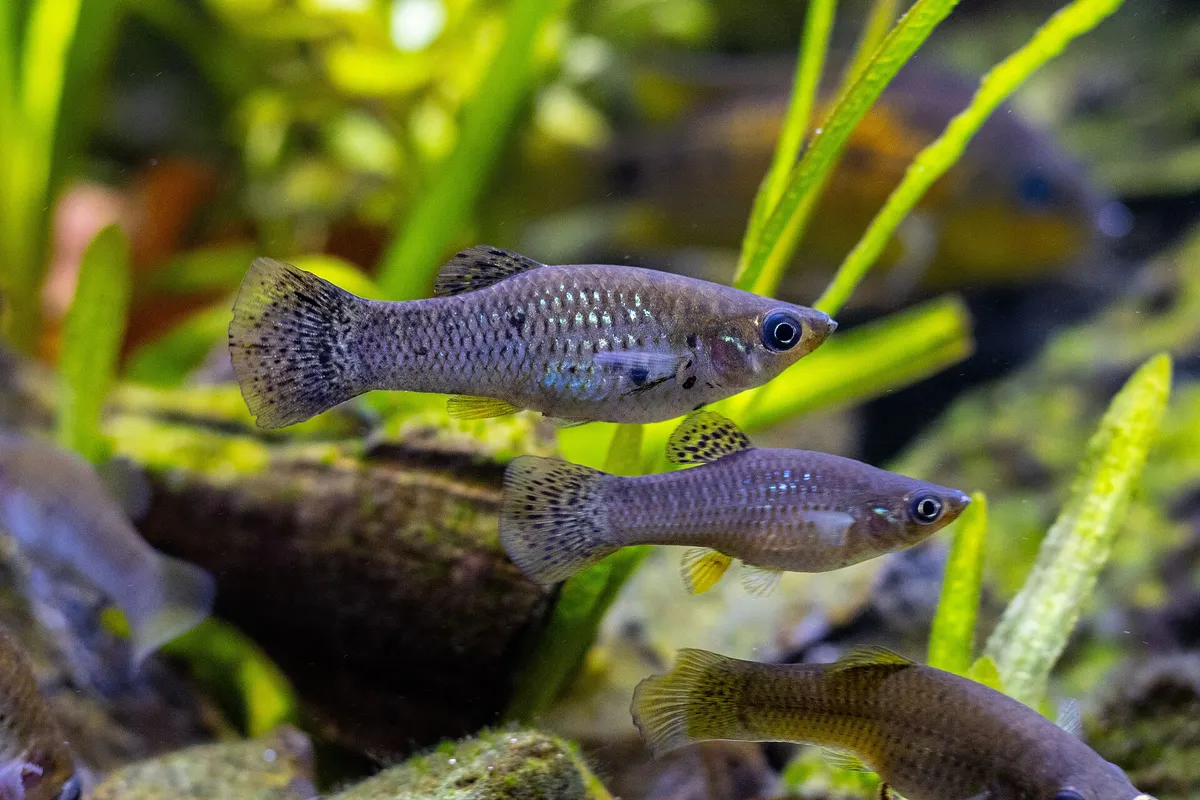
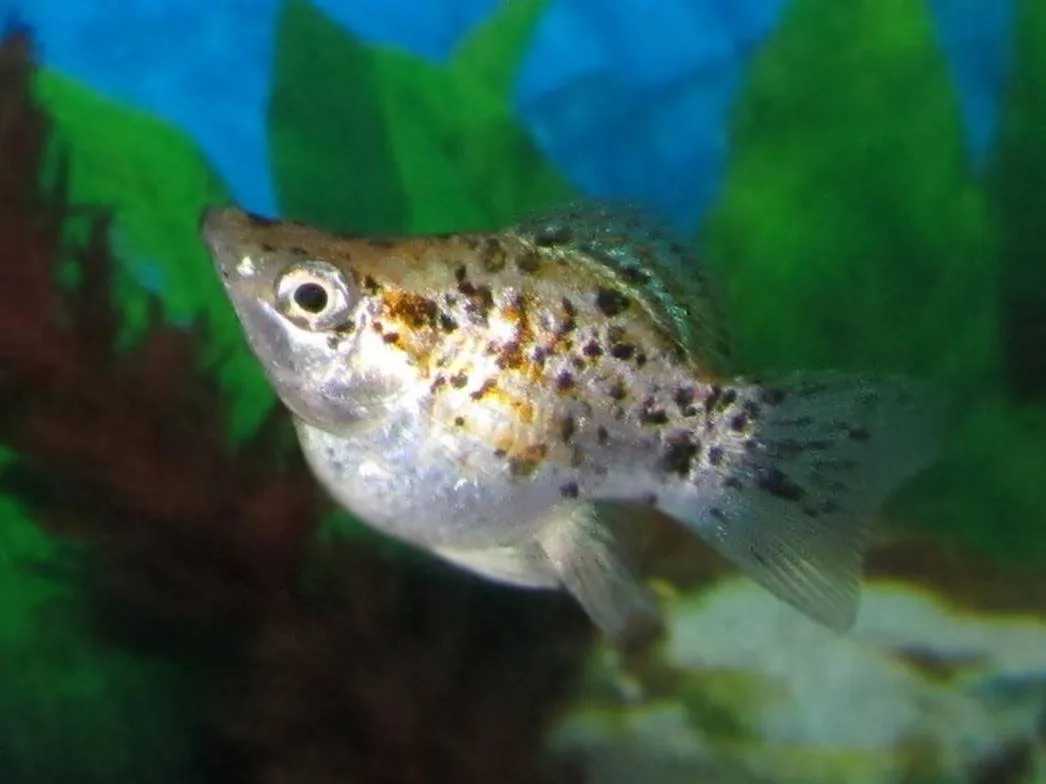
The short-fin molly, Poecilia sphenops, is the classic aquarium molly. It reaches about 3 to 4 inches and comes in black, silver, gold, dalmatian and many other colors. The all black form, often sold as the black molly, is one of the most popular freshwater fish in the hobby.
Sailfin Molly
Sailfin mollies (P. latipinna and the larger Yucatan sailfin, P. velifera) have a tall, flag shaped dorsal fin, most impressive on males. They grow bigger than short-fins and need more room, so give them at least a 29 gallon tank.
Balloon, Lyretail and Other Fancy Mollies
Balloon mollies are bred to have a short, rounded body and a curved spine. Lyretail mollies have long points on the top and bottom of the tail. Fancy forms like these are a little more delicate than wild type mollies, and balloon mollies can have trouble swimming if they are overfed.
Molly Fish Tank Size and Setup
A common question is the right molly fish tank size. Aquarium Co-Op recommends at least 20 gallons for most mollies and 29 to 55 gallons for the larger species. Mollies are active swimmers and produce a lot of waste, so a bigger tank keeps water quality steadier.
Stocking Example
A 20 gallon tank can hold a small group of short-fin mollies, for example one male and three females, plus a few bottom dwellers. In a 29 gallon tank you can keep a group of five or six mollies alongside a school of small fish. Remember that mollies breed fast, so leave room for growth or plan how you will rehome fry.
Heater and Filter
Most homes are cooler than mollies like, so use an adjustable heater set around 76 to 78°F. Our fish tank heater guide explains how to pick one. Choose a filter rated for your tank size or larger, and cover the intake with a pre filter sponge if you want fry to survive.
Plants and Decor
Mollies like open swimming space in the middle and top of the tank, with plants around the edges. Hardy plants such as anubias, java fern, hornwort and water sprite handle alkaline water well. Dense, fine leaved plants also give newborn fry places to hide from adults.
Molly Fish Water Parameters
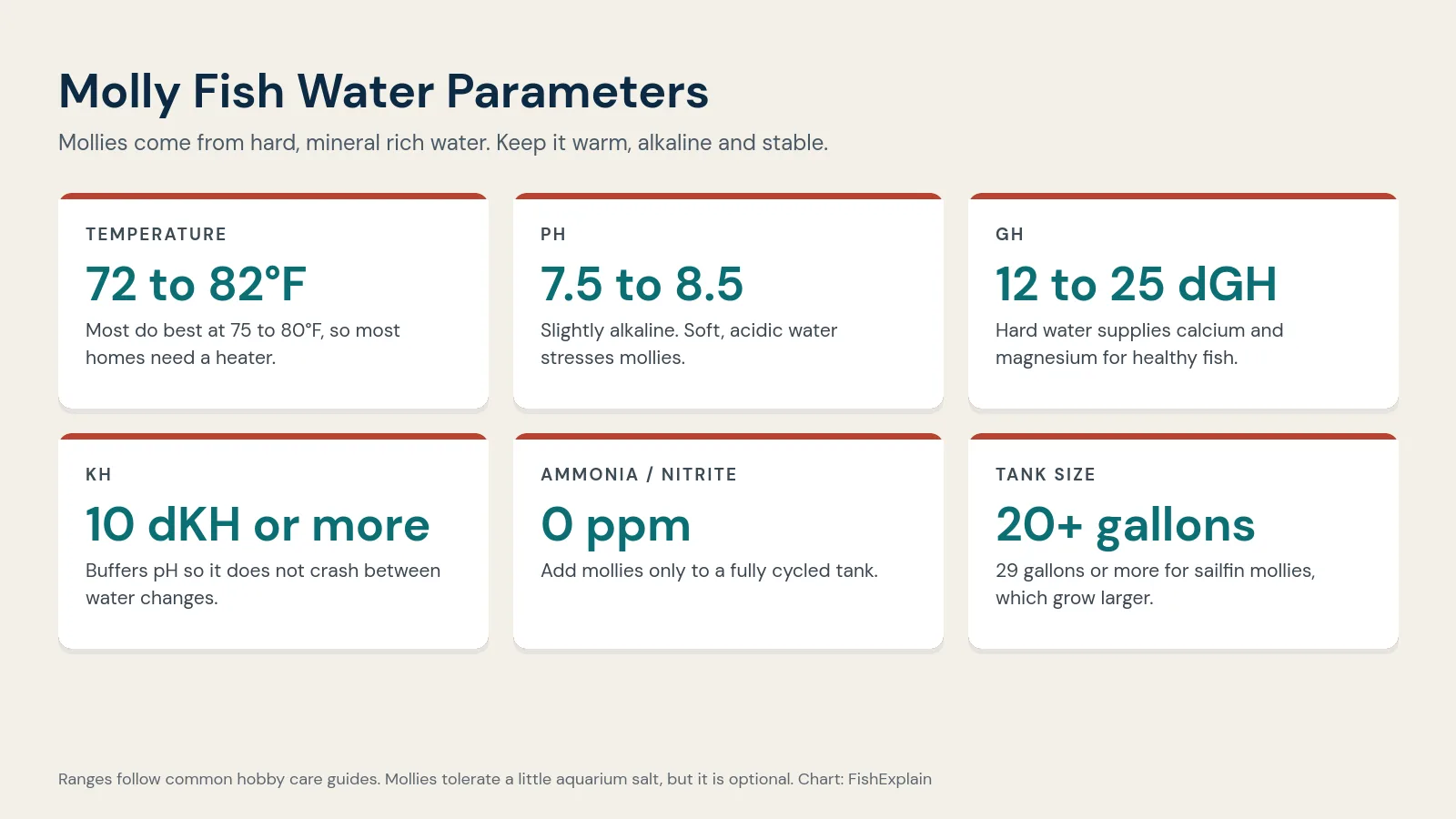
Water chemistry is the part of molly care that matters most. Mollies come from hard, mineral rich water, and many store mollies were raised in brackish ponds. Compare these targets with our general guide to aquarium water parameters.
Temperature
Mollies tolerate roughly 72 to 82°F, but they do best at 75 to 80°F. Cold water lowers their resistance to disease, and sudden drops in temperature are a common trigger for ich in mollies.
pH, GH and KH
Aim for a pH of 7.5 to 8.5, with high general hardness (GH) and carbonate hardness (KH). GH supplies calcium and magnesium, while KH keeps the pH from falling between water changes. If your tap water is soft, add a mineral supplement made for aquariums or crushed coral in the filter. Our aquarium pH guide shows how to raise and stabilize pH safely.
Do Mollies Need Salt?
No, mollies do not need salt in a freshwater tank with hard, alkaline water. Many keepers add a small amount of aquarium salt, but it is optional, and salt does not replace the minerals that GH and KH provide. Avoid salt if you keep scaleless fish, live plants that dislike salt, or tank mates such as corydoras.
Water Changes
Change about 25 percent of the water each week, and match the temperature and dechlorinate the new water. Mollies eat a lot, so nitrate builds up faster than in a tank of small tetras. Steady, regular changes are safer than large, rare ones.
What Do Molly Fish Eat?
Mollies are omnivores with a strong taste for plant matter. In the wild they graze algae and small invertebrates, and in the aquarium they pick at algae on glass, rocks and plant leaves all day.
Best Foods for Mollies
- A high quality flake or small pellet as the base diet
- Spirulina or other plant based flakes several times a week
- Blanched zucchini, spinach or cucumber as a treat
- Frozen or live foods such as brine shrimp and daphnia once or twice a week
- Gel foods, which suit both adults and growing fry
How Often to Feed
Feed once or twice a day, only as much as the fish finish in about two minutes. Long, normal colored strings of waste trailing from your mollies are a sign of overfeeding. Fancy balloon mollies are the most prone to bloating, so feed them sparingly.
Molly Fish Tank Mates
Mollies are peaceful, but they are active and curious, and they nibble at anything that might be food. Choose tank mates that like similar warm, hard water and are close in size.
Good Tank Mates
- Platies, swordtails and other livebearers
- Corydoras and other peaceful bottom dwellers that tolerate harder water
- Zebra danios and other active, hardy schooling fish
- Many tetras and barbs that are not fin nippers
- Snails such as nerites, which also help with algae
For more ideas, see our list of tropical freshwater fish that share the same temperature range.
Tank Mates to Avoid
Avoid slow, long finned fish such as fancy guppies with very long tails or bettas, since mollies may pick at their fins. Large cichlids may eat mollies, and adult mollies will eat small shrimp such as cherry shrimp. Male mollies can also harass other livebearers, so keep plenty of females in the group.
Male vs Female Molly Fish
You can tell males and females apart by the anal fin. Males have a narrow, rod shaped fin called a gonopodium, which they use to fertilize females. Females have a fan shaped anal fin, a fuller belly and are often larger.
Best Male to Female Ratio
Keep two to three females for every male. Male mollies chase females almost constantly, and a higher number of females spreads that attention out and reduces stress.
Pregnant Molly Fish and Breeding
Mollies are livebearers. The female carries eggs inside her body and gives birth to fully formed, free swimming fry. Females can also store sperm and give birth several times from one mating, so a new female from the store may already be pregnant.
Signs a Molly Fish Is Pregnant
- The belly grows larger and looks boxy or square from the side
- The dark gravid spot near the anal fin gets bigger and darker
- She may hide more or stay near plants and the heater
- Close to birth, she may breathe faster and refuse food
Gestation and Number of Fry
A molly fish pregnant period usually lasts about 30 to 60 days, depending on temperature and species. A young female may give birth to only a handful of fry, while an experienced female can drop 50 or more at a time.
Caring for Molly Fry
Adult mollies eat their own young, so add dense plants or move the fry to a separate tank. Fry are large enough to eat crushed flakes, powdered fry food and baby brine shrimp right away. Feed them small meals several times a day, and expect them to take several months to reach a size you can sell or give away.
Common Molly Fish Health Problems
Most molly health problems trace back to water that is too soft, too cold or too dirty. Fix the water first, then treat the disease.
Shimmying
A molly that sways in place without swimming forward is showing a stress sign called shimmying. It is often linked to soft water, low temperature or poor water quality. Test GH, KH, pH and temperature, and correct them slowly.
Ich, Fungus and Fin Rot
White spots point to ich, cottony growths to fungus, and ragged fins to fin rot. Raise the temperature slightly for ich, improve water quality, and use a medication made for the problem. Quarantine new fish for two weeks and acclimate them slowly, as shown in how to acclimate fish, to keep disease out of the main tank.
Frequently Asked Questions
How many molly fish should be kept together?
Keep at least three to four mollies, with two to three females for every male. A group spreads out the males' attention and helps mollies feel secure.
What size tank do molly fish need?
Most mollies need at least a 20 gallon tank. Sailfin mollies grow larger and do better in 29 gallons or more.
How long are molly fish pregnant?
Molly gestation usually lasts about 30 to 60 days. Warmer water tends to shorten it.
Can mollies live with guppies?
Yes. Guppies and mollies share similar needs, but mollies prefer harder water and may nip very long guppy fins, so watch them closely.
Why is my molly fish shaking?
Shaking or shimmying is a stress sign, most often caused by soft water, cold water or high ammonia and nitrite. Test the water and correct the cause slowly.
Keep exploring
 Aquarium Fish
Cherry Shrimp Care: Tank Setup, Water Parameters and Breeding
Cherry shrimp care made easy: tank setup, ideal water parameters, feeding, molting, breeding and safe tank mates for a thriving colony.
 Aquarium Fish
Cheap Freshwater Fish: 15 Hardy Species That Cost Under $5
Cheap freshwater fish that stay hardy: 15 species under $5, with sizes, tank needs and a sample budget stocking plan for a…
 Aquarium Fish
Types of Freshwater Fish: 40 Species by Family, With Facts
Types of freshwater fish explained: 40 species across trout, bass, catfish, carp, cichlid, perch and more, with quick facts and where each…