Can Fish Blink? The Short Answer
Can fish blink? For almost every fish in your aquarium, pond or local lake, the answer is no. A goldfish, a betta or a tetra has no lids to shut, so its eyes stay open from the day it hatches until the day it dies. That is why people often think fish never sleep.
They do sleep. They simply rest in a way that looks very different from ours. This guide covers why fish skip eyelids, the handful of species that can cover their eyes, how fish vision works underwater and how to tell when your own fish is asleep.
- Most bony fish have no eyelids and no tear glands.
- Many sharks protect their eyes with a third eyelid called a nictitating membrane.
- Mudskippers, which spend much of their time on land, evolved a true blink.
- Fish rest every day, often in a hiding spot, with their eyes open the whole time.
Why Most Fish Have No Eyelids
Eyelids solve problems that land animals face. Fish live where those problems mostly do not exist.
Water does the work of tears
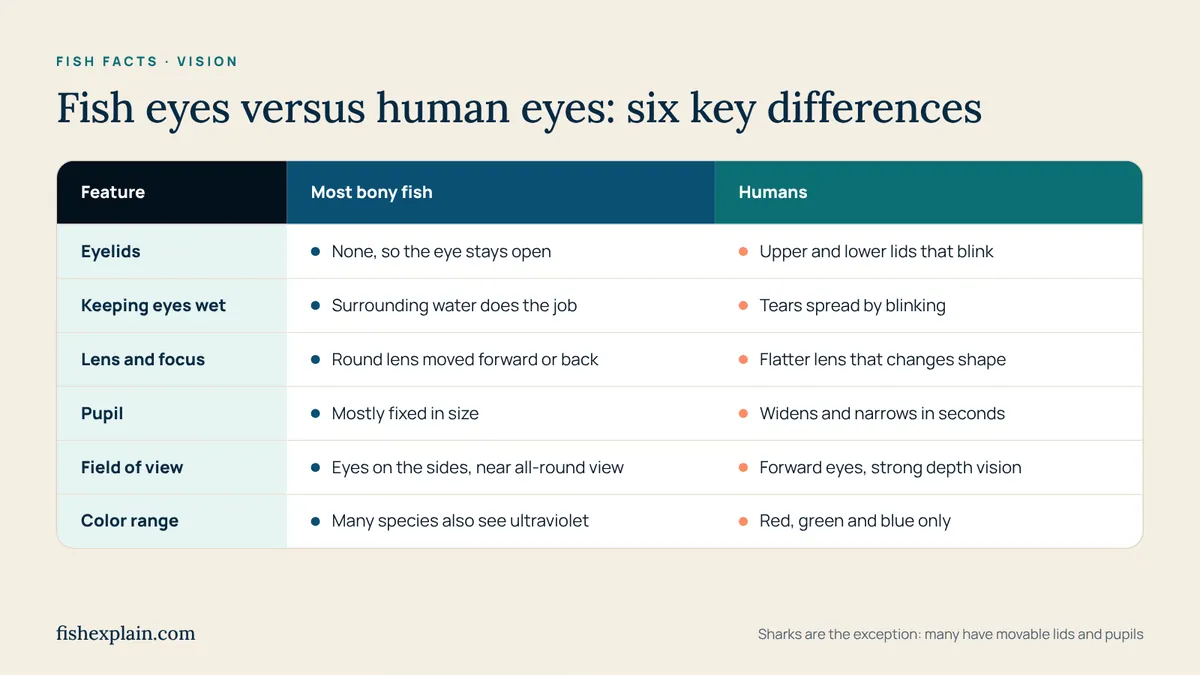
On land, air dries the surface of the eye within seconds. People blink thousands of times a day to spread tears and keep the cornea moist. A fish’s eye sits in water all the time, so it never dries out. Fish have no tear glands for the same reason.
Cleaning and protection
Blinking also wipes away dust. Underwater there is far less loose grit on the eye, and the steady flow of water rinses the surface. Many fish guard their eyes in other ways instead: a tough, clear cornea, eyes set slightly into the skull, and dark stripes across the face that hide the eye from predators.
Eyes that never shut
The tradeoff is that a fish cannot block out light by closing its eyes. Bony fish also have little or no control over pupil size, so bright light reaches the retina whether the fish likes it or not. Fish deal with this by moving into shade, under plants or into deeper water.
Fish That Can Cover or Protect Their Eyes
A small number of fish break the rule. None of them blinks the way you do, but each has found a way to shield the eye.
Sharks and the nictitating membrane
Sharks have upper and lower eyelids, though in most species they barely move. Many sharks, including tiger sharks, blue sharks and hammerheads, also have a nictitating membrane. This tough third eyelid slides across the eye when the shark bites or thrashes, protecting it from teeth, claws and spines. Our guide to whether fish have teeth explains why a feeding shark needs that shield.
Great white sharks roll their eyes back
Great white sharks have no nictitating membrane. When they strike, they roll each eyeball back into the socket so that only the white, armored rear surface faces the prey. For a moment the shark is attacking blind and relies on other senses to finish the bite.
Clear “fat eyelids” in some ocean fish
Mullet, herring, mackerel and jacks have an adipose eyelid. This is a clear, fixed layer of tissue that covers part of the eye, a little like built-in goggles. It cannot open or close, so it is not a blink. It may help streamline the head and shield the eye during fast swimming.
Mudskippers: the fish that really blink
Mudskippers are gobies that hop across tropical mudflats and spend long periods out of water. Air dries their eyes just as it dries ours, and they evolved a blink to cope. A mudskipper pulls each eye down into a cup in its head, and a thin membrane of skin rolls up over the surface. The eye then pops back up, wet and clean.
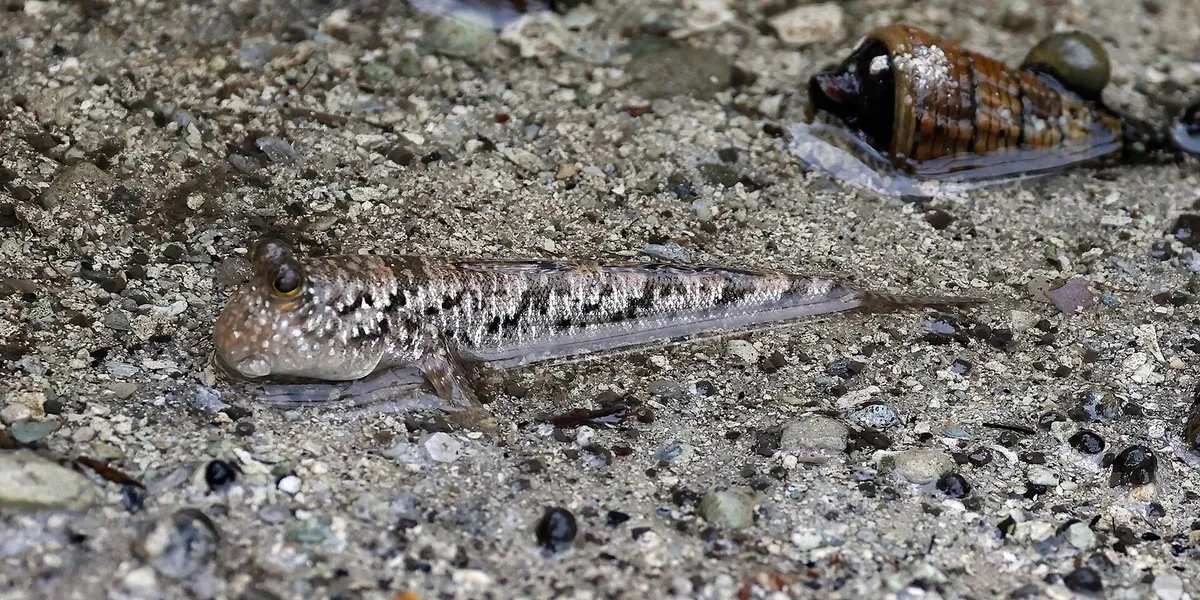
A 2023 study in PNAS on the origin of blinking in mudskippers found that their blinks do the same three jobs ours do. They wet the eye, protect it from injury and clear away debris. One species blinked more often when the air was drier. The mudskippers managed this without any new muscles or glands, by reusing the parts they already had. You can read more about these and other land-going fish in our guide to walking fish.
How Fish See Underwater
Fish eyes look a lot like ours from the outside, with a cornea, iris, lens and retina. Inside, they are tuned to a very different world.
A round lens that moves to focus
Water bends light almost as much as the cornea does, so a fish’s cornea does little focusing. The lens does nearly all of it. That is why fish lenses are round and dense, like a small glass marble. To change focus, most fish do not squeeze the lens into a new shape as you do. A tiny muscle pulls the whole lens closer to or farther from the retina, much like focusing a camera.
Pupils that stay the same size
Most bony fish have a fixed pupil. Instead of narrowing the pupil in bright light, they adjust the retina itself. Light-sensing cells and dark pigment shift position over many minutes, a process called retinomotor movement. This is why a fish can panic when room lights snap on in a dark house: its eyes have not had time to adjust. Many sharks and rays are different and can open and close their pupils.
Wide view, small blind spots
Most fish have eyes on the sides of the head. Each eye covers a huge arc, so together they see almost all the way around. The cost is weaker depth perception and small blind spots, usually right behind the tail and just below the mouth. Predators such as pike and many sharks have eyes set further forward for better judgment of distance.
Color and ultraviolet vision
Most fish see color, and many see more of it than people do. Goldfish and zebrafish carry four types of color-sensing cones, including one tuned to ultraviolet light. Guppies, cichlids and sticklebacks use ultraviolet patterns when choosing mates. Fish from deep or murky water often see a narrower range, since red light fades quickly with depth.
Eyes built for dim light
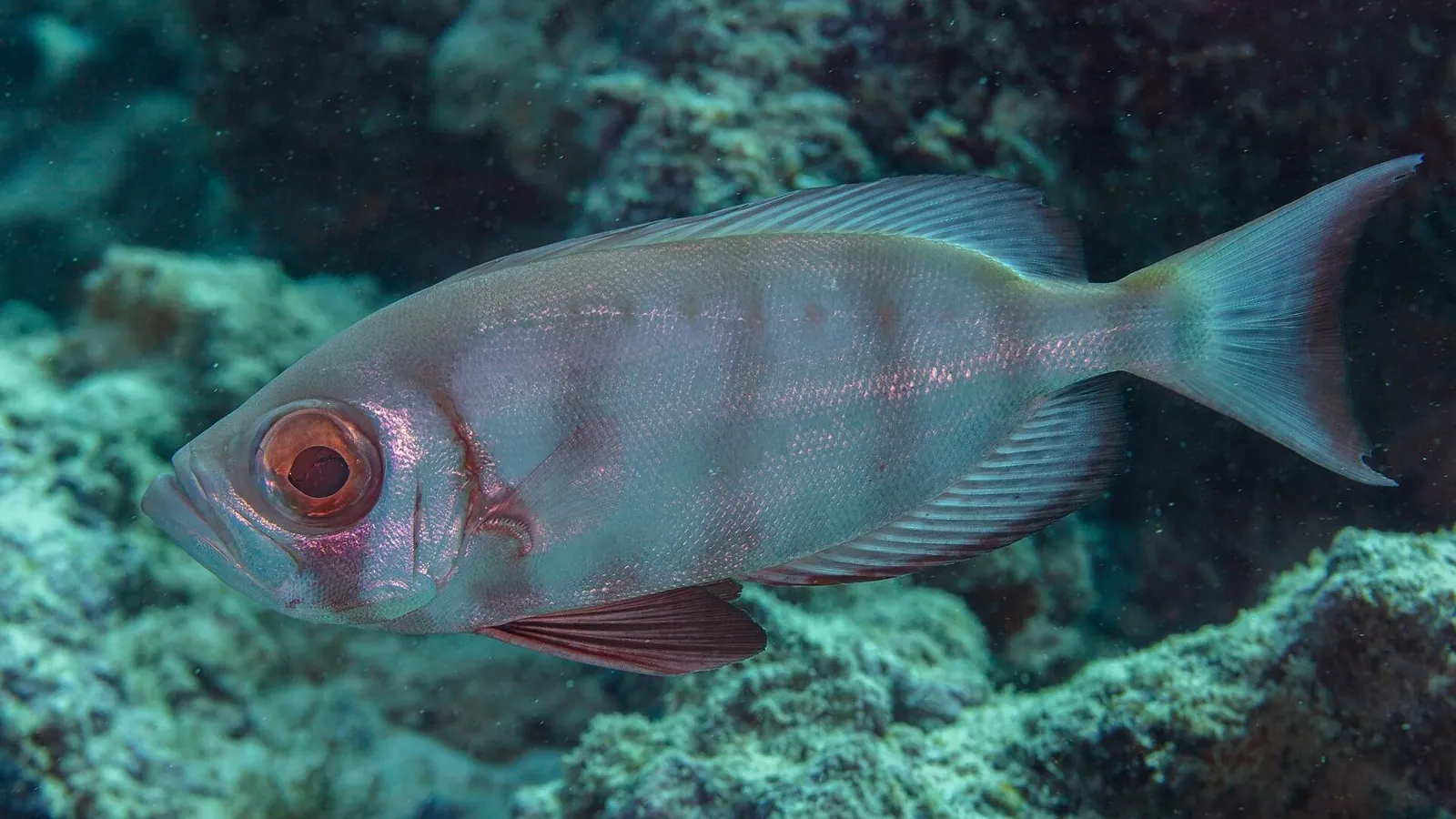
Night hunters and deep-water species pack their retinas with rods, the cells that work in low light. Many also have a mirror-like layer behind the retina called a tapetum, which bounces light back for a second pass. The walleye gets its name from the glow this layer gives its eyes. The bigeye in the photo at the top of this page has the same large, light-gathering eyes for feeding at night.
Do Fish Sleep?
Yes. Fish do not sleep in exactly the way mammals do, but nearly all of them have daily periods of deep rest. The NOAA Ocean Service describes this rest as a state in which fish slow their activity and metabolism while staying alert to danger.
What fish sleep looks like
Scientists call a fish asleep when it shows three things. It stays still for a stretch of time, often in a favorite spot. It reacts more slowly to a tap, a vibration or food. And if you keep it awake, it rests more later to catch up. These are the same behavioral tests used to define sleep in other animals.
What the science shows
Zebrafish are the best studied sleepers. In 2019, a Stanford team recorded brain activity in young zebrafish and found two distinct sleep states. One resembled the slow-wave sleep of mammals, and the other shared features with REM sleep, even though the fish’s eyes did not move. The researchers concluded that these sleep patterns arose at least 450 million years ago.
Cavefish offer the other side of the story. A 2011 study in Current Biology compared river and blind cave forms of the Mexican tetra, a fish whose cave populations have lost their working eyes. Over 24 hours, the river fish slept more than 800 minutes on average, while the cave populations slept only about 110 to 250 minutes. In that study, a fish counted as asleep after a full minute without moving.
How Fish Sleep With Their Eyes Open
Since they cannot close their eyes, fish rely on location and posture to rest safely.
Hiding spots and resting poses
Many fish wedge themselves into coral, tuck under rocks or settle among plants. Some float in midwater with barely a fin moving. Flatfish and gobies lie on the bottom, and some fish, such as the Pacific sand lance, burrow into sand. Colors often fade at night, which makes a sleeping fish harder to spot.
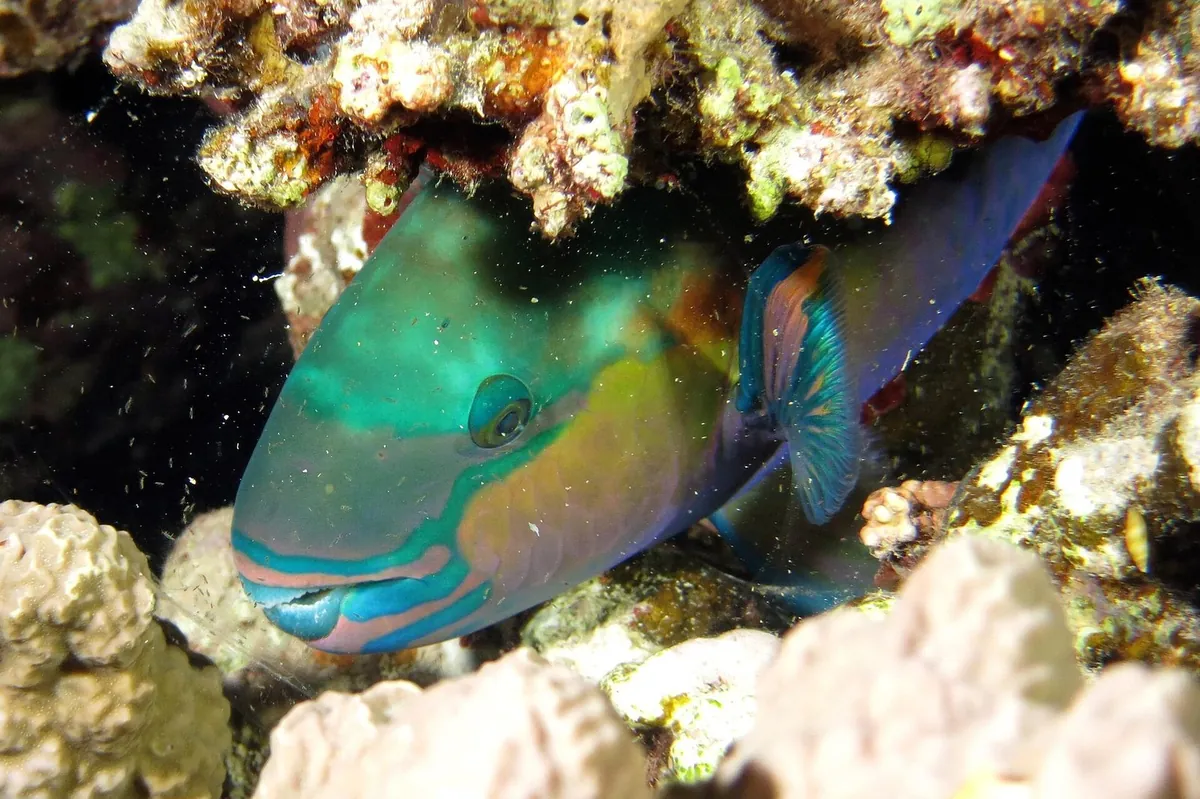
Parrotfish sleeping bags
Many parrotfish and some wrasses wrap themselves in a bubble of mucus before they sleep. Research on the Great Barrier Reef found that the cocoon takes under an hour to build and uses about 2.5 percent of the fish’s daily energy. In return, it keeps off tiny blood-feeding crustaceans that hunt reef fish at night. Cocooned fish were attacked far less often than fish without one.
Fish that keep swimming
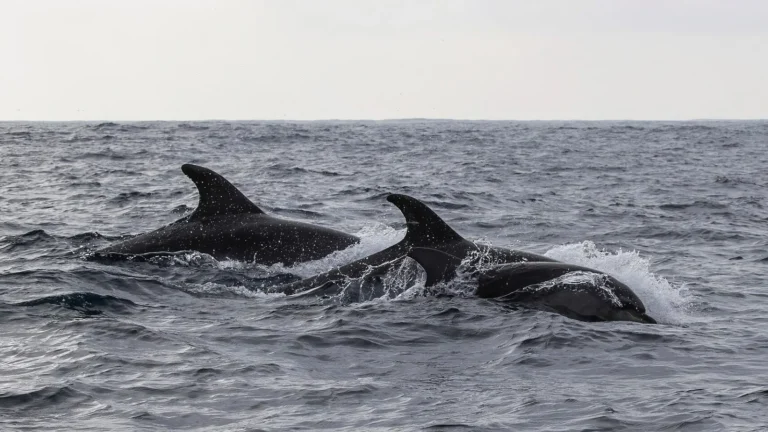
Some sharks, such as the great white and the mako, need to keep moving so that water flows over their gills. Tuna have a similar need. These fish are thought to rest while cruising slowly, rather than stopping. Other sharks, including nurse sharks and whitetip reef sharks, can pump water over their gills and lie still on the bottom or in caves. Dolphins solve the problem in another way, resting one half of the brain at a time, which we cover in are fish mammals.
How to Tell if Your Aquarium Fish Is Sleeping
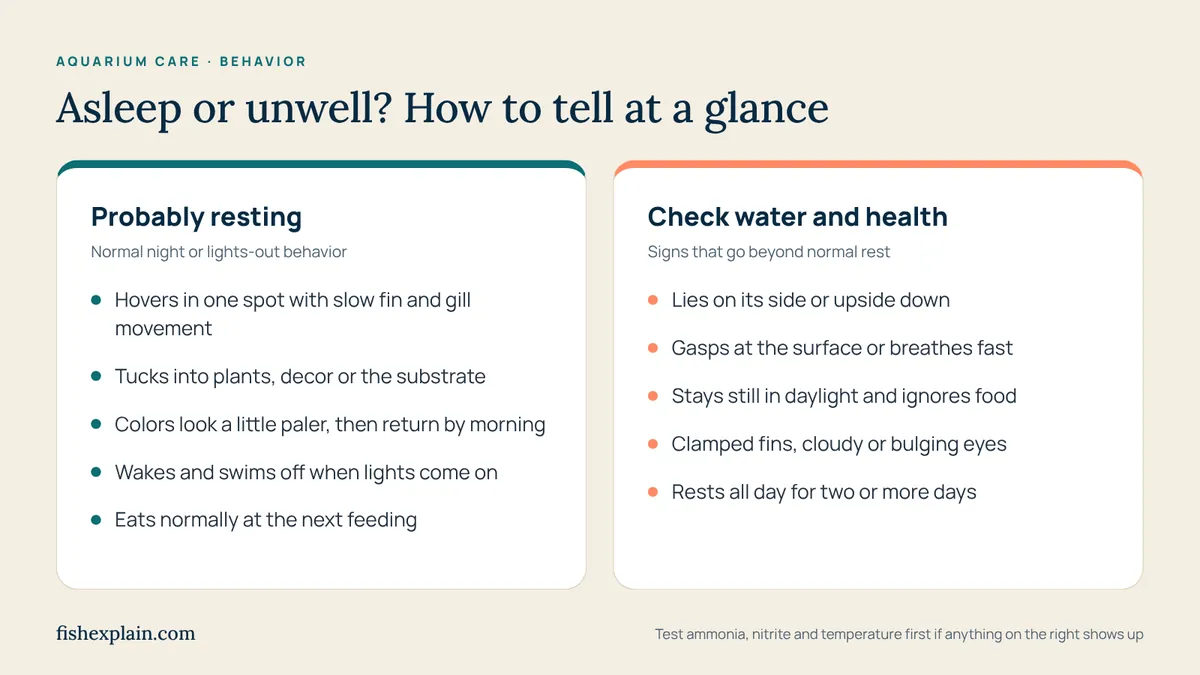
Telling sleep from sickness is the most practical part of this topic for fish keepers. The chart and notes below cover the main clues.
Signs of normal rest
A resting fish stays upright and balanced. It hovers or settles in a sheltered spot, breathes slowly and moves its fins just enough to hold position. It may look a little pale. When the lights come on or you approach the tank, it wakes within a few moments and eats at the next feeding.
Signs your fish may be unwell
Lying on its side, sinking, gasping at the surface or ignoring food during the day all point to a problem. So do clamped fins, cloudy eyes or eyes that bulge outward, a condition called pop-eye. Test the water first, since ammonia and nitrite spikes cause many of these signs. Our common fish diseases chart covers eye problems and other symptoms in detail.
How bettas sleep
Bettas are known for odd sleeping poses. Some rest on a broad leaf near the surface, some lie flat on the substrate and some wedge into a plant. This is normal for a healthy betta at night. If yours lies on the bottom during the day too, read our guide to betta fish behavior before death to check for warning signs early.
Helping Pet Fish See and Sleep Well
Fish cannot shut out light or noise, so their environment does the job that eyelids would. A few simple habits make a clear difference.
Keep a steady light schedule
Give your tank about 8 to 12 hours of light a day, on the same timetable every day. An outlet timer makes this easy. Lights left on around the clock deny fish their dark rest period and also feed algae.
Switch lights on gently
Because fish pupils do not adjust quickly, turn on the room light first and wait a few minutes before switching on the tank light. Many modern aquarium lights also have a dawn and dusk setting that ramps brightness up and down.
Give every fish cover
Plants, caves, driftwood and floating plants give fish dark places to rest. Shy and nocturnal species need these most. Keep the tank away from a TV or a busy doorway so that constant flicker and movement do not keep fish on alert.
Protect their eyes
Without eyelids, fish eyes are exposed to sharp decor and poor water. Choose smooth rocks and ornaments, especially for goldfish with bubble or telescope eyes. Weekly water changes keep the water clear, which helps prevent cloudy eyes. Our betta fish care guide sets out a simple routine you can adapt for most small tanks.
Can Fish Blink FAQs
Do fish close their eyes when they sleep?
No. Most fish have no eyelids, so they cannot close their eyes at any time, including during sleep. A sleeping fish keeps its eyes open, slows its breathing and movement, and usually rests in a sheltered spot. It reacts more slowly to disturbances until it wakes up.
Which fish can close their eyes?
No fish closes its eyes the way people do, but a few can cover them. Many sharks slide a nictitating membrane across each eye when they feed. Great white sharks roll their eyes back into the socket. Mudskippers pull their eyes down into their heads while a skin membrane covers them, which works as a true blink.
Do fish have eyelids?
Most bony fish, including goldfish, bettas, tetras and cichlids, have no eyelids. Sharks have upper and lower lids that barely move, and many add a third lid. Some ocean fish such as mullet, herring and mackerel have a clear adipose eyelid, which is a fixed layer of tissue that cannot open or close.
Can fish see in the dark?
Fish can see in very dim light much better than people can, thanks to retinas packed with rod cells and, in many species, a reflective layer behind the retina. In total darkness, no eye works. Fish then rely on their lateral line, smell and taste to find food and avoid obstacles.
How long do fish sleep?
It depends on the species. In one study of the Mexican tetra, river fish slept more than 800 minutes in 24 hours, while blind cave forms slept about 110 to 250 minutes. Most aquarium fish rest through much of the night and take shorter naps during the day.
Is my fish sleeping or dead?
A sleeping fish stays upright, breathes with slow, steady gill movements and wakes when the lights come on or the tank is gently disturbed. A dead fish shows no gill movement, often lies on its side or floats, and does not respond at all. If a fish is breathing but lying on its side, test the water and check for illness.
Final Thoughts
Open eyes, real rest
So, can fish blink? Almost never. Most fish have no eyelids because water already keeps their eyes wet and clean. Sharks shield their eyes with a third lid or by rolling them back, and mudskippers evolved a true blink for life on land. Every fish still needs rest, and it takes that rest with its eyes wide open. Give your fish a steady day and night, gentle lighting and places to hide, and they will sleep as well as any fish can.