Walking Fish: The Short Answer
“Fish with legs” sounds like a joke, but dozens of fish really do walk. Some haul themselves across mudflats, wet roads and lawns. Others stroll over coral rubble or climb waterfalls inside caves. This guide covers 13 walking fish and one famous impostor, the axolotl. For each, you will learn how it moves, how it breathes air and where it lives. We also explain what walking fish tell scientists about the first animals to leave the water and which species you can, or cannot, legally keep at home.
Walking Fish at a Glance
The table compares every species in this guide. “Land” means the fish regularly leaves the water. “Bottom” means it walks underwater. Sizes are approximate maximum lengths.
| Walker | Walks on | How it moves | Air breathing | Where it lives |
|---|---|---|---|---|
| Mudskippers Periophthalmus and relatives | Land | Crutches on front fins, skips with tail | Skin, mouth lining, gill chambers | Mudflats, mangroves; Africa to Indo-Pacific |
| Walking catfish Clarias batrachus | Land | Wriggles, braced on fin spines | Branched organ above the gills | Southeast Asia; invasive in Florida |
| Snakeheads Channa, Parachanna | Land (young fish) | Short wriggles between waters | Air chamber above the gills | Asia, Africa; invasive in the U.S. |
| Climbing perch Anabas testudineus | Land | Levers on gill cover spines | Labyrinth organ | South and Southeast Asia |
| Frogfish Family Antennariidae | Bottom | Walks on four armlike fins | None | Tropical and subtropical seas |
| Handfish Family Brachionichthyidae | Bottom | Walks on handlike fins | None | Southern Australia, mainly Tasmania |
| Epaulette shark Hemiscyllium ocellatum | Bottom and short trips in air | Wriggles and pushes with paddle fins | None; survives very low oxygen | Great Barrier Reef flats |
| Batfish Family Ogcocephalidae | Bottom | Props up and steps on stiff fins | None | Warm seas; red-lipped batfish off Galápagos |
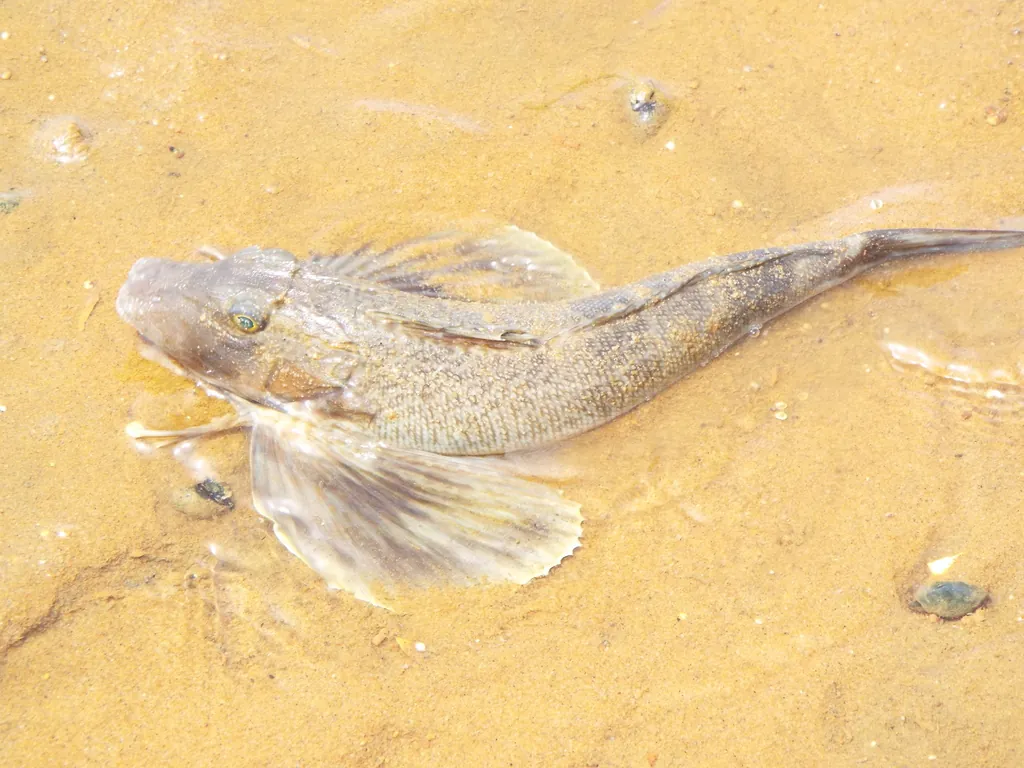
| Sea robins Family Triglidae | Bottom | Six legs made of free fin rays | None | Coastal seas, including the U.S. East Coast |
| Cave angelfish Cryptotora thamicola | Wet rock in caves | Salamander-like four-fin gait | Not known | Caves in northern Thailand |
| Lungfish Subclass Dipnoi | Bottom | Steps or bounds on thin hind fins | True lungs | Africa, South America, Australia |
| Bichirs Polypterus | Bottom and land | Pushes with front fins and body | Paired lungs, spiracles | Africa |
| Axolotl (not a fish) Ambystoma mexicanum | Bottom | Walks on four true legs | Gills, lungs | Xochimilco and Chalco, Mexico |
What Is a Walking Fish?
“Walking fish” is a nickname, not a scientific group. It covers unrelated fish that have found their own ways to push against a solid surface instead of swimming. Some are gobies, some are catfish, some are sharks and some are anglerfish relatives. They evolved walking separately, many times over.
Fins, Not Feet
No living fish has true legs. Arms and legs in land animals have a set pattern of bones, from a single upper bone down to wrists, ankles, fingers and toes. Most fish fins are thin webs of skin held up by slender rays. Walking fish make those fins work like limbs. Some use stiff spines or muscular fin bases. Sea robins split off a few fin rays to use as tiny legs. The climbing perch even uses the spiny edges of its gill covers.
Land Walkers and Bottom Walkers
Walking fish fall into two broad groups. Land walkers, such as mudskippers, walking catfish and climbing perch, leave the water on purpose and can breathe air. Bottom walkers, such as frogfish, handfish and batfish, never leave the sea. They step across sand and reef because walking is quiet, steady and well suited to ambush hunting.
Why a Fish Would Leave the Water
Leaving the water is risky, so fish do it for good reasons. Mudskippers feed on exposed mudflats at low tide. Walking catfish and climbing perch cross land to reach new pools, often at night or during rain. Epaulette sharks move between tide pools as the water drains away and oxygen drops. In each case, the ability to walk opens up food or living space that other fish cannot reach.
13 Walking Fish and How They Move
The list starts with fish that walk on land, moves to fish that walk on the seafloor and ends with the lungfish, the bichirs and the axolotl, which help explain how backboned animals first moved onto land.
1. Mudskippers (Periophthalmus and relatives)
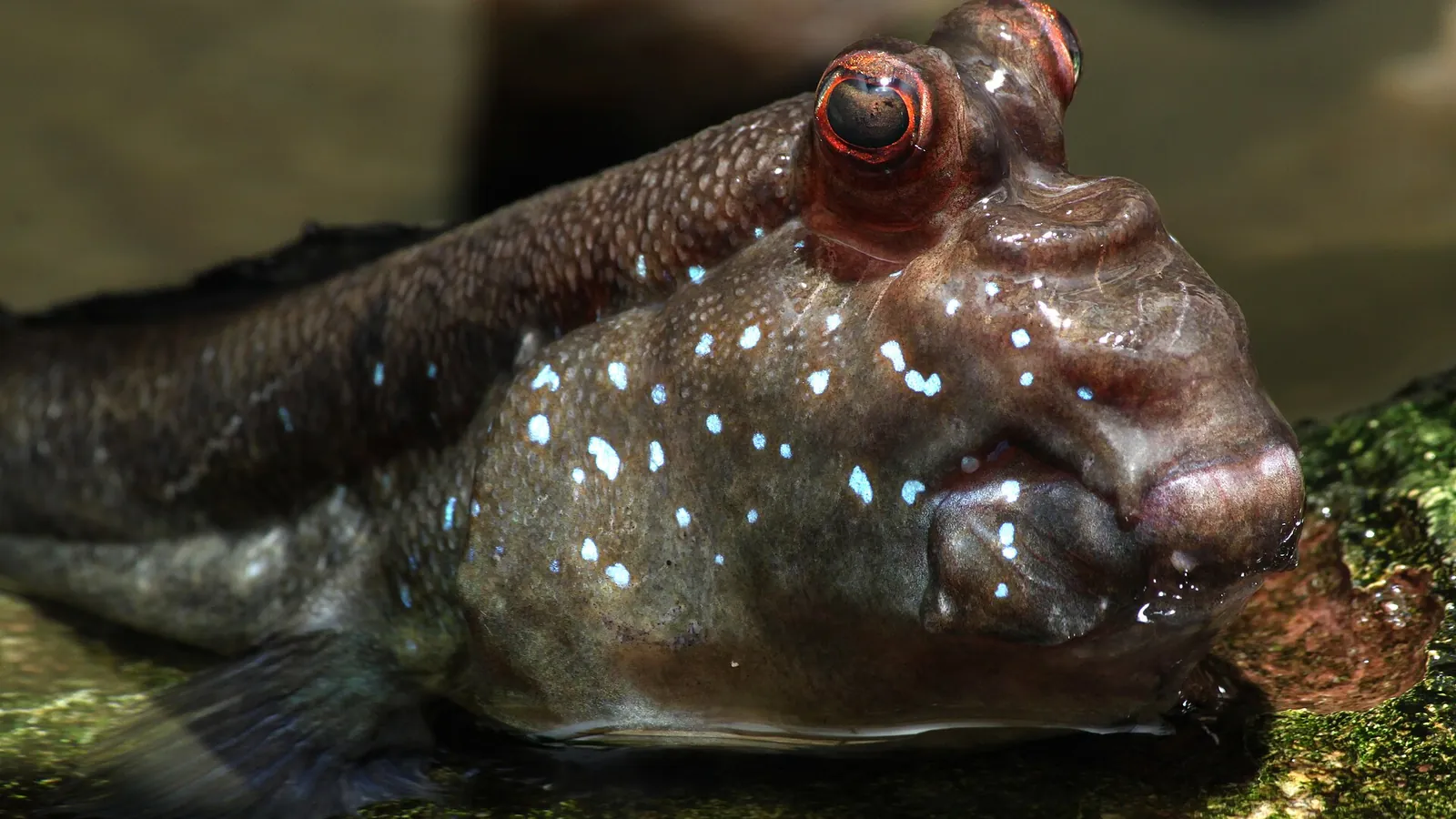
Mudskippers are gobies that spend much of their lives out of the water. They live on tropical mudflats, in mangrove swamps and along estuaries, from the Atlantic coast of Africa across the Indo-Pacific. Their eyes sit high on top of the head like a frog’s. To blink, a mudskipper pulls each eye down into a small, water-filled cup, which keeps the eye moist in air.
On land, a mudskipper plants both front fins and swings its body forward, a gait known as crutching. When it needs speed, it curls its tail and flicks itself into a jump. The Atlantic mudskipper can leap about 2 feet. Mudskippers absorb oxygen through their wet skin and the lining of the mouth and throat. Their large gill chambers close tightly in air, holding water and air that keep the gills working. Males dig deep burrows in the mud and carry mouthfuls of air down to their eggs.
Quick facts: Amphibious gobies · Mudflats and mangroves, West Africa to the Indo-Pacific · up to about 10 in · breathe through skin and mouth lining

2. Walking catfish (Clarias batrachus)
The walking catfish is the fish most people picture when they hear “walking fish.” It is native to Southeast Asia, from eastern India and Sri Lanka to Indonesia and Borneo, and reaches about 24 inches. A branched, treelike air-breathing organ above its gills lets it gulp air at the surface. On land, it wriggles like a snake while stiff spines in its front fins brace its body and keep it upright.
The species reached Florida through the aquarium trade. According to the USGS fact sheet on the walking catfish, fish were imported from Thailand in the early 1960s, some escaped in the mid-1960s and fish farmers released more near Tampa Bay around 1967 to 1968. It is now established in Florida, and its spread was helped by overland trips on rainy nights. Florida banned importing and keeping it in the late 1960s. Releases in California, Connecticut, Georgia, Massachusetts and Nevada did not take hold.
Quick facts: Air-breathing catfish · Southeast Asia, invasive in Florida · up to about 24 in · listed as federal injurious wildlife

3. Snakeheads (Channa and Parachanna)
Snakeheads are long, predatory fish from Asia and Africa. The best known in the United States is the northern snakehead, native to China, southern Siberia and North Korea. In North America it reaches about 3 feet and 19 pounds. A chamber above its gills, called a suprabranchial organ, lets it breathe air. In warm summer water it relies on air almost entirely.
Snakeheads have a reputation as fish that stroll across parking lots, but the truth is more modest. Young snakeheads can wriggle over wet ground for a few feet to reach nearby water. Adults are too heavy to travel well on land. They can, however, survive out of water for several days if they stay moist, with reports of up to four days. A northern snakehead population turned up in a Maryland pond in 2002 and was wiped out. Another was found in the Potomac River in 2004 and has been established there ever since.
Quick facts: Snakehead family · Native to Asia and Africa · northern snakehead up to about 3 ft in the U.S. · can live days out of water if kept moist

4. Climbing perch (Anabas testudineus)
The climbing perch is a labyrinth fish, part of the same group as gouramis and the bettas in our betta fish care guide. It lives in canals, ponds, swamps and flooded fields from India to Southeast Asia and China, and it grows to about 10 inches. FishBase lists it as an obligate air breather, so it must reach the surface to gulp air through its labyrinth organ.
The climbing perch crosses land between pools, mostly at night. It levers itself forward with sharp spines on the edges of its gill covers, while its fins and tail push. If its breathing organ stays moist, it can survive for a day or more out of water. Its genus name comes from a Greek word for “climbing up,” and old stories claim it scales trees. Modern scientific accounts describe it crossing land, not climbing trees. It has invaded islands in the Torres Strait, between Australia and New Guinea, and Queensland lists it as a noxious fish.
Quick facts: Labyrinth fish · South and Southeast Asia · up to about 10 in · walks on gill cover spines

5. Frogfish (Family Antennariidae)
Frogfish are lumpy, slow-moving relatives of the deep-sea anglerfish. There are about 50 species, found in tropical and subtropical seas worldwide, especially on coral reefs and rocky bottoms. Their front and hind fins are muscular and bend at joints much like elbows and knees. A frogfish can walk with an alternating step or use a crutching gait, where the large front fins carry most of its weight.
Walking suits the frogfish’s hunting style. It sits still, blends into sponges or algae and waves a lure on its head that looks like a small worm or fish. When prey comes close, its mouth opens in about six milliseconds. If a frogfish needs to escape, it switches tactics and shoots water out through small gill openings behind its front fins, a form of jet propulsion.
Quick facts: Anglerfish relatives · Tropical and subtropical seas · about 50 species · walks on four armlike fins

6. Handfish (Family Brachionichthyidae)
Handfish look like frogfish that grew real hands. The family has 14 species in five genera, all found in the inshore waters of southern and southeastern Australia. Tasmania is home to all but three. They grow to about 6 inches and commonly walk on their pelvic fins and handlike front fins rather than swim.
That quiet lifestyle has a downside. Handfish have no free-swimming larval stage, so their young cannot drift to new areas. As a result, they spread poorly and struggle to recolonize lost habitat. Australia lists the spotted handfish as Endangered. The red handfish is now one of the rarest fish in the world, with only two known colonies left.
Quick facts: Anglerfish relatives · Southern Australia, mainly Tasmania · up to about 6 in · 14 species

7. Epaulette shark (Hemiscyllium ocellatum)
The epaulette shark is a slim, spotted shark about 3 feet long. It lives on the shallow reef flats of the southern Great Barrier Reef. When the tide drops, pools on the reef flat get cut off, and oxygen falls while carbon dioxide builds up. The epaulette shark copes by walking, both underwater and across exposed reef, wriggling its body and pushing with its paddle-shaped fins.
It is also extremely tough. Researchers at Florida Atlantic University report that it can survive two hours with no oxygen at all, at temperatures far higher than most low-oxygen specialists can handle. It belongs to a group of nine walking sharks in the genus Hemiscyllium, found around Australia and New Guinea. A 2020 study suggested these sharks split from their relatives about 9 million years ago, which makes them the youngest sharks known.
Quick facts: Walking shark · Southern Great Barrier Reef · about 3 ft · survives 2 hours without oxygen

8. Batfish (Family Ogcocephalidae)
Batfish are flattened anglerfish relatives that prop themselves up on stiff front and hind fins and walk over the seafloor. Like frogfish, they carry a small lure on the snout. The most famous is the red-lipped batfish, which lives from the Galápagos Islands south to Peru. FishBase lists it at depths of about 10 to 390 feet, most often 10 to 250 feet, and up to about 8.5 inches long.
The red-lipped batfish lives on sandy bottoms and is thought to feed on small invertebrates. Its bright red lips are its trademark, but its walking fins are just as unusual. The front fins sit on armlike stalks, so the fish looks as if it is standing on a pair of short legs.
Quick facts: Anglerfish relatives · Red-lipped batfish: Galápagos to Peru · up to about 8.5 in · walks on four stiff fins

9. Sea robins (Family Triglidae)
Sea robins are bottom fish with big, winglike front fins. In Europe, the same family is called gurnards. The first three rays of each front fin are separate from the rest, giving the fish six small legs. A sea robin uses them to walk over sand and to probe the bottom for food.
Those legs do more than walk. In 2024, two studies in Current Biology from teams at Stanford University and Harvard University showed that the northern sea robin, common off the U.S. East Coast, can find buried prey with its legs. The legs carry small bumps called papillae that use some of the same receptor molecules found in taste buds. A related sea robin with plain, rodlike legs could not find buried prey. The researchers also identified a key gene, tbx3a, behind the legs’ development.
Quick facts: Searobin family · Coastal seas, including the U.S. East Coast · six leg-like fin rays · legs help sense buried prey
10. Cave angelfish (Cryptotora thamicola)
Despite its name, the cave angelfish is not an angelfish. It is a tiny hillstream loach that reaches only about 1.1 inches. It has no visible eyes and almost no color. It lives in fast-flowing rapids inside a cave system in northern Thailand, where it walks up rocks in rushing water and even climbs waterfalls.
A 2016 study in Scientific Reports, led by Brooke Flammang of the New Jersey Institute of Technology, found that this fish has a sturdy pelvic girdle with features once thought to exist only in four-legged animals. Its hips connect firmly to its backbone, which helps it hold its body up against gravity. It walks with a gait like a salamander’s, moving diagonal fins together. No other living fish is known to walk this way.
Quick facts: Hillstream loach · Caves in northern Thailand · about 1.1 in · climbs waterfalls
11. Lungfish (Subclass Dipnoi)
Lungfish are lobe-finned fish with true lungs. Six species survive today: one in Australia, one in South America and four in Africa. They are the closest living fish relatives of four-legged animals. The West African lungfish grows to about 3.3 feet, and FishBase lists it as an obligate air breather, so it must reach the surface to breathe. When its home dries out, it burrows up to about 10 inches into the mud and wraps itself in slime that hardens into a cocoon. It can wait there for more than a year until the rains return.
Lungfish also walk underwater. A 2011 study by University of Chicago researchers filmed African lungfish lifting their bodies off the bottom with their thin hind fins, then walking or bounding forward. Air in their lungs may help them float, so the slender fins can carry their weight. The finding suggests that walking movements appeared in fish before any animal moved onto land.
Quick facts: Lobe-finned fish · Africa, South America and Australia · West African lungfish up to about 3.3 ft · walks on hind fins

12. Bichirs (Polypterus)
Bichirs are long African fish covered in heavy, armorlike scales, with a row of small finlets along the back. They are ray-finned fish, not lobe-finned, but they belong to a very old branch of that group. Bichirs have paired lungs and gulp air when oxygen runs low. A 2014 study found they can also draw air in through spiracles, two small openings on top of the head. In the wild, they live in swamps and muddy river edges and move with snakelike motions.
Bichirs became famous in 2014, when researchers at McGill University raised young Senegal bichirs on land for eight months. Compared with bichirs raised in water, the land-raised fish held their heads higher, kept their fins closer to the body, took faster steps and slipped less. Their skeletons changed too. The study, published in Nature, showed how a fish’s body can adjust when it lives on land.
Quick facts: Bichir family · Africa · paired lungs plus spiracle breathing · walks on front fins and body

13. Axolotl, the “Mexican Walking Fish” (Ambystoma mexicanum)
The axolotl is sold as the “Mexican walking fish,” but it is not a fish at all. It is a salamander, an amphibian with four true legs. Many salamanders lose their gills as they grow up. The axolotl keeps its larval body for life, stays fully aquatic and breeds with feathery gills still in place. It walks along the bottom on those legs, which helps explain its misleading nickname.
Axolotls breathe mainly through three pairs of external gills, but they can also gulp air at the surface to fill their lungs. Adults are usually about 9 inches long. In the wild, they live only in the lakes and canals of Xochimilco and Chalco, near Mexico City. The IUCN lists the axolotl as Critically Endangered, with an estimated 50 to 1,000 adults left in the wild even though it is common in labs and home aquariums.
Quick facts: Salamander, not a fish · Xochimilco and Chalco, Mexico · usually about 9 in · Critically Endangered

How Walking Fish Breathe Air
Gills work beautifully in water but poorly in air. Without water to hold them apart, the thin gill filaments collapse and stick together, and the fish can no longer take in enough oxygen. Fish that leave the water solve this problem in four main ways.

The Labyrinth Organ
Climbing perch, bettas and gouramis have a labyrinth organ above the gills. It is a maze of thin, folded plates covered in blood vessels. The fish gulps air at the surface, and oxygen passes into the blood through those plates. Young bettas develop the organ about three to six weeks after hatching. Our guide to breeding betta fish explains why warm, humid air above the water matters while it forms.
Suprabranchial Organs
Walking catfish and snakeheads use air chambers above the gills. In the walking catfish, the chamber holds branched, treelike tissue. These organs let both fish live in warm, stagnant water with very little oxygen and survive short trips over land.
Skin and Mouth Breathing
Mudskippers absorb oxygen through their skin and through the lining of the mouth and throat. This only works while the skin stays wet, so mudskippers need humid air and stay close to the water’s edge. Their sealed gill chambers carry water and air to keep the gills moist.
True Lungs
Lungfish and bichirs have real lungs that grow out from the gut. Land animals inherited the same basic arrangement from fish ancestors. Many fish have a swim bladder instead, a gas-filled sac used mainly for buoyancy.
How Walking Fish Move
Walking fish do not share one style of walking. Each group has found its own solution, based on the body it inherited. The diagram sums up the six main methods.

Crutching and Skipping
Mudskippers move both front fins together, like a person on crutches. The tail adds a powerful flick for jumps. Frogfish use a similar crutching gait underwater when they need to move their bulky bodies.
Wriggling and Levering
Long-bodied fish such as walking catfish, young snakeheads and bichirs throw their bodies into S-shaped curves. Each curve pushes against mud, grass or the tank bottom. Stiff fin spines, or the spiny gill covers of the climbing perch, give extra grip.
Walking on the Seafloor
Frogfish, handfish, batfish and epaulette sharks step with front and hind fins. Sea robins add their six fin-ray legs. Walking lets these fish move slowly and quietly, which helps them sneak up on prey and stay hidden from predators.
Salamander-Style Steps
The cave angelfish moves diagonal fins together, much like a salamander walks. African lungfish lift their bodies on their hind fins. These gaits look the most like the walking of four-legged animals, so scientists study them closely.
Walking Fish and the Move to Land
Hundreds of millions of years ago, a group of fish with sturdy fins lived in shallow water. Their descendants became the first four-limbed animals, the ancestors of amphibians, reptiles, birds and mammals, including us. Living walking fish help scientists picture how that change may have happened.
Lobe-Finned Fish
The fish that gave rise to land animals were lobe-finned fish. Their fins had fleshy bases with bones inside, arranged in a pattern that later became arms and legs. Only two groups of lobe-finned fish survive today: the lungfish and the coelacanths. Most other fish, including mudskippers, catfish and bichirs, are ray-finned fish. They learned to walk on their own, long after the first land animals appeared.
Tiktaalik: The Fish With a Neck
In 2004, a team led by Neil Shubin of the University of Chicago and Ted Daeschler of the Academy of Natural Sciences in Philadelphia found fossils of Tiktaalik roseae on Ellesmere Island in the Canadian Arctic. The animal lived about 375 million years ago and reached about 4 to 9 feet. It had scales and fins like a fish, but it also had a flat, crocodile-like head and a neck. Its front fins held bones that match an upper arm, a forearm and parts of a wrist, strong enough to prop up its body in shallow water.

What Living Walking Fish Can Teach Us
Modern walking fish are not our ancestors, and most evolved walking independently. They still act as living test cases. The lungfish study suggests walking may have begun underwater. The bichir study shows how quickly a fish’s body can respond to life on land. The cave angelfish shows that hips strong enough for walking can evolve more than once.
Can You Keep Walking Fish in an Aquarium?
Some walking fish are sold in the aquarium trade. Others are protected in the wild, too large for home tanks or illegal to own in much of the United States. Always check the rules before you buy.
Walking Fish Sold in the Hobby
- Bichirs: the Senegal bichir is the most common. It is hardy and long-lived, and FishBase notes captive bichirs living 34 years and more.
- Mudskippers: they need brackish water plus a large area of mud or rock above the waterline. Like the brackish species in our freshwater puffer fish guide, they do poorly in a standard freshwater tank.
- Frogfish: they are kept in marine aquariums, but they can swallow tankmates as big as themselves, so they are best kept alone.
- African lungfish: they are sold as juveniles but can reach about 3.3 feet, so few homes can provide enough space.
- Axolotls: they are popular pets, but they need cool water and are restricted in some places. Check with your state wildlife agency first.
Restricted and Illegal Walking Fish
Under federal law, the walking catfish family (Clariidae) and the snakeheads (Channa and Parachanna) are listed as injurious wildlife. That means live fish and viable eggs cannot be imported into the United States without a special permit. Snakeheads were added in 2002. Many states also ban keeping them, and Florida has banned possession of walking catfish since the late 1960s. Federal and many state rules require anglers to kill any snakehead they catch, and wildlife agencies ask for every catch to be reported.
The climbing perch is not banned at the federal level, but it is a declared noxious fish in Queensland, Australia, because of its invasive spread. Handfish, the cave angelfish and the red-lipped batfish are not legally available to hobbyists. If you ever see a fish for sale that seems rare or unusual, ask for the scientific name and origin before buying.
Setup Tips for Amphibious Fish
- Use a tight-fitting lid. Fish that can breathe air and crawl will escape through small gaps.
- Keep the air above the water warm and humid for labyrinth fish and mudskippers.
- Cover filter intakes and cable holes. Our guide to the best fish tank filters compares models with safer intakes.
- Give land-loving species a gentle ramp or shore so they can leave the water on their own terms.
- Never release aquarium fish into the wild. Walking catfish and snakeheads show how quickly an air-breathing fish can spread.
Walking Fish FAQs
What fish can walk on land?
Mudskippers, the walking catfish, the climbing perch and young snakeheads can all move across land. Each one breathes air, so it can survive short trips between pools. Bichirs can also push themselves across wet ground with their front fins and body. Most other walking fish, such as frogfish and batfish, walk only on the seafloor.
Do walking fish have real legs?
No. No living fish has true legs with the bone pattern found in land animals. Walking fish use fins, stiff fin spines, separate fin rays or even gill covers as limbs. The lobe-finned ancestors of land animals did have bones inside their fins, and those bones later evolved into arms and legs.
Is the walking catfish illegal in the United States?
The walking catfish family, Clariidae, is listed as injurious wildlife under federal law, so live fish and eggs cannot be imported without a special permit. Florida has banned importing and keeping walking catfish since the late 1960s. Other states have their own rules, so check with your state wildlife agency before buying any catfish sold under that name.
Can snakeheads really walk on land?
Only a little. Young snakeheads can wriggle a few feet over wet ground to reach nearby water. Adults are too bulky to travel well on land. Snakeheads can, however, breathe air and survive for several days out of water if they stay moist, which helps them spread between ponds during wet weather.
Is the axolotl a walking fish?
No. The axolotl is sold as the Mexican walking fish, but it is a salamander, an amphibian with four true legs. It keeps its feathery gills and stays in the water for life. Wild axolotls live only near Mexico City, and the IUCN lists the species as Critically Endangered.
How do walking fish breathe out of water?
They use extra breathing surfaces besides their gills. Climbing perch use a labyrinth organ, while walking catfish and snakeheads use an air chamber above the gills. Mudskippers absorb oxygen through wet skin and the lining of the mouth. Lungfish and bichirs have true lungs. All of these work only if the fish stays moist.
Which walking fish can I keep in a home aquarium?
Bichirs are the easiest walking fish for most hobbyists. Mudskippers suit experienced keepers with a brackish tank and a land area. Frogfish need a marine aquarium of their own. African lungfish grow too large for most homes. Walking catfish and snakeheads are restricted under federal law, and many states ban them outright.