Best Fish Tank Filters: The Short Answer
The best fish tank filters all do the same three jobs: they trap debris, host the beneficial bacteria that break down fish waste, and keep water moving. What changes between filter types is media capacity, current strength, noise and ease of cleaning.
This guide compares HOB, canister, sponge, internal and undergravel filters side by side. It also covers the flow rate rule, the correct order for filter media, and a simple way to choose the right aquarium filter for your tank and fish.
How an Aquarium Filter Works: Three Stages
Every aquarium filter pulls water in, pushes it through media, and returns it to the tank. The media handles three types of filtration.
- Mechanical filtration traps solid particles such as uneaten food, plant debris and fish waste. Sponges, foam pads and filter floss do this job.
- Biological filtration is the most important stage. Nitrifying bacteria living on porous media convert toxic ammonia into nitrite, then into far less harmful nitrate.
- Chemical filtration removes dissolved substances. Activated carbon pulls out odors, tannins and medications, while resins such as Seachem Purigen remove organic waste.
Ammonia from fish gills and decaying food builds up fast in a closed tank. The University of Florida IFAS Extension explains in its guide to ammonia in aquatic systems that even low concentrations damage fish gills and tissue. A filter with plenty of biological media is your main defense, which is why media capacity matters more than brand name.
Fish Tank Filter Types Compared
Here is how the five main types of fish tank filters stack up.
| Filter type | Best for | Pros | Cons |
|---|---|---|---|
| Hang-on-back (HOB) | Most community tanks, 5 to 75 gallons | Affordable, easy to install, quick media access, adds surface agitation | Visible on the tank rim, limited media space, needs a gap in the lid |
| Canister | Large, planted or heavily stocked tanks, 30 gallons and up | Large media capacity, quiet, hidden in the cabinet, flexible media layout | Higher cost, more parts, harder to clean, risk of leaks if hoses are loose |
| Sponge | Bettas, shrimp, fry, breeding and quarantine tanks | Cheap, gentle flow, very safe for tiny fish, excellent biological filtration | Takes up tank space, weak mechanical filtration, needs an air pump |
| Internal (submersible) | Small tanks, turtle tanks, hospital tanks | Compact, inexpensive, no hanging hardware | Takes up tank space, small media volume, cleaning means reaching into the tank |
| Undergravel | Simple, low-cost setups with gravel substrate | Uses the whole gravel bed as biological media, no visible box | Hard to clean, poor with sand or rooted plants, largely replaced by newer designs |

Hang-On-Back (HOB) Filters
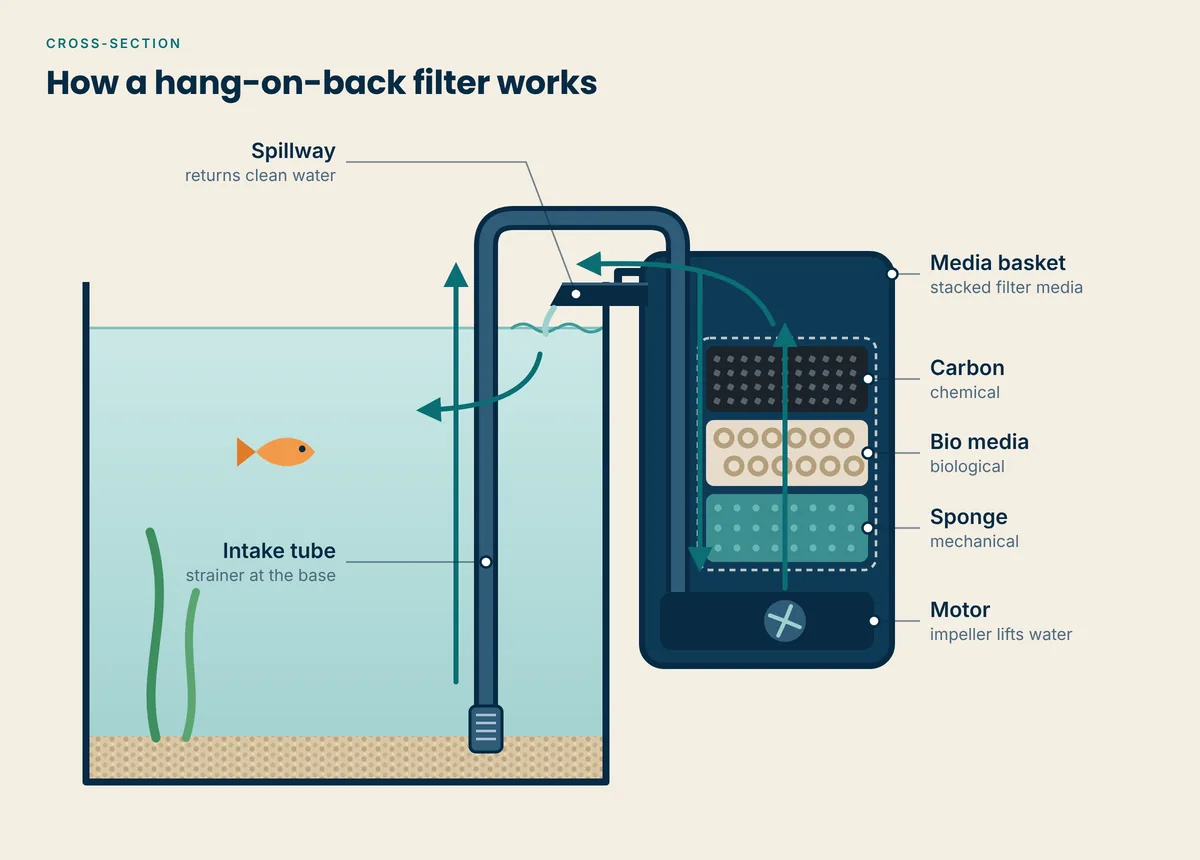
A hang-on-back filter hooks over the rear rim of the tank. An intake tube draws water up into a media box, and the clean water spills back over a lip like a small waterfall. That spillway breaks the water surface, which helps oxygen exchange.
HOB filters are the most popular choice for beginners because they are easy to set up and the media sits right at the top of the tank.
What to Look For in a HOB Filter
- Adjustable flow, so you can slow the current for long-finned fish.
- A media basket rather than a fixed cartridge, so you can use your own sponges and bio media.
- An intake sponge if you keep shrimp or fry.
Many keepers prefer basket-style HOBs over cartridge models. Throwing out a cartridge every month also throws out a large share of the beneficial bacteria living on it.
Canister Filters
A canister filter is a sealed container that sits in the cabinet below the aquarium. Hoses carry water down to the canister, through stacked trays of media, and back up to the tank. It holds far more media than a HOB of similar price.
Canisters suit tanks of 30 gallons and up, planted aquascapes where you want hidden equipment, and messy fish such as goldfish, cichlids and large plecos.
The trade-off is maintenance. You need to shut off valves, disconnect hoses, open the canister and clean each tray. Most keepers do this every one to three months rather than weekly. Check hose connections and the lid seal afterward to prevent leaks.
Sponge Filters
A sponge filter is a block of foam on a strainer with a lift tube. An air pump pushes bubbles up the tube, and the rising bubbles pull water through the foam. Bacteria colonize the huge surface area of the sponge, so a sponge filter offers strong biological filtration with very gentle flow.
That gentle flow makes sponge filters ideal for bettas, shrimp, small fish and fry. Our guide to breeding betta fish shows why soft flow matters in a fry tank, and a sponge filter is also a good fit for the setups in our betta fish tank size guide.
The downside is weak mechanical filtration. Fine particles can stay in the water, and you need to buy an air pump, airline tubing and a check valve separately.
Internal and Undergravel Filters
Internal Filters
An internal filter is a small powered box that sits fully underwater, held to the glass with suction cups. It suits turtle tanks with low water levels and tanks with tight lids. Media volume is small, so it works best for light bioloads or as a second filter.
Undergravel Filters
An undergravel filter uses a perforated plate under the substrate. Air or a powerhead draws water down through the gravel, turning the gravel bed into a biological filter. They do not work with sand, they struggle under rooted plants, and trapped waste is hard to remove. Most keepers now choose a HOB or sponge filter instead.
Commonly Recommended Filter Models
The models below come up again and again in aquarium forums and fish store recommendations. Specs are taken from the manufacturers’ published figures. They are listed so you can compare sizes and flow, not as results from our own testing.
| Model | Type | Rated tank size | Rated flow |
|---|---|---|---|
| AquaClear 20 / 30 / 50 / 70 / 110 | HOB, basket style | 5 to 20 / 10 to 30 / 20 to 50 / 40 to 70 / 60 to 110 gallons | 100 / 150 / 200 / 300 / 500 GPH |
| Seachem Tidal 35 / 55 / 75 / 110 | HOB, basket style | Up to 35 / 55 / 75 / 110 gallons | 130 / 250 / 350 / 450 GPH |
| Fluval 107 / 207 / 307 / 407 | Canister | 10 to 30 / 20 to 45 / 40 to 70 / 50 to 100 gallons | 95 / 121 / 206 / 245 GPH filter circulation |
| Oase BioMaster Thermo 250 / 350 / 600 / 850 | Canister with built-in heater | Up to 70 / 90 / 160 / 225 gallons | 250 / 300 / 350 / 400 GPH |
| Hikari Bacto-Surge | Air-driven sponge | Several sizes, the largest rated up to 75 gallons | Depends on the air pump |
Why These Models Are Popular
The AquaClear series is known for its adjustable flow and roomy media basket, which holds a foam block, bio media and carbon in sequence. The Seachem Tidal line adds a surface skimmer, a self-priming pump and a maintenance alert that rises when the media is clogged; the full lineup is on the Seachem Tidal comparison page.
The Fluval 07 series is a common first canister. Fluval lists both a pump output and a lower filter circulation figure for each model. The lower circulation number is the safer one to plan with. The Oase BioMaster Thermo includes a pre-filter module that catches debris before it reaches the main media, plus an integrated heater that removes one more device from the tank. The Hikari Bacto-Surge is a well-liked sponge filter for shrimp and betta tanks, and it needs a separate air pump.
Flow Rate: The 4 to 6 Times Rule
A common guideline is to choose a filter that turns over your total tank volume 4 to 6 times per hour. Multiply the tank size in gallons by 4 and by 6 to get your target range in gallons per hour (GPH).
| Tank size | 4x turnover | 6x turnover |
|---|---|---|
| 5 gallons | 20 GPH | 30 GPH |
| 10 gallons | 40 GPH | 60 GPH |
| 20 gallons | 80 GPH | 120 GPH |
| 40 gallons | 160 GPH | 240 GPH |
| 55 gallons | 220 GPH | 330 GPH |
| 75 gallons | 300 GPH | 450 GPH |
The number on the box is usually measured with no media loaded. Real flow drops once the filter is packed and as sponges clog, so a filter at the top of your range gives you a buffer.
When to Break the Rule
- Bettas, fancy goldfish and other long-finned fish struggle in strong current. Turn the flow down or baffle the outflow with a sponge.
- Shrimp and fry tanks do well with low flow from a sponge filter.
- Goldfish, cichlids and other messy fish produce a lot of waste, so aim for the high end or above.
Filter Media Order: Mechanical, Biological, Chemical
The order of your filter media affects how well each stage works. Water should pass through mechanical media first, then biological media, then chemical media.
- Mechanical first. Coarse sponge, then finer foam or floss, traps debris before it reaches the bio media.
- Biological second. Ceramic rings, sintered glass or porous stone give bacteria a clean, oxygen-rich home.
- Chemical last. Carbon or resins work best on water that is already free of particles that would coat them.
If debris reaches your biological media first, it clogs the pores where bacteria live and weakens the filter. In a HOB, follow the direction the water flows through the basket. In a canister, the bottom tray is usually where water enters, so coarse sponges go at the bottom. Check the manual for your model, because a few designs flow the other way.

Chemical media is optional for most freshwater tanks. Remove carbon during treatment, since it pulls many medications out of the water. Our guide to sick betta fish explains when medication is needed.
How to Choose the Best Filter for Your Tank
1. How Big Is Your Tank?
Under 10 gallons, a small sponge filter or adjustable HOB works best. From 10 to 55 gallons, a basket-style HOB is the easy default. Above 55 gallons, a canister, two HOBs, or a canister plus a sponge filter gives you enough media and flow.
If you are still choosing the tank itself, our aquarium fish tank buying guide compares sizes, shapes and materials before you pick a filter.
2. What Fish Do You Keep?
Bettas, shrimp and fry need gentle flow and guarded intakes, as our betta fish care guide explains. Community fish such as tetras, rasboras and corydoras are happy with a standard HOB. Big waste producers need extra media capacity. If you are planning a mixed betta community, our list of fish that can live with bettas helps you match tank size and stocking.
3. Is the Tank Planted?
Planted tanks benefit from a canister because the equipment stays hidden and less surface agitation helps keep CO2 in the water. Low-tech planted tanks do fine with a HOB.
4. How Much Maintenance Will You Do?
A HOB takes a few minutes every two to four weeks. A sponge filter needs a quick squeeze in old tank water. A canister needs less frequent cleaning, but each session takes longer.
Filter Maintenance Mistakes to Avoid
- Rinsing media under the tap. Chlorine and chloramine kill beneficial bacteria. Rinse sponges in a bucket of old tank water.
- Replacing all media at once. Change only part of the media at a time so the bacteria colony survives.
- Running a new filter without cycling it. A new tank needs several weeks for bacteria to build up before you add a full stock of fish.
Most cloudy water problems trace back to filter issues like these. If your water has turned milky or green, see our guide on why a fish tank gets cloudy for a step-by-step fix.

Fish Tank Filter FAQs
What is the best type of filter for a fish tank?
For most tanks between 10 and 55 gallons, a basket-style hang-on-back filter is the best all-round choice. It is affordable, easy to clean and holds enough media for a typical community tank. Choose a canister for large or planted tanks and a sponge filter for bettas, shrimp and fry.
How many GPH filter do I need for my tank?
Multiply your tank size in gallons by 4 to 6 to get the target flow in gallons per hour. A 20 gallon tank needs roughly 80 to 120 GPH. Rated flow drops once media is added, so pick a filter at the top of your range.
Is a canister filter better than a hang-on-back filter?
A canister filter is better for tanks over about 55 gallons, heavily stocked tanks and planted aquascapes because it holds more media and runs quietly. A hang-on-back filter is cheaper, simpler and easier to service, which makes it the better choice for most smaller tanks.
Are sponge filters good enough on their own?
Yes, a sponge filter is enough for lightly stocked small tanks, betta tanks, shrimp tanks and fry tanks. It provides strong biological filtration with gentle flow. It is weaker at trapping fine particles, so larger or messier tanks usually need a HOB or canister as well.
What order should filter media go in?
Filter media should go in the order mechanical, biological, then chemical. Sponges and floss catch debris first, porous bio media hosts bacteria next, and carbon or resin polishes the water last. Follow the direction water flows through your specific filter.
How often should I clean my aquarium filter?
Clean a HOB or sponge filter every two to four weeks and a canister every one to three months, or when flow drops. Rinse media in old tank water, never tap water, and replace only part of the media at a time to protect beneficial bacteria.