Unicornfish: The Short Answer
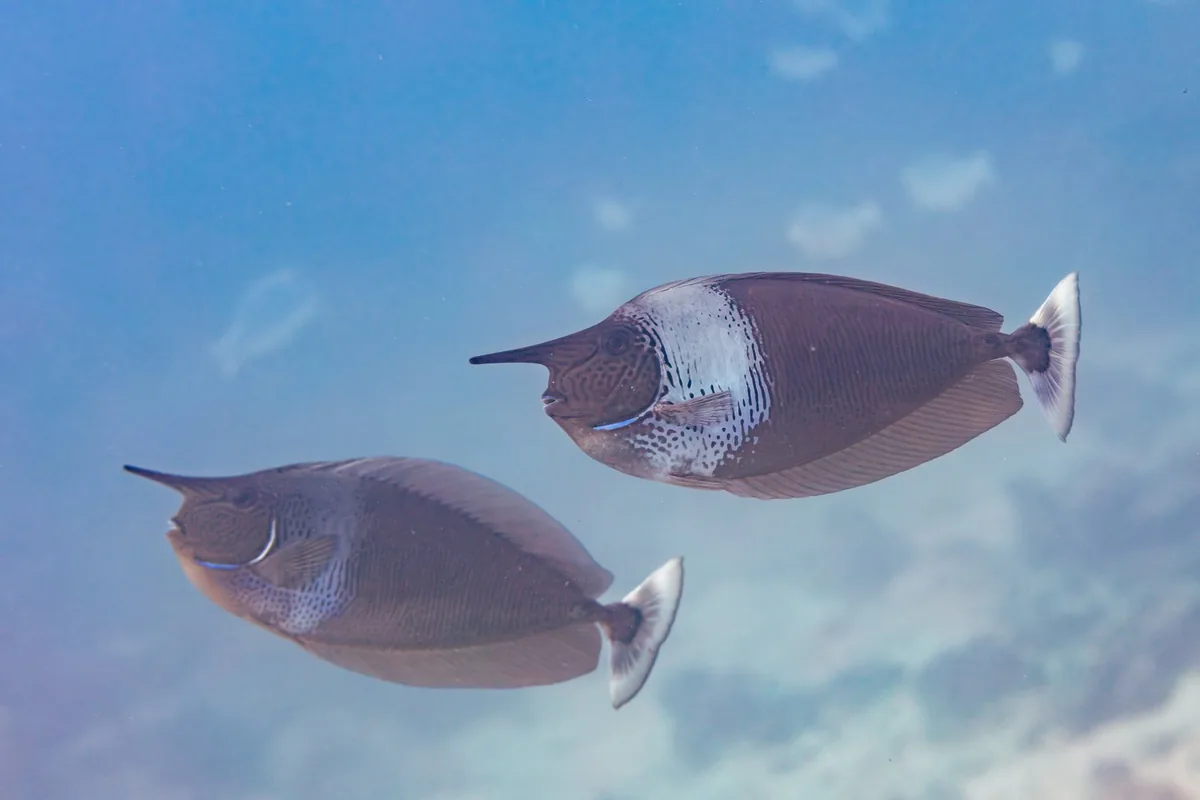
The unicornfish is one of the strangest sights on a coral reef. A gray, torpedo-shaped fish glides past, and a bony horn juts straight out from its forehead like something from a medieval storybook. Divers in Hawaii, the Red Sea and the Great Barrier Reef see them often, yet few people know what they are looking at.
Unicornfish belong to the genus Naso, a group of about 20 species in the surgeonfish family. They are close cousins of the tangs that aquarium keepers know well. Several species carry a horn, all of them carry razor-like blades on the tail, and the best known, the bluespine unicornfish, can live for more than half a century.
This guide explains what the horn is, why scientists still argue about its purpose, how to tell the main species apart, where unicornfish live, and why they are both a treasured food fish in Hawaii and a demanding aquarium pet.

What Is a Unicornfish?
Genus Naso and the surgeonfish family
A unicornfish is any member of the genus Naso, part of the family Acanthuridae. That family also includes the tangs and surgeonfishes, so the blue tang from Finding Nemo is a relative. The name Naso comes from the Latin for nose, chosen because of the projection on the forehead of the species now called Naso unicornis.
Like all surgeonfishes, unicornfish have an oblong body, a small mouth set low on the head, and a single long dorsal fin. What sets them apart is a slender tail base armed with fixed bony plates, and in roughly half the species, a forehead horn or bump.
How many unicornfish species exist
FishBase lists 20 species in the genus, split into two subgenera. The large subgenus Naso holds 17 species. The small subgenus Axinurus holds three slim, fast species with one tail plate per side instead of two. Sizes range from the 30 cm slender unicornfish to the whitemargin unicornfish, which reaches a full meter.
Why the Unicornfish Has a Horn
What the horn actually is
The horn is a rostral protuberance, a bony outgrowth of the skull covered in skin. It is not a spine and it never detaches. Young fish have none. In the bluespine unicornfish it begins as a bump and lengthens as the fish grows, so a long horn usually marks an older, larger animal. Both sexes grow one in most species, although male bluespine unicornfish average slightly longer horns, and female humpback unicornfish have almost none.
Not every species has a horn. Only about nine of the 20 carry a forehead projection, in two shapes. Four species, including Naso unicornis, Naso annulatus and Naso brevirostris, grow a long, forward-pointing horn. Others, such as Naso vlamingii and Naso tuberosus, grow a rounded hump instead. Genetic work suggests the long horn evolved independently at least three times, which hints that it serves a real purpose.
What scientists think the horn does
Nobody knows for certain. Three ideas appear in the scientific literature.
- Display and recognition. A 2007 study in Ichthyological Research by Hiroshi Arai and Tetsu Sato watched captive Naso unicornis and Naso vlamingii in Japan. Males rapidly changed the color of the horn or hump when courting females and facing rival males. The horn was never used to strike, defend or feed.
- Hydrodynamics. Some researchers propose that the horn smooths water flow around the head and improves swimming control. This idea remains untested, and it struggles to explain why the fastest Naso species lack a horn.
- Distance judgment. Peter Wainwright’s lab at UC Davis raised the possibility that a horn helps midwater plankton feeders judge the gap to tiny prey. Yet two long-horned species are bottom-feeding herbivores, so this cannot be the whole story.
What remains uncertain
The display hypothesis has the best direct evidence, but in most species the horn barely differs between sexes, and sexual selection usually exaggerates a trait in one sex. Until someone measures mating success against horn length in the wild, the question stays open.

The tail blades are a different weapon
The business end of a unicornfish is the tail. On each side of the narrow caudal peduncle sit one or two bony plates with sharp, forward-pointing keels. Unlike the folding scalpel of a regular tang, these blades are fixed and always exposed. In the bluespine unicornfish they are electric blue, which gives the species its name. Males carry much larger blades than females, and a sideways slap from a big adult can open a deep cut.
Unicornfish Species Compared
Seven species account for most diver sightings and most aquarium sales. Lengths come from FishBase.
| Species | Common name | Horn or hump | Max length | Range |
|---|---|---|---|---|
| Naso unicornis | Bluespine unicornfish | Long horn | 70 cm | Red Sea and East Africa to Hawaii and French Polynesia |
| Naso lituratus | Orangespine unicornfish | None | 46 cm | Pacific, Christmas Island to Hawaii and Pitcairn |
| Naso annulatus | Whitemargin unicornfish | Long horn | 100 cm | East Africa to Hawaii, Marquesas, southern Japan |
| Naso brevirostris | Spotted unicornfish | Long horn | 60 cm | Red Sea to Hawaii and the Galapagos |
| Naso tuberosus | Humpnose unicornfish | Rounded hump | 60 cm | Indian Ocean to western Pacific |
| Naso vlamingii | Bignose unicornfish | Rounded hump | 60 cm | East Africa to Line Islands and Tuamotus |
| Naso hexacanthus | Sleek unicornfish | None | 75 cm | Red Sea to Hawaii and the Marquesas |
How to read the differences
A horn is not required to be a unicornfish. The orangespine unicornfish, the most common Naso in pet stores, has a smooth forehead. The sleek unicornfish is a streamlined plankton eater that schools above reef drop-offs. The whitemargin unicornfish has a horn that can be longer than its head and is the giant of the group. For more reef oddities, see our guide to the rarest fish in the world.

Where Unicornfish Live
Indo-Pacific range
Every unicornfish species lives in the Indo-Pacific. The genus stretches from the Red Sea and East Africa across the Indian Ocean, through Indonesia and the Great Barrier Reef, north to southern Japan, and east to Hawaii, the Marquesas and the Galapagos.
Reef slopes, surge zones and depth
Habitat varies by species and age. Bluespine unicornfish favor shallow, turbulent water, often right in the surge zone where waves break over the reef crest. Adults stay mostly within the top 12 meters, while juveniles hide in lagoons and rocky shorelines. Plankton feeders such as the whitemargin and sleek unicornfish prefer outer reef drop-offs between 25 and 60 meters. The orangespine unicornfish is recorded as deep as 90 meters. As a group, unicornfish use a wider depth range than any other surgeonfishes.
Diet, Size and Lifespan of the Unicornfish
What unicornfish eat
Diet splits the genus in two. Bluespine, orangespine and humpnose unicornfish browse leafy brown algae, especially Sargassum and Dictyota, plus coarse red seaweeds. In Hawaii the bluespine even eats the invasive alga Gracilaria salicornia. By clearing large seaweeds, these browsers keep space open for corals, which is why fisheries scientists call Naso unicornis a keystone browser.
The other half eats zooplankton. Spotted, bignose, sleek and adult whitemargin unicornfish hover in midwater by day, picking off drifting animals, then shelter in the reef at night.
How big and how old they get
The bluespine unicornfish reaches about 70 cm and a record 5.8 kg. The whitemargin tops out near 100 cm. Age is the more surprising figure. Researchers in Hawaii sectioned the otoliths, or ear bones, of bluespine unicornfish, counted annual rings, and checked them against bomb radiocarbon from 1950s nuclear tests. The fish lived more than 50 years. Early growth was fast and uneven, so a four-year-old could already be near full size, and body length told researchers little about an adult’s age. FishBase lists 23 years as the maximum for the whitemargin unicornfish.
Behavior, Color Change and Reproduction
Schooling and cleaning stations
Bluespine unicornfish are often solitary or in small groups, but they also join large mixed schools of surgeonfish that sweep across the reef. Plankton feeders form dense schools in open water. All species visit cleaning stations, where cleaner wrasses pick parasites from skin and gills. In the wild this keeps parasites in check, a job aquarists must do by hand, as our guide to ich on fish explains.
Flashing colors on demand
Unicornfish change color within seconds. The bignose unicornfish switches from dull gray to bright blue lines and spots. Males use these flashes in courtship and disputes, and the Arai and Sato study found the horn or hump itself lights up during displays.
Spawning
Unicornfish spawn in pairs. A male courts a female with color flashes, usually in the evening, and the pair rises together to release eggs and sperm into open water. The eggs drift as plankton, and the larvae settle on the reef weeks later as small, hornless juveniles.
Kala: Unicornfish in Hawaiian Culture and Fishing
A treasured food fish
In Hawaii the bluespine unicornfish is called kala, a word meaning thorn, and the name also covers two related species. Kala was a staple before Western contact and is still prized today, grilled, dried or eaten raw. Its tough skin was once stretched over half a coconut shell to make a small drum.
Size limits and regulations
Because kala lives for decades, the State of Hawaii regulates the catch. Under Hawaii Administrative Rules chapter 13-95, kala must measure at least 14 inches to be taken, possessed or sold, and the recreational bag limit is four fish per person per day. Commercial sales need a permit under an annual catch cap. The Division of Aquatic Resources publishes the full marine regulated species list, and proposals to tighten herbivore rules were under review in 2023.
Conservation status
The IUCN Red List rates the bluespine, orangespine, whitemargin and most other unicornfish as Least Concern. The main threats are local: heavy spearfishing near populated islands and reef loss through bleaching and sediment. Healthy herbivores are among a reef’s best defenses, so protecting unicornfish protects coral too.
Keeping a Unicornfish in an Aquarium
Tank size and swimming room
Unicornfish are not beginner fish. Even the smallest species sold, the orangespine, grows to around 45 cm and swims constantly. A bluespine unicornfish needs at least 300 gallons, in a tank longer than it is tall, with strong flow and open water. Our comparison of the best fish tank filters covers canister and sump options for large marine systems, and our guide to a cloudy fish tank explains what happens when filtration falls behind.
Feeding and tank mates
Feed dried nori on a clip several times a day, frozen herbivore blends, and some meaty food for plankton eaters. Underfed unicornfish lose weight and develop the lateral line erosion covered in our chart of common fish diseases. Before buying one, keep these rules in mind:
- House one Naso per tank unless the system is huge; they fight their own kind.
- Expect friction with other tangs of similar shape, especially those added later.
- Peaceful reef fish, such as those in our clownfish care guide, are usually ignored.
- Use a lid; startled unicornfish jump.
- Quarantine new arrivals, since surgeonfish catch ich easily.
Unicornfish vs tang: the key differences
Both belong to Acanthuridae, so the overlap is large. The practical differences are size, blades and temperament. Tangs such as the yellow tang stay under 20 cm and carry a single folding scalpel per side. Unicornfish grow two to four times larger and carry fixed blades. They are generally calmer toward unrelated species but need far more room, and several wear a horn that no true tang has.
Fun Facts About the Unicornfish
Quick facts worth remembering
- The genus name Naso simply means nose.
- Bluespine unicornfish have been aged at more than 50 years using ear bones.
- The horn is skull bone, not a tooth or spine, and it never falls off.
- Only about nine of 20 species have a horn or hump.
- Males flash their horn a different color to court females and warn rivals.
- Some unicornfish graze seaweed like underwater cattle. For fish that leave the water entirely, read our article on walking fish.
Unicornfish FAQs
Why does the unicornfish have a horn?
Scientists have not settled the question. The strongest evidence points to display: males change the horn's color while courting females and confronting rivals, and it is never used as a weapon. Other proposals include a hydrodynamic role or help with judging distance to prey, but neither has solid support. The horn grows with age and appears only in some species.
Is a unicornfish a type of tang?
Yes, in the broad sense. Unicornfish, tangs and surgeonfishes all belong to the family Acanthuridae. Unicornfish form their own genus, Naso, and differ from true tangs by their larger size, their fixed tail blades instead of a folding scalpel, and in several species a forehead horn. Aquarium stores often sell them under the name unicorn tang.
How big does a unicornfish get?
Size depends on the species. The bluespine unicornfish reaches about 70 cm and almost 6 kg. The whitemargin unicornfish is the largest at around 100 cm total length. Smaller species such as the orangespine unicornfish top out near 46 cm, and the slender unicornfish stays around 30 cm. All of them are large by reef fish standards.
Can a unicornfish hurt you?
It can. The bony blades on each side of the tail are sharp and fixed in place, and a large male can inflict a deep cut with a sideways swipe. Unicornfish are not aggressive toward people, so injuries almost always happen to fishers handling a live catch. The forehead horn is blunt and poses no danger.
What do unicornfish eat?
Bluespine, orangespine and humpnose unicornfish graze leafy brown and red algae such as Sargassum. Spotted, bignose, sleek and whitemargin unicornfish feed mainly on zooplankton in midwater during the day. In aquariums, all species need generous daily portions of nori and herbivore foods, with added frozen meaty food for the plankton-eating species.
How long do unicornfish live?
Bluespine unicornfish in Hawaii have been aged at more than 50 years through otolith ring counts checked with bomb radiocarbon dating. The whitemargin unicornfish has a published maximum age of 23 years, and most other species have not been studied closely. Long life and slow maturity are the main reasons Hawaii sets a minimum size for kala.
Can I keep a unicornfish in a home aquarium?
Only with a very large system. Plan for at least 300 gallons for a bluespine unicornfish, strong filtration, a secure lid, and several feedings of algae each day. Keep a single Naso per tank and introduce other tangs with care. Experienced marine keepers can succeed, but unicornfish are a poor choice for a first saltwater tank.
Final Thoughts
A reef fish worth a second look
The unicornfish earns its name with a horn that science still cannot fully explain, and it earns respect with blue blades, a 50-year lifespan and a grazing habit that keeps reefs clear of seaweed. Watch one on a dive, enjoy kala at a Hawaiian table, or admire one in a public aquarium. Just be realistic before trying to keep one at home.