Clownfish Care: The Short Answer
Clownfish are the most popular saltwater fish in the hobby, and for good reason. They are hardy, they stay small, and captive-bred fish are easy to find. This guide covers species, tank setup, water parameters, anemones, pairing, breeding, diseases and real US prices, so you can plan the whole tank before the first fish comes home.
Clownfish Species for Home Aquariums
Clownfish, also called anemonefish, belong to the damselfish family, Pomacentridae. A species profile from the USDA Southern Regional Aquaculture Center (SRAC) counts 30 recognized species: 29 in the genus Amphiprion and one in Premnas. About 25 have been bred in captivity, but three species make up most of what you see in US stores.
Ocellaris Clownfish (Amphiprion ocellaris)
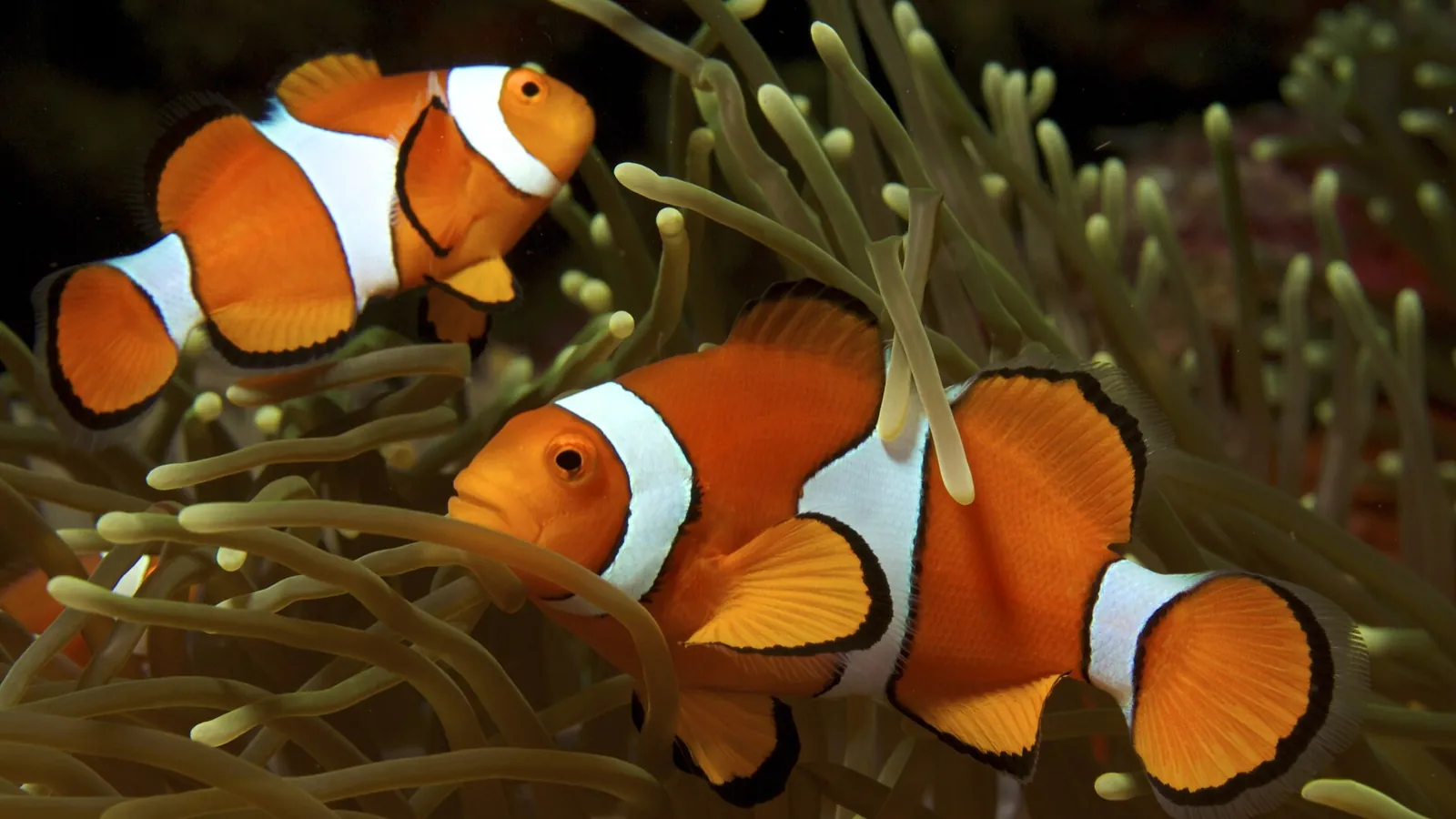
The ocellaris, or false percula, is the classic orange clownfish with three white bands. SRAC calls it the most prominent clownfish in the marine ornamental trade. FishBase lists a maximum length of about 4.3 inches (11 cm). It lives on reefs in the eastern Indian Ocean and western Pacific, from the Andaman Sea through Indonesia and the Philippines to northwest Australia, Taiwan and the Ryukyu Islands. FishBase also records one ocellaris that lived 12 years in captivity, so plan for a long commitment.
Percula Clownfish (Amphiprion percula)
The percula, sometimes sold as the true percula or orange clownfish, is the second most common farmed species. It comes from a smaller area of the western Pacific: northern Queensland, the northern Great Barrier Reef, northern New Guinea, the Solomon Islands and Vanuatu. FishBase gives the same 4.3 inch maximum, although retailer care sheets describe aquarium fish as staying closer to 3 inches.
How to Tell Ocellaris and Percula Apart
The two species look almost identical, and young fish are often mislabeled. Check these points:
- Black outlines: the percula has thick black edges around its white bands. The ocellaris has thin black lines or almost none.
- Dorsal spines: the ocellaris usually has 11 spines in its dorsal fin. The percula has 9 or 10.
- Fin height: the ocellaris has a taller spiny dorsal fin.
Care is the same for both, so the choice is mostly about looks and price.
Maroon Clownfish (Premnas biaculeatus)
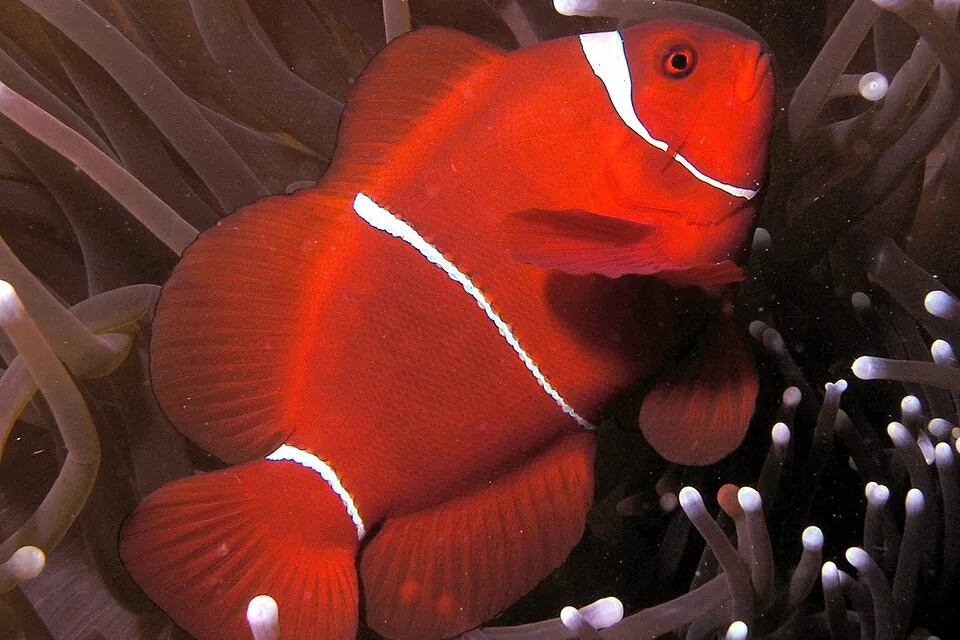
The maroon clownfish is the largest and boldest of the three. FishBase lists a maximum length of about 6.7 inches (17 cm), and its other name, spinecheek anemonefish, comes from the spines below each eye. Wild maroons live with the bubble tip anemone, Entacmaea quadricolor. LiveAquaria rates the species as semi-aggressive and says maroons do not get along with each other, so keep one fish or one mated pair per tank. Gold stripe maroons are reported to be a little calmer than white stripe fish.
| Species | Max size (in) | Min. tank (gal) | Temperament | Natural host anemones |
|---|---|---|---|---|
| Ocellaris Amphiprion ocellaris | 4.3 | 20 for a pair | Peaceful | Magnificent and giant carpet anemones |
| Percula Amphiprion percula | 4.3 (often about 3) | 20 for a pair | Mostly peaceful | Leathery, magnificent and giant carpet anemones |
| Maroon Premnas biaculeatus | 6.7 | 30 | Semi-aggressive | Bubble tip anemone |
Sizes come from FishBase. Minimum tank sizes follow LiveAquaria care sheets. All three species are listed as Least Concern by the IUCN.
Captive-Bred vs Wild-Caught Clownfish
Most saltwater aquarium fish are still caught on reefs. Clownfish are the big exception. A UF/IFAS overview of commonly cultured marine ornamental fish calls clownfish and their color morphs a staple species for marine fish farms, and notes that Florida leads US ornamental fish aquaculture.
Why Captive-Bred Is the Better Buy
- Less pressure on wild reefs. SRAC reports that the US imported more than 2 million clownfish between 2000 and 2011. Buying farm-raised fish avoids adding to that number.
- Used to aquarium life. Farmed clownfish are weaned onto prepared foods as larvae and grow up in tanks, so most eat pellets and frozen food from day one.
- Fewer stressful steps. Wild fish go through collection, holding and long shipping before they reach a store. Stress is a known trigger for disease outbreaks in marine fish.
Designer Clownfish
Breeders now sell dozens of color morphs, such as snowflake, platinum, black and white, mocha and storm clownfish. They are the same species and need the same care. The only real difference is price, which can reach several hundred dollars for rare lines.
Clownfish Tank Size and Setup
Clownfish are small, but a saltwater tank needs more equipment than a freshwater one. Plan the whole system before you buy fish.
Tank Size
A pair of ocellaris or percula clownfish needs at least 20 gallons. A maroon clownfish, or any clownfish tank with a bubble tip anemone, needs 30 gallons or more. Bigger tanks hold steadier temperature and salinity, which makes them easier for beginners. If you plan to add other fish later, our guide to how many fish fit in a 20 gallon tank explains stocking limits.
Filtration and Flow
SRAC notes that clownfish systems need both mechanical and biological filtration to keep nitrogen waste low. In a reef tank, live rock and the filter media provide the biological part. An all-in-one tank with a rear filter chamber is a simple start. Add a protein skimmer if you plan to keep an anemone, and use a small powerhead for gentle to moderate flow. Our comparison of the best fish tank filters explains how the main filter types work.
Lighting
Clownfish themselves need only a normal day and night cycle. Strong lighting matters only if you keep an anemone or corals. In that case, buy a reef-capable LED with a timer. A bubble tip anemone needs moderate to high light.
Heater, Water Source and Test Kits
- Heater: an adjustable heater with a reliable thermostat keeps the temperature steady.
- RO water: the Ornamental Aquatic Trade Association (OATA) says reverse osmosis water is generally used for marine tanks, because tap water carries chlorine or chloramine. Our guide to spring, distilled and tap water explains the differences.
- Salt and a refractometer: mix a quality marine salt and measure it with a refractometer or a good hydrometer.
- Test kits: you need tests for pH, ammonia, nitrite and nitrate at the very least.
Clownfish Water Parameters
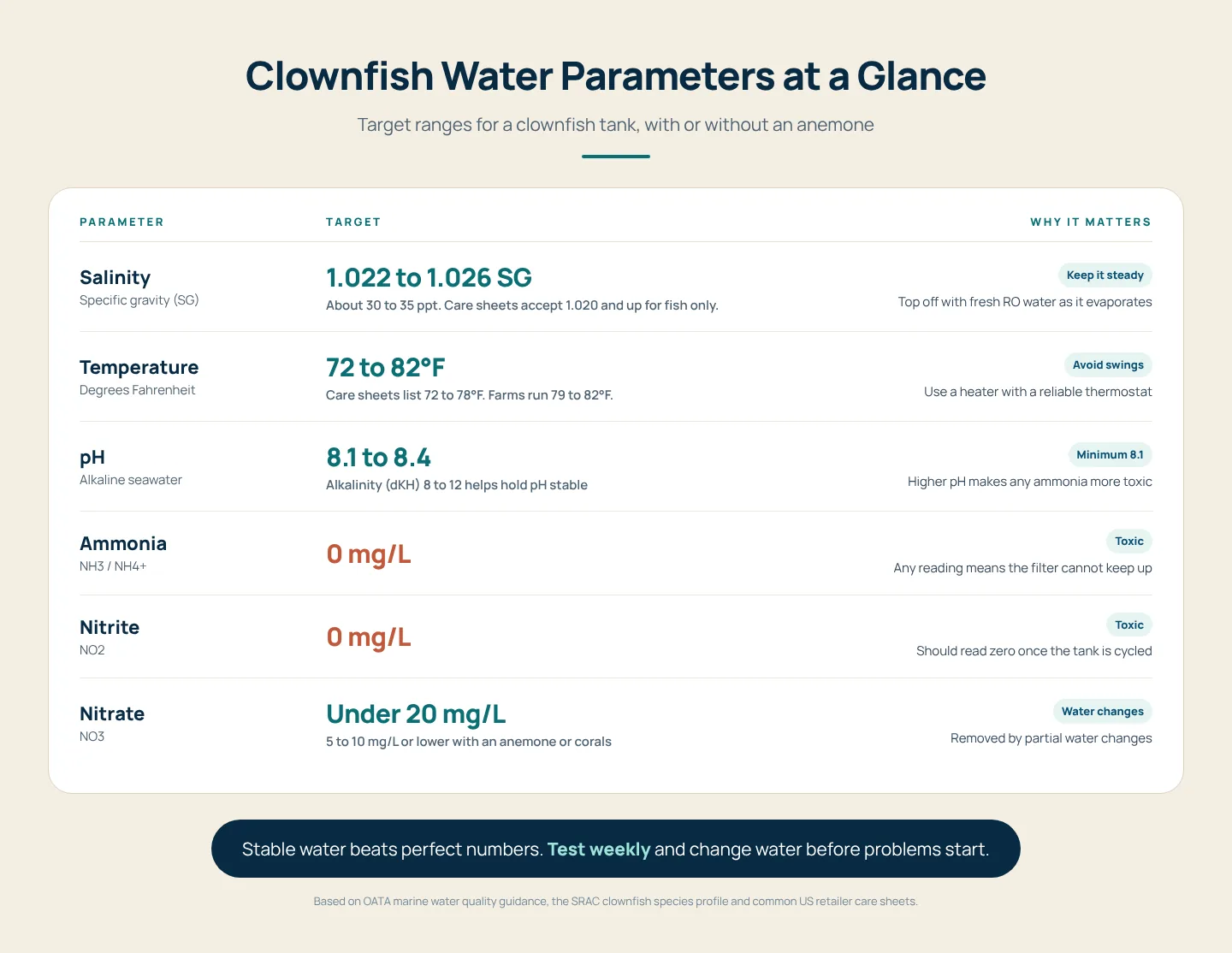
Clownfish tolerate a fairly wide range, but they do poorly with sudden changes. Aim for steady numbers inside these ranges.
Salinity and Specific Gravity
SRAC lists 30 to 35 parts per thousand (ppt) for clownfish culture. That equals roughly 1.022 to 1.026 specific gravity (SG). Retail care sheets accept 1.020 to 1.025 for fish. If you keep an anemone or corals, stay near natural seawater, which is about 35 ppt or 1.026 SG. Water evaporates but salt stays behind, so OATA advises topping off with fresh RO water, not salt water.
Temperature
US care sheets list 72 to 78°F, and the SRAC profile gives 79 to 82°F for farm systems. Any steady temperature in that window works. The goal is to avoid swings, which stress fish and can trigger disease.
pH and Alkalinity
Keep pH between 8.1 and 8.4, with carbonate hardness (dKH) of 8 to 12 to buffer it. OATA uses pH 8.1 as the minimum for tropical marine fish in the trade. It also warns that ammonia becomes more toxic as pH rises, which is one more reason to keep ammonia at zero.
Ammonia, Nitrite and Nitrate
OATA says ammonia and nitrite should always read zero. For nitrate, it suggests no more than 20 mg/L in a fish-only tank and 5 to 10 mg/L with invertebrates such as anemones. Test at least once a week, and test right away if a fish stops eating or breathes fast. If the water turns hazy, our guide to a cloudy fish tank covers the common causes.
Cycling the Tank Before Adding Clownfish
Never add clownfish to a brand new tank. Fish waste and leftover food make ammonia. Beneficial bacteria turn that ammonia into nitrite and then into nitrate. A new tank does not have enough of those bacteria yet, so ammonia and nitrite build up. Building that colony is called cycling.
How to Cycle a Saltwater Tank
- Fill the tank with RO water mixed to the right salinity, and run the heater, filter and flow.
- Add rock and sand, then an ammonia source, such as a small pinch of fish food or bottled ammonia.
- Dose a bottled nitrifying bacteria product if you want to speed things up.
- Test every few days. Ammonia rises first, then nitrite, and both fall as nitrate appears.
- The tank is cycled when ammonia and nitrite both read zero and nitrate shows up on the test.
How Long It Takes
Cycling usually takes several weeks. Bottled bacteria and mature rock can shorten it, but test results, not the calendar, should decide when fish go in. Add the clownfish pair first, then other fish slowly.
Clownfish and Anemones
The bond between clownfish and anemones is the reason many people want these fish. A UF/IFAS review describes it simply: the fish shelter in the stinging tentacles, which do not harm them, and the fish bring food to the anemone.

Natural Host Anemones
In the wild, FishBase lists the magnificent anemone (Heteractis magnifica), giant carpet anemone (Stichodactyla gigantea) and Mertens’ carpet anemone (S. mertensii) as ocellaris hosts. Percula use the leathery anemone (H. crispa), magnificent anemone and giant carpet anemone. These large anemones are hard to keep alive in home tanks, so most keepers choose a different host.
The Bubble Tip Anemone
The bubble tip anemone, Entacmaea quadricolor, is the usual choice. It is the natural host of the maroon clownfish, and captive ocellaris and percula often accept it too. LiveAquaria rates it as moderate in care, with a 30 gallon minimum. It can reach 12 inches across, though it usually stays smaller under bright light. It may move around until it finds a spot it likes, and it can sting nearby corals.
Light, Flow and Feeding Needs
- Light: moderate to high. Under weak light the anemone stretches out and loses its bulb-shaped tips.
- Flow: medium, from a powerhead or wavemaker.
- Rockwork: deep crevices in live rock over sand, where the foot can attach.
- Safety: cover pump intakes with a guard or sponge, since a wandering anemone can be pulled in and torn.
When to Add an Anemone
Do not put an anemone in a newly cycled tank. LiveAquaria recommends an established system with high water quality, strong filtration and an efficient protein skimmer. In practice, that means waiting until the tank has run for several months with stable salinity, pH, alkalinity and nitrate. Add the anemone before you add many corals, so you can see where it settles.
Can Clownfish Live Without an Anemone?
Yes. Captive-bred clownfish live their whole lives without an anemone. Farms raise them in bare tanks, and breeding pairs lay eggs on tiles or clay pots. Some clownfish adopt a rock, a pump or a corner of the tank instead. Skipping the anemone is the easier and cheaper option for beginners.
Hosting Substitutes
Some clownfish adopt soft or large-polyp corals in place of an anemone. Frogspawn coral (Euphyllia divisa) and xenia are among the reported substitutes. Hosting is up to the fish, and some never host anything, so do not buy a coral only for this purpose.
What to Feed Clownfish
Wild clownfish are omnivores. They eat zooplankton such as copepods, plus some algae. In the aquarium, they accept almost any marine food.
Best Foods
- Staple: a quality marine pellet or flake sized for small fish.
- Frozen foods: mysis shrimp, brine shrimp and marine frozen blends.
- Plant matter: foods with spirulina, nori or other marine algae.
How Often to Feed
Retailer care sheets suggest feeding adults two or three times a day. Give only what the fish finish in about a minute or two, and remove leftovers. Young, growing clownfish benefit from frequent small meals. SRAC advises farms to feed juveniles at least three times a day. If you keep an anemone, the clownfish may carry food to it, which is normal behavior.
Clownfish Tank Mates
Ocellaris and percula clownfish are peaceful with most fish of a similar size. The main conflicts come from other clownfish.
Good Tank Mates
- Small gobies and blennies
- Cardinalfish and firefish
- Small, peaceful wrasses suited to the tank size
- Reef-safe invertebrates such as cleaner shrimp and snails
Fish to Avoid
- Large predators: lionfish, groupers and big eels can swallow a clownfish.
- Aggressive fish: large damselfish and dottybacks may bully them.
- Extra clownfish: keep one pair per tank. A third clownfish is often chased away, and maroons rarely tolerate other maroons.
Pairing and Sex Change
Clownfish are protandrous hermaphrodites. Every fish starts life as a male, and the dominant fish in a group can turn into a female. A group forms a strict size ranking: the largest fish is the female, the second largest is the breeding male, and smaller males wait below them.

How to Form a Pair
The easiest method is to buy two small juveniles of the same species and add them together. One will grow larger and become the female. SRAC also describes adding one small and one larger fish, which speeds up the process. Avoid pairing two adults of unknown sex, since two females will not pair and may fight.
What Happens When the Female Dies
SRAC explains that when the female dies, the male changes into a female over about 2 to 3 months. A younger fish then takes over the male role. In a home tank, you can add a smaller juvenile to replace the lost partner.
Breeding Clownfish: The Basics
Clownfish are one of the few marine fish that hobbyists can breed at home. Spawning is easy. Raising the babies is the hard part.
Spawning and Eggs
A settled pair cleans a flat surface near its territory, such as a rock, tile or clay pot. SRAC reports that captive pairs spawn about twice a month all year, with nests of 300 to 600 sticky eggs. The male guards the nest, fans the eggs and removes bad ones. Eggs hatch after about 7 days, usually soon after the lights go out, although warmer or cooler water shifts the timing.
Raising the Larvae
Newly hatched larvae are only about 4 mm long. In the SRAC system, they eat enriched rotifers first, then newly hatched brine shrimp from about day 5. They settle and start to look like tiny clownfish at 10 to 20 days after hatching. Farms grow them to a sellable 1.5 to 2 inches in about 3 to 4 months. A home breeder needs a separate larval tank and live food cultures before the first hatch.
Common Clownfish Diseases
Most clownfish problems come from new fish, stress or poor water. The three diseases below can kill fast, so learn the signs before you buy. Our chart of common fish diseases covers general symptoms.
Brooklynella (Clownfish Disease)
Brooklynella hostilis is a single-celled parasite that SRAC calls clownfish disease. It attacks the gills first and then the skin. Signs include rapid breathing, heavy mucus that looks like a gray or white coating, and patches of peeling skin. A veterinary review lists stress, high ammonia, high temperature and crowding as triggers. Formalin baths and freshwater dips have been used to treat it, while copper did not work. Act within hours, and ask an aquatic vet before treating.
Marine Ich (Cryptocaryon irritans)
Marine ich, or saltwater white spot, causes small white spots, flashing, cloudy eyes and fast breathing. A UF/IFAS fact sheet on Cryptocaryon lists copper, chloroquine, hyposalinity and tank transfer as treatment options. Copper is usually held at 0.15 to 0.20 mg/L of free copper for weeks. Marine ich is a different parasite from freshwater ich on fish, so freshwater treatments do not carry over.
Marine Velvet (Amyloodinium ocellatum)
Velvet gives fish a fine, dusty or powdery look. Fish breathe fast, gather near the surface and stop eating, and some die with few visible signs. An SRAC fact sheet says the life cycle can finish in as little as 3 to 6 days, so outbreaks move quickly. The same fact sheet describes copper at 0.15 to 0.2 mg/L for at least 2 to 3 weeks, or chloroquine, as effective treatments.
Quarantine Prevents Most Problems
Quarantine every new fish in a separate tank before it joins the display. UF/IFAS recommends at least 3 to 6 weeks, and its summary suggests 30 to 90 days before new fish join an established system. Treat sick fish in the quarantine or hospital tank, never in a tank with an anemone, corals or shrimp, because copper is highly toxic to invertebrates.
How Much Do Clownfish Cost?
The fish are the cheap part of a clownfish tank. The setup costs more, and it is worth budgeting for it before you buy. The tables show typical US retail prices in October 2026, taken from list prices at major online stores. Local store prices vary, and many items sell out.
Clownfish and Anemone Prices
| Item | Typical US retail price |
|---|---|
| Ocellaris clownfish, captive-bred, standard orange | About $17 to $30 each |
| Percula clownfish, captive-bred | About $22 to $37 each |
| Maroon clownfish, captive-bred gold stripe | From about $40 |
| Designer morphs (snowflake, platinum, black ice, storm) | About $50 to $200 |
| Rare designer maroons | Up to about $400 |
| Bubble tip anemone | About $48 (green) to $135 (rose) |
For comparison, SRAC reports wholesale prices of $2.00 to $3.50 for a standard ocellaris at the farm, which shows how much of the retail price covers shipping, holding and store costs.
Setup Costs
| Equipment | Typical US retail price |
|---|---|
| 20 gallon all-in-one tank with return pumps (no lights) | About $136 to $170 |
| Complete 20 gallon starter kit (tank, LED lights, heater, rock, sand, salt, refractometer, powerhead) | About $570 |
| Refractometer | About $35 |
| Saltwater test kit (pH, ammonia, nitrite, nitrate) | About $36 to $38 |
| Marine salt mix, 50 gallon bag | About $22 to $24 |
| 4-stage RO/DI water unit | About $180 to $243 |
A Sample Starter Budget
A pair of standard captive-bred ocellaris in a complete 20 gallon starter kit, plus a test kit and a spare bag of salt, comes to about $660 to $690. Adding a home RO/DI unit raises that to roughly $840 to $930. Buying RO water from a store keeps the upfront cost lower. Ongoing costs include salt, test refills, food and electricity.
Clownfish Care FAQs
Are clownfish good for beginners?
Yes. Captive-bred ocellaris and percula clownfish are among the hardiest saltwater fish. They stay small, eat prepared foods and adapt well to aquarium life. The challenge is the saltwater tank itself, so learn to cycle the tank, test the water weekly and keep salinity steady before you buy your first pair.
What size tank does a clownfish need?
A pair of ocellaris or percula clownfish needs at least 20 gallons. A maroon clownfish needs 30 gallons or more because it grows larger and is more aggressive. If you want a bubble tip anemone, plan for at least 30 gallons, strong lighting and an established tank with good filtration.
Do clownfish need an anemone?
No. Captive-bred clownfish live healthy lives without an anemone. Farms raise them in bare tanks, and pairs breed on tiles or rocks. An anemone adds natural behavior but also cost, strong lighting and extra care. Many keepers skip it, and the fish often adopt a coral, rock or corner instead.
How long do clownfish live?
With good care, clownfish can live for many years in an aquarium. FishBase records one ocellaris clownfish that lived 12 years in captivity. Stable water, a varied diet, careful quarantine and a peaceful tank all help a pair reach an old age, so treat them as a long-term commitment.
Can you keep two clownfish together?
Yes, and a pair is the best way to keep them. Buy two small juveniles of the same species and add them at the same time. The larger fish becomes the female. Adding a third clownfish usually leads to chasing, and two adult females will fight, so stick to one pair per tank.
How much does a clownfish cost?
In October 2026, a standard captive-bred ocellaris typically costs about $17 to $30 at major US online stores, and a captive-bred percula about $22 to $37. Designer morphs such as snowflake or platinum often cost $50 to $200. The tank and equipment cost far more, with complete 20 gallon kits around $570.
What is the white coating on my clownfish?
A gray or white slimy coating with fast breathing and peeling skin may point to Brooklynella, also called clownfish disease. Small, distinct white spots suggest marine ich. A fine dusty sheen suggests velvet. All three can kill quickly, so move the fish to a hospital tank and contact an aquatic vet the same day.


