Knowing how often to feed betta fish is simple: give an adult betta one or two small meals a day, only what it can eat in about two minutes. For most bettas that means 2 to 4 small pellets per meal, plus one fasting day each week. Young bettas need more frequent meals, and overfeeding causes most bloating and swim bladder trouble.
That simple routine prevents the most common betta health problems, which come from too much food rather than too little. Bloating, constipation and swim bladder trouble almost always start with a generous owner and a hungry-looking fish.
This guide covers how often to feed a betta at every age, exact portion sizes by food type, a sample weekly schedule, fasting, vacations and what to do when your betta stops eating.
How Often Should You Feed a Betta Fish?
Healthy adult bettas do best on one or two small meals a day, spaced 8 to 12 hours apart. Two half portions are easier on digestion than one large meal, so morning and evening feeding works well.

Keep the total daily amount the same whichever pattern you choose. Two meals should never mean double the food. Split one day’s portion in half instead.
Young bettas grow fast and need more frequent meals, while older, slower fish need a little less. The table below shows how feeding frequency changes as your betta ages.
| Age | Meals per day | Portion per meal | Fasting |
|---|---|---|---|
| Fry (0 to 8 weeks) | 3 to 5 | Tiny live foods such as infusoria, microworms or baby brine shrimp | No |
| Juvenile (2 to 6 months) | 2 to 3 | 1 to 2 small pellets or a pinch of frozen food | No |
| Adult (6 months to 2 years) | 1 to 2 | 2 to 4 pellets in total per meal | 1 day a week |
| Senior (over 2 years) | 1 | 2 to 3 pellets or soft frozen food | 1 day a week |

How Much Should You Feed a Betta? The Eyeball Rule
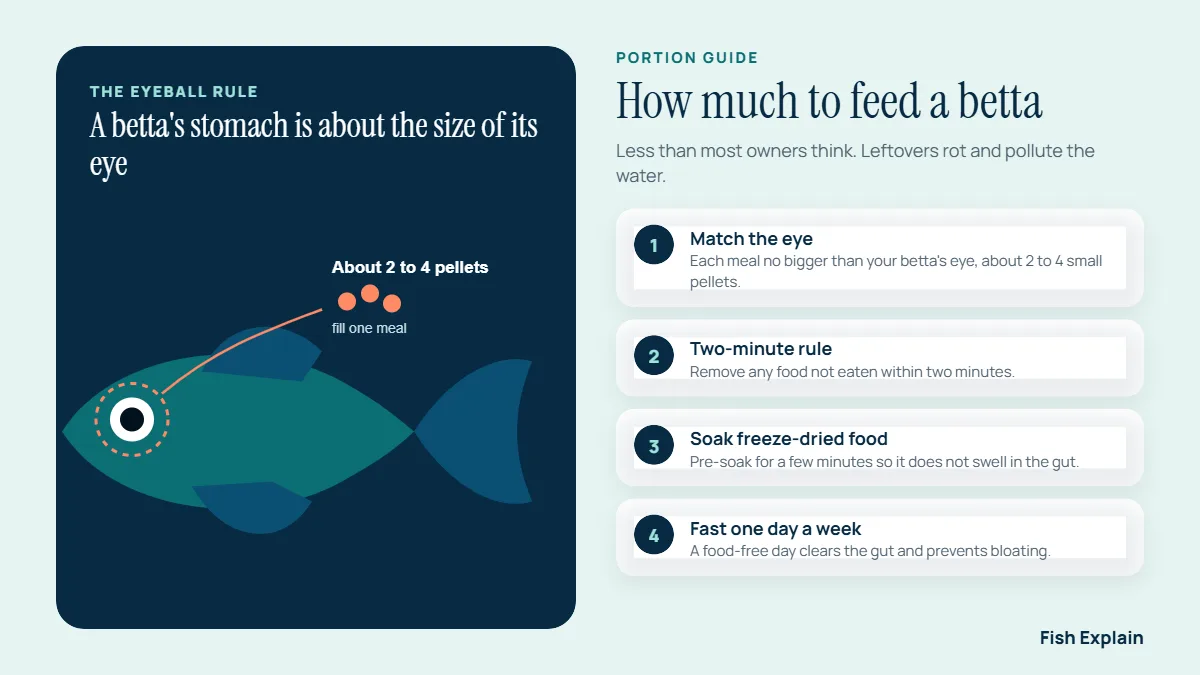
A betta’s stomach is roughly the size of its eye. Each meal should be no bigger than one of your betta’s eyes, which is far less food than most new owners expect.

A second check is the two-minute rule. Drop food in, watch, and remove anything left after two minutes with a net or turkey baster, because leftovers rot and pollute the water.
Pellet sizes vary between brands, so count by volume rather than number. Soak freeze-dried foods for a few minutes first, because they swell in the stomach and can cause bloating.
| Food type | Amount per meal | How often |
|---|---|---|
| Betta pellets (small) | 2 to 4 pellets | Daily staple |
| Betta flakes | A pinch the size of the eye | Occasional backup only |
| Frozen bloodworms | 2 to 3 worms | 2 to 3 times a week |
| Frozen or live brine shrimp | 3 to 5 shrimp | 2 to 3 times a week |
| Daphnia | A small pinch | Once a week, helps digestion |
| Freeze-dried foods (soaked) | 2 to 3 pieces | Treat, once a week at most |
Why Bettas Need So Little Food
Wild bettas live in shallow rice paddies and slow streams in Southeast Asia. They snap up insects and larvae that fall onto the water, as the Animal Diversity Web at the University of Michigan describes.

Those meals arrive in small, irregular amounts. A betta’s gut is built for little and often, not full bowls, so it cannot process large meals quickly or completely.
Bettas also beg. They swim to the front glass and flare whenever you walk past, which looks like hunger but is simply learned behavior. Feeding every time your betta begs is how overfeeding starts.
Should You Fast Your Betta One Day a Week?
Yes. A weekly fasting day gives the digestive tract time to empty and clear any backlog. Most aquarium keepers and fish vets agree that a healthy adult betta benefits from one food-free day a week.
Fasting lowers the risk of constipation and bloating, two problems that can press on the swim bladder and cause floating or sinking. It also gives the filter a lighter waste load for a day.
Do not fast fry or juveniles, as they need steady food to grow. If your betta is already bloated, a short fast of two to three days often helps before you try a daphnia meal.
A Sample Weekly Feeding Schedule for Adult Bettas
Routine matters as much as portion size. Feeding at the same times each day helps you notice changes in appetite early, which is often the first sign that something is wrong.

| Day | Morning | Evening |
|---|---|---|
| Monday | 2 pellets | 2 pellets |
| Tuesday | 2 pellets | 2 to 3 frozen bloodworms |
| Wednesday | 2 pellets | 2 pellets |
| Thursday | 2 pellets | 3 to 5 brine shrimp |
| Friday | 2 pellets | 2 pellets |
| Saturday | Small pinch of daphnia | 2 pellets |
| Sunday | Fasting day | Fasting day |
This plan rotates protein-rich frozen foods with a quality pellet staple. Choose pellets with whole fish, shrimp or insect meal as the first ingredient rather than wheat or soy fillers.
How Water Temperature Changes Your Betta’s Appetite
Bettas are tropical fish, and their metabolism depends on water temperature. PetMD’s betta care sheet recommends keeping the water between 76 and 81°F, with a stable heater setting.

In warm, stable water, bettas digest well and eat eagerly. Below about 76°F, digestion slows, appetite drops and uneaten food builds up, so cut portions and fix the heater before worrying about food.
Sudden temperature swings stress the fish and can stop it eating for a day or two. A reliable heater and thermometer are the simplest ways to keep appetite steady.
Signs You Are Overfeeding Your Betta
Overfeeding shows up in both the fish and the tank. A betta with a round, swollen belly after eating is carrying too much food, even if it still asks for more.
Watch for stringy or no waste, sluggish swimming, floating sideways, or trouble staying level. In the tank, look for leftover food on the gravel, cloudy water and rising ammonia readings on your test kit.
If you see these signs, fast your betta for two or three days and do a partial water change. Restart with smaller portions and count every pellet you add.
| Sign | Likely cause | What to do |
|---|---|---|
| Swollen belly after meals | Too much food in one meal | Smaller portions, add a fasting day |
| No waste for 2+ days | Constipation | Fast 2 to 3 days, then feed daphnia |
| Floating or sinking sideways | Swim bladder pressure from bloating | Fast, keep water warm and clean |
| Cloudy water, food on gravel | Leftovers rotting | Remove uneaten food after 2 minutes |
| Scales sticking out like a pinecone | Dropsy, not overfeeding | Quarantine and seek a fish vet |
What to Do If Your Betta Won’t Eat
A betta that skips one meal is usually fine. New fish often refuse food for a few days while settling in, and many bettas ignore food on the day of a water change.

Check water temperature and test for ammonia and nitrite first, because poor water is the most common cause. Then try a different food, such as frozen bloodworms, which tempt most picky bettas.
If your betta refuses food for more than 3 or 4 days, or shows clamped fins, color loss or white spots, look for signs of illness and consider contacting an aquatic vet.
Feeding Your Betta When You Go on Vacation
A healthy adult betta can safely go 2 to 4 days without food, so a long weekend needs no special plan. Feed normally the day before you leave and do a water change.
For trips of five days or more, use an automatic feeder set to one small portion a day, and test it at home first. Avoid vacation feeder blocks, which dissolve and can foul the water.
If a friend is feeding your fish, pre-portion each day’s food into a pill organizer. This stops the most common vacation mistake: a helpful sitter pouring in far too much.
Common Betta Feeding Mistakes to Avoid
Most feeding problems come from good intentions. The single biggest mistake is feeding a betta whenever it looks hungry, because bettas always look hungry.
Other common errors include feeding tropical community flakes, which are low in protein, and using the same freeze-dried food every day without soaking it first.
Also avoid human food such as bread, meat or fruit. If your betta shares a tank, make sure tank mates are not stealing its food, as our guide to what fish can live with bettas explains.
Betta Feeding FAQs
How many pellets should I feed my betta?
Most adult bettas need 2 to 4 small pellets per meal, once or twice a day. Use the eyeball rule: each meal should be no bigger than your betta’s eye.
Is it OK to feed a betta once a day?
Yes. One meal a day works well for many adult bettas. Just give the full daily amount in one small meal and keep one fasting day each week.
How long can a betta go without food?
A healthy adult betta can go 2 to 4 days without food safely, and some survive longer. Fry and juveniles should not go without food, and sick fish need extra care.
What time of day should I feed my betta?
Morning and evening feeds, about 8 to 12 hours apart, work best. Feed after the tank light is on so your betta can see and catch its food.
Can bettas eat tropical fish flakes?
They can in a pinch, but general flakes are low in protein and break apart quickly. A quality betta pellet makes a better daily staple.
Why does my betta spit out its food?
Bettas often spit out food that is too big or hard, then eat it again once softened. Constant spitting can mean the food is too large or the fish is unwell.
Pingback: Why Is My Fish Tank Cloudy? Causes and Fixes by Color
Pingback: What Do Fish Eat? Pet, Pond and Wild Fish Diets